How To Land a Job at Spectrum and How The Process Works

Have you been laid off, permanently furloughed or looking to pivot into a new career in 2020? You may want to consider a career in cable because Spectrum is always looking to building a bright future in spite of change. They build it with their products and services, however they can’t build them unless they have people like you.

Below are Q&A’s that a recruiter has answered on behalf of the job seekers.


  1. Suppose you come in as a Customer Service Representative, with minimal experience from at least 6 months to 1 year. If you are looking to go into another department, do you offer training for that?
    In fact, the customer service job posting only says you need 6 months of experience working with customers. It didn’t have to be from a call center and you don’t need to have a tech background. Once you go onboard, and generally after 6 months you go on an internal career progression.
    There will be courses that you are required to take to move up. For example, in customer service – there are 4 levels of customer service. During your tenure, you do get merit increases but your bigger jumps in pay come as you complete the industry courses that we pay for and have you assigned to, so it’s really up to you where you go.
    The key here is, once you get to Customer Service Level 4, that’s where you can start applying for let’s say a Floor Coach — which is lower than a Supervisor or you can decide whether you want to move over to the Quality Assurance Department, another department — but those are not internal progression roles. So for folks that are in the Customer Service Level 2 for two years, the company doesn’t prevent you from applying for a Supervisor — but in many cases, those who applied for the role, have already completed Customer Service Level 4, they’ve finished all their courses, and they’ve already moved over to Quality Assurance or something like that … so your internal competition tends to be as strong as you coming in externally, because you are competing with everybody who has the same and higher skills.
  2. What percentage of Spectrum jobs require a college degree?
    I will not be able to give you a specific percentage however, I’ve went through the number of departments I’ve been in — Sales, Customer Service, IT, Engineering, Field Operations, etc., but in all of those I can only recall where it’s a Manager or Director role where a degree is required.
    Most of the other departments will say that they prefer an Associate’s or Higher, except for the Entry-Level roles. In their case, they prefer a GED or higher.
    But remember, “prefer” doesn’t mean you can get the role without it because they will appear on every job you look on the website. It will either say “A degree is required” OR “With a degree OR equivalent experience”.
    By enlarge, most people aren’t bringing in a degree when it’s lower than a manager or director. They’re bringing some technical certifications with them, they’re bringing a high school diploma/some college, because we are focused to train you ourselves. We’ve got so many courses that we want you to take, that the department offers. You’ll be trained to become an industry expert sometime within the first 5 years.
  3. Does the Spectrum Careers page indicate the salary range?
    No they don’t. However, I suggest that you check O*NET OnLine because Spectrum is a federal contractor and our jobs are linked to that website. So if you see a job title, let’s say 70,000 technicians and you see that their average salary is $30,000 a year. It gives you an idea.
  4. I come from a Graphic Design background and I want to go into a career change — possibly heading towards becoming a future technician? Are there any trainings that Spectrum offers?
    Yes and no. If you’re going for a different career, there’s going to be some minimum qualifications there. You will hear that you can create a Functional Resume that focuses on your career skills as opposed as to where you work.
    Look at the job description as it’s posted and you’ll see all the skills on that job description that you know that you can do.
    Once you craft that resume, you can show those skills and how long you’ve used them. And your work history will be on the bottom.
    Once you upload that resume, the recruiter will go through that folder and the system will flag you (to have your resume looked at) because you have the skills that the job has posted. That is how you get your foot in the door, I’ll be straightforward as a recruiter; we are required to look at every single resume. We have to interview those who are the most qualified first.
    Once you have those crossover skills that you have listed on your resume, it will increase your chances of getting noticed and that phone call for the interview since you are showing them that you can bring that talent, those skills, those tools to the table.
    You will then fall into the range of 1-100 of being the most qualified because you are still competing with how many people applied to that position — how much experience and skills they have. There’s a little bit of luck in terms of changing roles as well.
  5. Are there any trading schools for skills training related to what Spectrum is looking for in Field Tech? For example, if I want to become a low voltage technician?
    Absolutely. Thankfully, there is the Workforce Investment Act that is funneled through the U.S. Department of Labor and the Workforce 1 stations where you can get training for those specific skills. You are capitalizing on what the federal government has already put in place.
    So when we post a job for a technician, I’m going to be looking for someone who has about 6 months of technical experience where we typically find folks in that minimum range who graduated from APEX Technical School. Let me be specific. So a person who has graduated with a certification in low voltage from APEX Technical which is a 900 hour course, they may come in as Tech Level 1 if they have no other technical experience. But they are still considered because they have the minimum experience. So we interview that person. Again, don’t forget — it depends how many jobs that are there and how many people that applied at the same time.
    But I am the one who usually call those candidates myself — to bring folks in from Tech Level 1 so by the time they are in Tech Level 5, we train them up from the beginning. Generally, it would be $17.50 for this role.
    However, if a person graduates with their Network+ certification, that’s going to start at $26.50 since they will come in as Tech Level 4. Now, you would have made a difference of starting at $17.50 an hour to $26.50 an hour — just by doing that on your own. We also pay for the courses. However, if you paid for them yourself you will now just start at a higher level.
  6. If I do not have any experience. Will any trade school experience be credited? Are low voltage cable installer courses helpful?
    APEX Technical, Comptia Network+, Comptia A+ Certifications, NEW (Non-Traditional Employment for Women), BICSI  – are all certificate programs / providers we like to interview for the entry-level Field Tech.   They will come in with only their Technical training cert between $17-$26.50 (depending on several variables).
    Workforce Investment Act will pay for many of the training programs on your behalf through a Workforce 1 Center and their “training voucher” program. Stop by your WF1 office for details.
  7. How much of a hindrance would something like a very long period of unemployment be in getting hired? No one would hire me because I have been unemployed for a while and my unemployment just keeps getting longer and longer because of this. It’s a vicious cycle.
    It is, and I understand that 100 percent. Good thing I will tell here is, that answer will vary depending on what company you go to – but as of 2013, you might see on our website – that we do not discriminate against anyone based on their employment history.
    Now, it’s not uncommon for people to be a Director and they’re applying for an entry-level role. Many employers will say they would be overqualified. However, Spectrum doesn’t do that.
    Some of them who are out of the workforce for 4 or 5 years, many employers would say they are unreliable. Spectrum doesn’t do that. We only go based on the job description and your qualifications.
    So if you apply for something within Spectrum that you’ve done or did in the past, you will get a call. You just have to be ready to perform and bring up those skills in you. You wouldn’t get declined based on your length of unemployment. You will get the offer or not, based on how you perform on the interview.
  8. I saw a Customer Service position in a Spectrum store. Are they salary based or just commission based?
    The Retail Store / Cable Store rep has both part time openings and full time openings.  There are two types of roles.
    One is a Customer Experience Rep – that will be the title when it’s posted. It’s entry level and is wage based. No sales. You might also see it posted from time to time as a “store greeter”.
    The Retail Store Rep is the other (so titled; in some areas of the country its called simply “Cable Store Rep”. NYC its called “Retail Store Rep”. This is also hourly wage. No upselling is a requirement for the role, however, should you upsell and close the sale, you would get commission on the upsell. So, in this case it’s “base + Commission” in practice, but technically, its just hourly wage.
  9. Will AI automation take over all customer service jobs? I always prefer people to people.
    Great question! And your suggest of preferring “people to people” indicates there will be in person service reps for the foreseeable future for us.  
    Remember, Spectrum needs customers to be able to connect with their services and with the company in a way that best benefits the customer experience.
    A number for customers are not tech savvy and still mail letters at the post office, and some are “customer service savvy” and would rather not wait in line for a chat or a phone call, so its easier for them to just go into the store, since they know that will be the solution to their problem anyway. And some are very Tech saavy, and would not want to speak with anyone in person, or via phone – they get their need met via chat only.
    So for now, Spectrum Stores and store associates are an important part of the Charter organization. Additionally, we have the Customer Help Desk who uses both phone and Chat to manage customer needs.
    Spectrum Store employees help the Sales & Marketing organization drive sales, retain customers and provide personal interaction and knowledge through exceptional customer service. With more than 3,500 retail employees and nearly 700 stores nationwide, Charter has more locations than many top retailers. To find a Spectrum Store near you, click here. You can also find some details on Cable Store Reps.
    That said, while Call Center, and Cable Stores and the in-person experience are an essential customer link for us right now, as noted in the presentation, the future changes due to changes in consumer tastes and interests.  For sure we will anticipate the change, and adapt to it as need dictates in order to relevant.
  10. Will they train and field technical without any background experience?
    It’s not out of the question; and it has been done frequently in the past. However, the key factor here is how many spots do we have open when you apply.
    Let’s say we have 100 Field Tech spots available. We fill 80 of them with people with some experience.  If we still have open spots and no new candidates with experience apply, then, the hiring managers start to look at “cross-over skills”… that is what OTHER skills do you bring as shown on your resume? Does your resume show a history of consistently sticking to your goals; do you stay on jobs for a long time or short; during the interview, did you come across as teachable and focused on success, or “just need a job” attitude.
    So, technically, the answer is YES, but in practice, usually we don’t post so many Techs spots that we run out of candidates with “some” experience.
  11. What if someone has over 20 years experience in customer service not call center experience?
    That’s a win-win for us – depends how it works for you.
    The customer Service – Video Repair rep is hourly pay; no commission or sales.  It currently pays $20/hr.
    If you have 20+ years in customer service, customer account management, resolving customer concerns.  You’ll do well on the interview.
    But, there is a computerized assessment you would have to first pass to get the interview.  The test is designed to answer the question, “Has this applicant the aptitude and / or experience to work in a call center?”
    If you’ve worked in a call center (like 311, Geico, Telemarketing, Survey Center), for certain you’ll pass the assessment based on your experience alone – but if you’ve never worked in a call center but have the aptitude for it, you’ll still pass the assessment. But, if that really just isn’t your thing, for sure you wouldn’t pass the assessment – then, the system will notify you your application will not be moved forward.
    If all of those factors work for you, then, you should give it a try and apply.
  12. Is Spectrum currently hiring for interns in marketing/communications? If so, how much training is provided to assist new hires?
    Yes and no.
    We have an annual internship program across the country.  The internships post the first week of February, and interns are selected for the summer internship by May.  They start their paid internships in June and continue until the middle of august.  This year’s internship ended on Friday, August 14th, 2020.  We did have Marketing interns this year.
    However, how the program works, is, in December, each department that WANTS to have an intern will submit the request for an intern at that time (to ensure it gets costed into the budget for the next year.)
    Then, when budget review is complete, those departments whose budget allowed for an intern will then send a request to the Talent Acquisition department to secure an intern for the program.
    So, while its very usual to have Marketing interns each year, it’s not ALWAYS the case, and we don’t actually know yet what departments will request interns. So, best bet is to wait till February, then visit the website and search for the word INTERN. All internship roles will be posted. Apply to the one you meet the job requirement.  (Generally, there is a lot of competition because very little experience is required – instead they are looking at educational goals, volunteer experiences, what you major currently is in school… that sort of thing. Obviously having some prior experience related to the Major will be a plus).
    The only other option is Spectrum Networks usually has a 1 year internship. But, its not paid. You work in the Broadcast media division for 1 year as an apprentice – kind of, I should say. Then, a job full time job is offered to you after you graduate in the department you’ve been working in. It’s a lot of work, and not everyone’s cup of tea. But, it can work for the right person. It will also post usually in February when they have it.
    In either case, though, training is part of the internship – its designed to give you real work experience in a role / department related to your degree.
  13. What the hourly rate are for Customer Service Representative? How many hours per can you work? What are times for work schedule?
    If you apply to the NYC locations for example, the CSR is $18.50/hr base pay + $0.75 for Night Differential base on shift
    Current Training Schedule Six (6) weeks
    100% attendance mandatory
    TUESDAY – SATURDAY 10:00 a.m. to 7:00 p.m.
    After Training Work Shift: 1:00 pm – 10:00 pm (anticipate having this shift for at least 6 months or more before having a chance to change shifts.) | (Two consecutive weekdays off, will be required to work Saturday & Sunday as part of the work schedule and most holidays)
    Normally a 40 hr work week; but overtime is available at times. Generally, floor leadership will seek volunteers for overtime and Exceptional Employees sign themselves up for it.
  14. How should I apply & what are recruiters exactly looking for on resume or cover letter?
    Apply here: General job applications are found at the website : jobs.spectrum.com.   Once they apply, they can let you and I know, and I’ll take a look and offer advice or make connections deemed appropriate.
    In general, a good resume must have : 1) Contact Section 2) Chronological Experience Section (covering at least the last 7 years), and 3) Education / Additional Skills, Certifications section

a.       I advise to read the job description first. Each job will have a section that shows “required qualifications/skills” and possibly a “preferred qualifications” section as well.

b.       The Resume MUST list how your job experience matched those hiring manager requested skills and experiences.  (other sections will include education and training as well.)

c.       Remember to list accomplishments as well on your resume – they should tell us

                                                               i.      What you did

                                                             ii.      How well you did it

                                                           iii.      Its impact on the business / project

So, the resume is the first chance the hiring manager gets to see if you can perform the duties of the role.  Use it as your marketing tool to highlight how you’ve done what they’re requesting.

The Hiring Process/Timeline on the NYC Real Estate Industry

Zoé Kellerhals-Madussi, the President of Sales and Marketing at LG Fairmont, was raised and educated in France, Switzerland, Italy and the United States, lending a multi-cultural and linguistic perspective to her client skills. With a degree in corporate communications and a specialization in luxury marketing, Zoé previously worked in marketing high end commercial real estate.

Leah Azizian, the Head of Business Development & Project Feasibility at the Developments Division at LG Fairmont, has recently launched a podcast called, “Real Estate Untapped” which is available on Spotify and Apple, featuring both conversations with other people both in and out of the real estate industry.

This podcast is definitely a humbling experience for those who are thinking about going into the real estate field or would want to learn more and her first quick episode speaks about why Leah joined the industry and what real estate means to her.

Below, I have interviewed
LEFT: Leah Azizian (Head of Business Development & Project Feasibility at the Developments Division at LG Fairmont)
RIGHT: Zoé Kellerhals-Madussi (President of Sales & Marketing at LG Fairmont)
to get their input regarding the hiring process/timeline


Please note that Leah is providing insight to prospective agents, or those seeking to join the industry, while Zoé is providing insight from the brokerage’s perspective.


  • For someone who is unsure about where to begin in real estate, what would your advice be for him/her? 
    • Leah — I’ve noticed over time that some people are interested in achieving a particular role (for example: becoming a developer, or real estate attorney), but still consider obtaining a real estate license first and becoming an agent in order to understand the fundamentals. While I can understand the thought process behind this, I usually advise against this. I believe that if you have a certain vision in mind, it’s best to connect with people who hold the position closest to what you are seeking. This way you’ll get the most clarity as to whether the vision you have for yourself is worth following through with.
  • For someone who is interested in becoming a real estate sales agent, how do they begin this process?
    • Leah — Once you have obtained your license, it’s time to choose a brokerage to associate yourself with. I generally advise to begin speaking with different brokers and/or brokerages before you officially obtain your license in order to get the wheel rolling. Make sure you take the time in every meeting to ask the right questions to understand the brokerage’s vision, team culture, and what’s expected of you. You can find a list of important questions here.
  • Is there room for advancement/professional growth?
    • Leah — Real estate agents by nature are independent contractors, and essentially work for themselves. So “professional growth” is defined as something else in the real estate field. It generally correlates more directly to personal career growth, than growth within the company. This can be seen with the type of clients you work with (for ex: progressing a higher end clientele), or the type of projects you choose to work on. A fair share of agents also choose to advance their career by partnering with the right agent or broker to establish a team together, and produce greater sales volume. However, depending on the brokerage you associate yourself with, there may be room for you to advance in helping the brokerage grow as a whole; this is usually most prevalent amongst younger firms that are still expanding.
  • Is training provided for an unlicensed realtor?
    • Leah — Generally, brokerages won’t associate you into their firm or provide training until you’re licensed. Once you are licensed though, it’s good to keep in mind that the level of training that each brokerage provides differs. Some will hold the hands of beginning agents more and provide extensive hours of training, while others will keep it to the basic necessities and encourage you to learn through experience. 
  • What kind of attitude would an ideal candidate possess? 
    • Zoé — At LG Fairmont, we seek a few attributes when hiring agents. Because the barrier of entry is so low in this industry, it is difficult to figure out who could be a good candidate based on their resume. Rather, character weighs in strongly. Because we are a small group, it is important that any new member is someone who we see will not only fit in but be an asset to the firm. The personality trait we seek is an entrepreneurial mindset. If you are someone who is willing to get your feet wet and do what it takes to become successful, you will fit in properly. Curiosity also goes hand in hand with that. Because real estate agents are independent contractors, they must be capable of asking questions at all times to learn the most possible. If you are not curious and you are not a go-getter, you will not be successful in this industry. 
  • What are the challenges that they will face in the industry?
    • Zoé — The biggest challenge in this industry is the lack of stability. There are constant ups and downs. Mostly, you will do this on your own. No matter what firm you join, if you don’t understand the importance of proactively seeking a circle of allies, you will be on your own. The lack of stability will make you a very strong person but it will also create moments where you need to step out and breathe. I believe one of the most important roles I provide as President of Sales and Marketing is to consistently find better ways to tackle that lack of stability. That is the biggest role of a brokerage: to tackle the instability and create a support system that will be reflected in your pipeline. The busier you are, the more stability you create.
  • What sets LG Fairmont apart?
    • Zoé — Let’s be honest: every brokerage offers similar services. Many times, clients believe that because you are an agent from a firm they recognize, the agent will be better. This is the power of marketing. It does not reflect the truth though. Agents that do not offer great services can be found anywhere. Fantastic agents can also be found across the industry. As I mentioned before, what we are constantly seeking to improve at LG Fairmont is how to help agents create stability and successful careers. This includes leads, a fair and open split system, a management team that is always there to help, marketing, and a boutique atmosphere. We also do not believe in upfront costs for agents so you do not pay a desk fee with us. 
  • Real estate agents have to put on multiple hats. How do they get all of this work done?
    • Leah — Being an independent contractor provides you with a certain liberty that other career paths don’t, but it can be easy to get caught up in the moment and work on tasks that either won’t monetize well or provide you with long term value. It’s important to train yourself to stay as organized as possible, and prioritize the tasks that align most with the goals you are aiming to achieve. I usually pause throughout the day and ask myself whether I am working on the tasks that currently matter most. 
  • How are real estate agents paid?
    • Leah — Real estate agents get paid through commission only, that is earned upon closed deals. 
  • How do you land your first client? And continue to build that network?
    • Leah — You can land your first client through anywhere and everywhere. Real estate is a people’s business, built on trust. You don’t need an extensive network to land your first client. All it takes is one person who you know and trust, to refer you to someone looking for a home. You continue to build your network by focusing on building wholesome relationships with others. If your focus is on meeting others, and building relationships, the clients will follow. 

A New Wave of Coronavirus Means A New Round of Layoffs

Image via CSISMag

The U.S. economy has lost at least 15% of jobs or more in every sector/industry. While many jobs are slowly picking back up, no industry has fully recovered yet. Most white-collar jobs (jobs that are professional, performed in an office or administrative setting) have transitioned to working from home, however blue-collar jobs (jobs that require manual labor; skilled or unskilled) have remained to be essential, so therefore they need to be on site. You can read more about the difference of white-collar jobs vs. blue-collar jobs here.

According to the Bureau of Labor Statistics, below shows the percentage of jobs in each industry that were cut and the percentage of job cuts that recovered as of November 2020.

Industry% of jobs in the industry that were cut% of job cuts that has recovered
Accommodation43.6220.46
Administrative and Waste Services17.4941.01
Air Transportation15.28-36.88
Amusement, Gambling & Recreation58.0651.05
Arts, Entertainment & Recreation53.7740.13
Clothing & Accessories Stores61.8359.24
Dentist Offices56.293.24
Department Stores24.8293.31
Film & Sound Recording Industries51.718.61
Financial Activities3.1541.94
Food & Drinking Places49.3961.85
Furniture & Home Furnishing Stores46.1273.65
Government4.262.79
Healthcare9.5657.68
Hospitals2.31-3.62
Leisure & Hospitality49.3253.84
Manufacturing10.6152.53
Museums & Historical Sites28.487.21
Professional & Technical Services5.7842.85
Retail Trade15.2179.74
Scenic & Sightseeing Transportation65.9438.02
Social Assistance16.2945.81
Source: Bureau of Labor Statistics, November 2020

With more job cuts and layoffs, there will be less job postings and this will impact the way that employers reassess and reevaluate their plans as they move forward. With the new wave of Coronavirus hitting this winter, many sectors and industries will be facing job deficits due to low demand.

The rate of the quitting is not unusually low despite the high unemployment rate and the pandemic. The impact of this downturn is inconsistent because some folks have no job prospects, while other folks are constantly finding opportunities. According to CSISMag, a staggering 20.7 million jobs were lost in April, marking the steepest drop in employment on record. Employers have since restored over 9 million of these jobs, but the ongoing pandemic may undercut this partial rebound.

There are some folks who have received one or multiple offers and voluntarily changed jobs during the lock down, while there are other folks who are very skilled and has talent, as well remaining diligent throughout their job search — can’t even get a slice of that opportunity; particularly those who are recent graduates, those with disabilities, illnesses, ageism or other personal reasons like taking care of children or a family member. It has become extremely difficult for folks who have extensive experience and are heads of households who need living wages. So, the longer that they remain unemployed, the harder they will be seen as employable, due to the harsh reality that they are letting those skills atrophy.

Because of the job deficits that these companies are facing, some promote internally or bring on a new external hire due to the fears of budgets up in the air. There are also a handful that are simply willing to hire entry-level workers at low wages to hedge their stakes against a declining economy.

Aside from employee layoffs, there are also many individuals leaving their jobs due to big cuts in their hours — affecting their pay. They want to find a job that is equal or slightly close to what they were making before the pandemic, however it is not easy. This leaves the labor market with more job seekers than job openings. In order for one to keep their unemployment insurance, they have to constantly apply to many jobs per week — which makes it very strenuous for individuals needing a job to finding one quickly or even at all.

How The COVID-19 Pandemic Will Affect Millennial and Generation Z Job Seekers And What They Should Do

Image via Dribbble

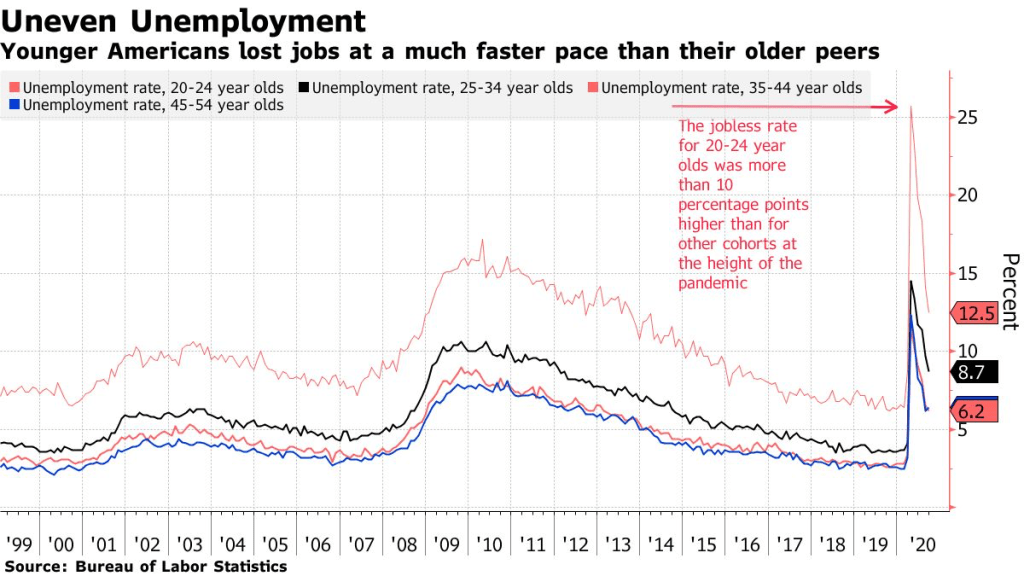
Research has shown that the Millennial and Generation Z’s who have just graduated at the end of 2019, during 2020, or in the next coming years, will be facing high unemployment rates which can affect the U.S. economy in the long-run.

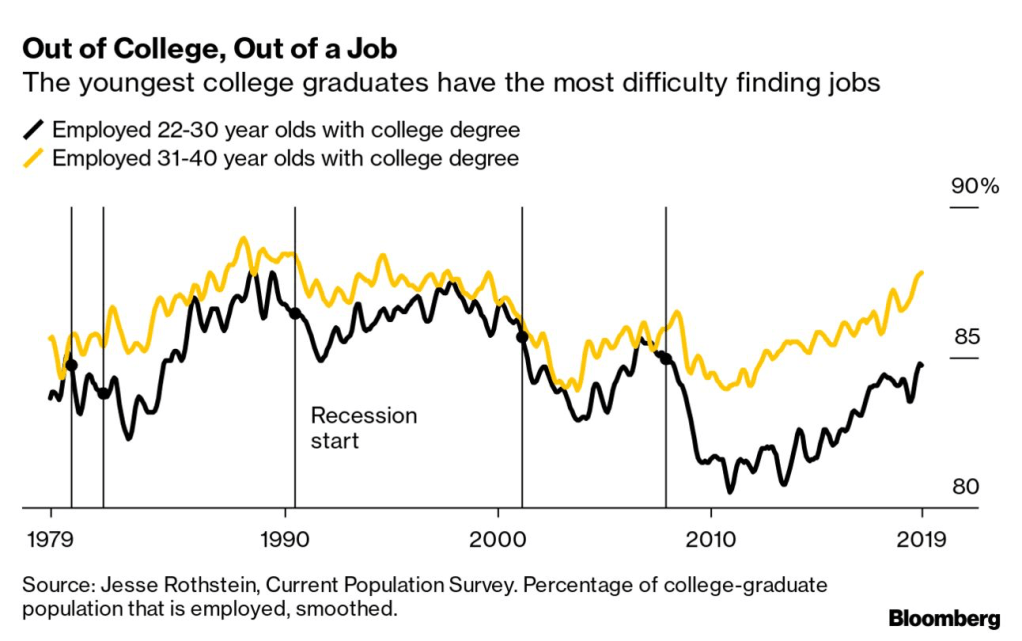
Image via Bloomberg

According to Bloomberg, economists say the longer that young people are forced to delay their careers, the worse their prospects will be in the future to hold a job, accumulate wealth, or even get married or start a family.

Long periods of unemployment, or working part-time gigs or temporarily in jobs outside their desired fields, can jeopardize young professionals’ future salary increases and opportunities for them to build key relationships.

For college students and recent graduates, choosing a major based on availability of jobs is a recipe for an unsatisfying life. Instead, search for something you truly enjoy, something you find exciting, and the job will come, in due time.

Image via Shutterstock

Some of you are thinking that graduating in this global health and economic crisis may have delayed your career growth, however it is definitely not a career death sentence. Take as much time as you need to chase your dreams! Everyone you know may be interested in finance, STEM, healthcare, etc. but follow your own roadmap because these paths are certainly not for everybody. It may take you a month, 6 months or 1 year after graduation to find a job amid the pandemic. Many companies have resumed their hiring and have pivoted new ways in doing so. In addition, a lot of companies are hiring workers to work from home as well, which can be a new way of reducing unemployment.


Advice and Tips For Recent Graduates

  • You should definitely continue to explore your interests, values and motivators if you did not spend as much time in the exploration process before your graduation. Through networking and pivoting, chances are you may find roles that weren’t even on your radar and; potential opportunities — that are even better than the ones that you have initially considered.
  • You want to actively connect on LinkedIn with everyone from your college community — students, classmates, recent graduates, professors, mentors, connections from your school internships, career advisors, and career centers! The best chance of success is typically from a referral.
    • Take full advantage of your college career center. Even though you have graduated, you are still part of their alumni network!
    • Take full advantage of employment centers/workforce providers that are located in your area!
      • The services that your college career center and workforce providers (non-profit based) offer are completely FREE in terms of resume critique, mock interviews, career advisement, mentorship, networking help, job placement assistance and referrals, and many more.
  • You want to actively connect on LinkedIn with your outside connections — former colleagues, friends, family members, neighbors! Set up virtual appointments on Zoom, Cisco Webex, Google Meet, Slack, and virtual happy hour, etc. You want to inform everyone that you are currently job searching and let them know what kinds of jobs you are looking for. They may know of someone who is hiring for what you are looking for and they may end up passing along a lead.
  • Do something different and take free courses that will get you out of your comfort zone. Whatever it is that you are doing, traveling, eating, cooking, working with animals/pets, people, your true passion unfolds.
    • If you can’t discover anything you like, you should consider volunteering although nobody likes to work for zero profit. At a time like this, putting your gifts, talents and skills to help a nonprofit organization really helps many folks figure out what their purposes are.
      • This will lead folks to reflect on their passions and realizing how this experience ignites them, as this is a way of connecting them to their future career paths. Not many think of this, however volunteer experience actually offers you the opportunity to lead, grow and evolve as an individual — whether it is impacting the lives of young people, helping the less fortunate or patients/elderly, will allow you to continue to pave your way forward.
      • Also, volunteer work opens many doors for you! There are individuals that I know who have volunteered throughout their whole life, which has led them into their current leadership roles.
  • Keep in mind that there are many companies that have IT, finance, project management, HR, marketing, public relations, etc. Just because the sector/industry for that position isn’t what you are ideally looking for, this is a good time to still apply to that potential employer. The point is to not overlook them!

We all know that 2020 is undoubtedly a financial and emotional struggle for many college graduates. Many students are struggling to find employment and has also lost their jobs due to the pandemic. This has increased financial stress for students who are paying bills; financially helping their parents/family; paying for their tuition (which resulted in 68% returning to their home, 22% staying off campus, 7% staying on campus, 3% went elsewhere), etc.

According to Student Loan Hero:

However, do not be afraid to ask for help. If you feel that you are struggling with food and housing insecurity, paying for online classes, paying your rent, there are many resources to help you. You may want to look into Supplemental Nutrition Assistance Program (SNAP), Unemployment Insurance and Emergency Financial Aid.


Additional Resources for NYC and U.S. Residents

  • If you live in the NYC area, there are free meals where meals can be picked up at all Meal Hubs 9:00am to 12:00pm, Monday through Friday. Meal Hubs will operate for children, families and adults.
  • If you live in the NYC area and you, or a friend or family member has a small business that has been impacted by COVID-19, they may want to seek assistance and guidance from NYC Small Business Services. You may apply for emergency loans, like the Paycheck Protection Program as well as requesting financing assistance.

How To Save Your Organization Costs When Hosting a Virtual Job Fair

Image via Bryant University

Many businesses and workforce providers have shifted their in-person programs, services and operations to being fully remote and virtual due to the COVID-19 work response. Due to the highest unemployment rate in American history, workforce providers rapidly found ways to continue preparing job seekers for the job market. That way, these individuals can get back on their feet as they are being guided through their job search, as well as assisting them by securing income relief. In the workforce development field, organizations swiftly shuffled their staff resources, pivoted their programs and discovered new ways to deliver their services. This brings us to today’s post about shifting in-person job fairs to virtual job fairs.

We’ve heard about some of the top virtual career fair platforms before such as Handshake, CareerEco, Brazen, etc. However, for many small workforce non-profit organizations, the biggest consideration would be the cost – which ultimately leads them to seek for low-cost platforms. But of course, many non-profits offer free services – so a free platform may be their top choice. However, be mindful that free platforms do not have the necessary tools that your organization may desire to run a successful virtual fair.

What is an alternative? I suggest looking into Zoom. You may be thinking, “How is that even going to work? Isn’t that platform normally used to hold meetings, social networking or virtual happy hour?” Yes, however you can make a job fair happen.

Before you begin to brainstorm with your team, be mindful that:

  • Planning and preparing a virtual job fair requires as much attention from staff as an in-person job fair does, since this involves the same amount of staff and preparation to execute the plan successfully and accordingly.
  • To plan for job fairs virtually, there needs to be a good amount of controls to prevent long winded speakers, visitors and guests from interrupting the flow of the event.
  • You need to make sure that your event organizers are prepared to handle any unexpected challenges — making sure that they are very knowledgeable of the platforms being used in order to utilize features and tools to mitigate chaos.
  • You also need to make sure that your employers are prepared beforehand — how do we make sure they know the game plan and the platform features? (e.g. Set up a dry run 30 minutes – 1 hour before the actual event)

Next, you want to ask to yourself:

  • Why should our team even do or consider hosting the remote job fair? What is the purpose of this? Will our organization benefit/get anything out of doing this?
  • How is our team going to plan our job fair? Is there a contingency plan? And after your team has it all planned out, think about “why did we arrange the job fair in the way that we did?”
    • Now you’re still thinking, “How can you do this on Zoom? There are no Zoom features that can be accommodating for virtual job fairs.”
    • Option 1 (No Cost): Group the employers per session and assign a designated time for employers (1-2 representatives) and invite interested participants to join any session that they desire to – because this will prevent lagging, crashing and in case there may be any network connection issues. You can give the first half hour of each session to employers and have them discuss about their available positions or future openings and give the last half hour to open up the floor for Q&A’s.
      • How would you group them? By sector/industry? Or diversify them? Whichever you choose, make sure that it can maximize participant attendance in each session to create an engaging discussion rather than just listening to employers speak/present the whole time.
    • Option 2 (Low Cost to High Cost): Create breakout rooms to have job seekers interact with employers. However, please note that depending on the size of your audience, Zoom Rooms cost $49 per room per month. For annual subscribers, it costs $499 per year or $41.58 per (break out) room per month. Additional add-ons include cloud recording (starts at $40/month).
  • How are we going to collect resumes? What platform/tool?
    • Dropbox may be a good alternative if you want to follow up with employers individually after you have your job seekers upload their resumes for the positions that they are applying for. It is a helpful tool to consider when creating shareable folders for the employers so they are receiving resumes directly from those who are applying for them, rather than just receiving a bulk of random resumes. It can also help your team keep track of the resumes that you can follow up and reach out to for future job opportunities that you may find suitable for them, if they do not get a job through your job fair.
    • If you go with the option of Dropbox, to keep it organized, you may want to request the submissions of resumes to being renamed/formatted uniformly so that it makes it easier for the employer to access them.
      • However, it may be a challenge if one of the employers are unable to access Dropbox due to their firewalls that blocks the application.
      • A solution to that if it does happen, is to send candidate names who have applied to that employer so the recruiter can locate their applications.
    • Zoom gives you the option to upload attachments in the chat box as well.
  • How do we have job seekers register? (You may want to check out top recommendations for event registrations)
    • Personally, I like to use Eventbrite because it is a popular registration tool for creating events. In addition, it is convenient, easy to collect statistics and see your metrics, as well as following up with job seekers after the event).
  • How is my team going to execute the plan?
    • Who is the audience? In this case, it would be job seekers. But what are the demographics/population that you are looking to serve?
    • Which employers are participating? Are the positions that they are applying for going to meet the language/educational/skills requirement of the job seekers that will be attending?
      • How would our team pitch the event to employers?
        • A tip for non-profits:
          • Employers that you have established long-term relationships with, will not decline unless they do not have a hiring need for that season.
          • You also want to maintain a close relationship with your organization’s fundraisers, gala honorees and board members since they can be a huge contribution because they are your biggest supporters.
    • Work on outreach and marketing
      • Create flyers and outreach materials to get the word out to your community.
  • Outcomes: How do we follow up after the event?
    • Feedback surveys from job seekers and employers are a helpful way to improve future virtual job fairs
    • Stay in contact with employers regarding next steps on reportable number of interviews and/or hires
    • Evaluations: Consider best practices, challenges, highlights and what your team would have done the same and/or different. Also some questions to debrief on after:
      • How many resumes were submitted? Which employers received the highest number of resumes? Which received the lowest number of resumes?
        • This kind of data will be helpful to determine which employers are the most popular to pursue further relationships/partnerships in the future because the number of placements/hires matter most vs. those with barely any improvement in the number of hires.
        • This kind of data is also helpful to figure out why job seekers were not interested or qualified in a particular employer.
      • How many participants showed up vs. those who registered?
      • What kind of technical difficulties while setting up the fair (prior and during)? What contingency plan should we consider moving forward?

Technical issues to take care of while practicing dry run on Zoom

  • Avoid disrupting call-ins
    • Registration is very important to keep unwanted guests from entering in. Therefore, it is good to enable a waiting room in your Zoom account settings if you are the host.
  • Allow call-ins to raise hands if they want to speak
  • Automatically mute participants upon entry to prevent distractions/echoes
  • Disable sound when participant joins or leaves
  • Limit spamming on chat box
  • Make sure employers come prepared and have them do a quick dry run before event actually begins!

How To Get Past The Applicant Tracking System (ATS)

Image via TalSuite

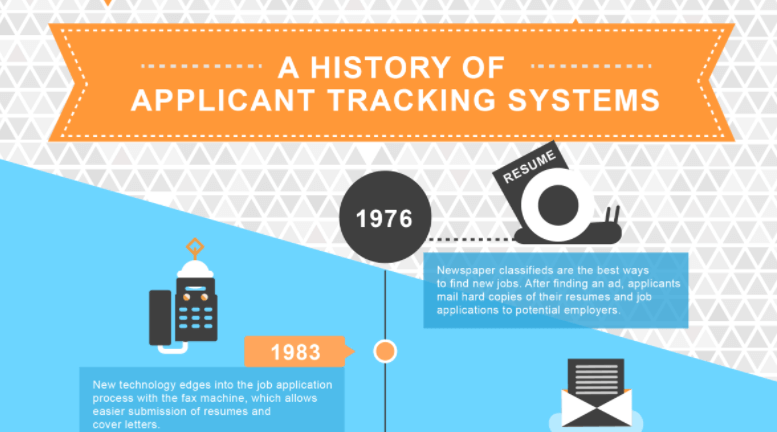
I am sure many of you are aware of what an Applicant Tracking System (ATS) is, since all job applications are required to be submitted online. Back then, job seekers had it way easier. They just had to rely on the newspaper and telephone, and they will be asked by the employer to come in for an interview. However, they have since, revolutionized the hiring process and the labor market in a blink of an eye.

Image via Jobscan
To find out more about how Applicant Tracking Systems have evolved, their article gives useful facts on their infographic.

An ATS is basically a robot that is programmed to pre-screen the applicant’s resume before the hiring team gets a chance to lay their eyes on them. Obviously, it is not as intelligent as humans are, since it is pre-programmed to do what it has to do.

The ATS is programmed to scan for specific keywords that the employer has entered into the system. Some resumes will only be selected to move on to the next step, based on the keywords that the employer has configured. Many employers use the ATS as a way to screen out candidates by asking knockout questions. This is a way to determine which candidates are able/willing or unable/unwilling to perform a job function. For instance, if an ATS is programmed to eliminate resumes that do not hold a Bachelor’s Degree, then those with an Associate’s Degree will definitely not be considered. Here are more examples of the types of knockout questions to look out for when applying on an online portal/job board.

The ATS has simplified the hiring process for employers, since 75% of recruiters and talent managers use some form of recruiting or applicant tracking software; according to Capterra.

On the other hand, causing it to be opposite for job seekers – the ATS makes their job search process more challenging and stressful as they have to pay close attention to every little detail. According to Mashable, nearly 80% described their job search as time-consuming and stressful, and many reported that they would be deterred from completing an application if they encountered tech hurdles (60%), couldn’t upload their resume (55%), couldn’t follow up on the application’s status (44%) or couldn’t complete the application on a mobile device (20%).

The nitty-gritty of getting past the ATS is to analyze and study the job description and keywords carefully as you tailor your resume to what they are looking for. Many job applicants tend to just submit their resume without tweaking their resume to the positions that they are applying for. Always make sure your resume matches the job description and that it has the exact keywords listed.

Note: The ATS is unable to distinguish the difference between the terms CPA and Certified Public Accountant, it is always more safe to list the whole word out instead of abbreviating or shortening it.

Note: Make sure your resume font and format is simple, organized and consistent. If a resume looks too fancy and abstract with colors, images, symbols and other unnecessary stuff, the ATS may count it as unqualified and will move on to the next resume. According to Forbes, studies have shown that up to 75% of qualified applicants are rejected by ATS programs because they can’t be read. You don’t want to be one of the 75%.


DO’s

  • Keep your font simple. Use Times New Roman, Calibri, Arial or any font that looks “appropriate” and “legible”. Make sure the size font is between 10-12. No bigger, no smaller.
  • Use simple bullet points like the one I am using at the moment or even a dash (-) works as well. Just make sure it isn’t a special kind of symbol because that can program the ATS to view your resume as “unqualified” and you don’t want to jeopardize a qualified resume just because of an unrecognizable symbol.
  • Consistent formatting. This is important to ensure that your resume will pass an ATS, so that it would not confuse the system.
    • Margin Size: 1 inch
    • Left Alignment is the way to go because that is the standard way of reading. Don’t center it or align it to the right. Definitely, do not include text boxes. I’ve seen some job seekers do that. This will just confuse the ATS. If we all read from left to right, that is how the ATS will be programmed to read it as well.
    • Length: Keep it minimum at 1 page and maximum at 2 pages. Remember, make sure it has the included keywords and is visually appealing to the employer! You are not writing a Curriculum Vitae. Unless you are applying for a profession that you have had years of experience in and highlighting publications that are linked to the work you do, (i.e., college professor), there is no need to go past 2 pages with irrelevant experience. Know how to distinguish the difference between a resume and a curriculum vitae.
    • Font: As mentioned in the first bullet point.
  • Your resume should aim towards the specific position. Like I have mentioned earlier, read and study the job descriptions. Always always always, keep a look out for specific keywords whether it is in the required qualifications or preferred qualifications that involves your education, competencies/skill sets, licenses, trainings and experience.
  • Do your research on the employer! Make sure you are always tweaking your resume based on their mission, goals and culture.
    • How can you be of value to them? How does your experience, education, skill sets match the employer’s needs of the role?
  • Make sure your section headers are simple: “Objective”/”Professional Summary”, “Skills”, “Certifications/Licenses”, “Work History”/”Experience”, “Education”

DON’Ts

  • Unless you are a graphic designer, avoid including images, graphics, tables/charts, special fonts or unrecognizable symbols. The ATS is programmed to read simple and straightforward things.
  • As mentioned in the DO’s section, section headers are preferred to be simple rather than overdone. An ATS will not understand “Where I Attended School”. So leave it as “Education”.
  • Do not misuse keywords. Use them where you see fit.
  • So many job seekers that I have assisted often put on the bottom of their resume, “References Available Upon Request”. This consumes space and employers obviously know that if needed, they will contact you for it.
  • Select the right file type for your resume. To play it safe, upload your resume as a .doc, .docx or .pdf file. These are the most common and preferred formats. It just looks more appealing to employers as well.
    • Please avoid using specialty formats such as .dot, .dotx, .rtf, .txt, .htm, .docm, .dotm, .xml, .mht because not only are employers unable to access the file, but many ATS can’t read them.
  • Categorize your section headers carefully.
    • If the employer is seeking specific skills (pro tip: when they list the requirements/qualifications, pay attention to those on the top as those are what they looking for in a candidate the most) and you have that, you may want to shift your skills section to the top while leaving your experience and education to the bottom.
    • If the employer is seeking 5+ years in talent management and you’ve been a talent lead or in the HR team for over a decade, you may want to put your experience first and highlight those relevant skills as you go along.
  • Never list your job duties using other terms other than action verbs!
  • When listing out your experience, make sure you do not include the word “I”. It should always be in third person as if you are the narrator of your resume.

Still need more career and resume advice on how to tackle the ATS and ensure that you land your dream job/career? Check out TopResume’s useful article and their informative infographic about ATS.