Career Tips: Negotiation, Messaging and Interview Follow-Up (John Hadley Edition)

Photo of John Hadley
John Hadley teaches job seekers internationally strategies and skills that enable them to tap into the ‘hidden’ job market and find the best jobs now. He also works with professionals struggling to become and be seen as influential leaders.

John Hadley was a Fellow of the Society of Actuaries in the financial services industry for 25 years. He began his career at Equitable Life, ultimately serving as Disability Income Product Manager. Commercial Life brought John in to build a new department, where he progressed to Chief Actuary. He then opened a successful consulting practice helping companies make their systems operate as advertised, which generated over $2.5 million in revenues.

John continues to be active in the community and the corporate sector. He has served on many community and industry initiatives, is a sought-after speaker on career and marketing issues, contributes regularly to a variety of publications as well as his own Career Tips newsletter, with over 9,500 subscribers. He conducts a wide variety of tele-classes, webcasts, and seminars. He has a BS in Mathematics from Stanford University, where he also satisfied the requirements for an Economics major.


Dear Career Tips: More Salary Negotiation
I’m in-between jobs. Recruiters are asking salary per hour. Some jobs are asking for salary range – this is OK. Some are contract. This means they pay per hour. How do you set a price per hour that would include benefits – medical, vacation, etc. – if these are not included?

Dear Negotiating:
There are so many aspects to negotiation, and they are so situation-specific, that it’s hard to give you a meaningful answer to such a general question. You might want to pick up “Never Split The Difference” by Chris Voss: it’s all about the psychology of negotiation, and filled with real-life examples of applying those techniques, including salary / job offer negotiations. And the techniques are pretty straightforward.

The general thought I was advised on and followed for determining the hourly rate I wanted was to take my desired annual salary (for a full-time job), add 25%-35% to cover benefits, and then divide by the expected days per year (times 40 hours) as if the contract was for a full year. I would subtract the vacation time I would plan on and holidays in the expected days, so as to cover that. In other words, if I expected to take 5 weeks off per year, I would consider the full year to be 47 weeks.

Then I would consider the length of the contract. If it’s a short, guaranteed contract (say, less than 6 months), then I’m going to add another 25% to account for the time I need to spend marketing to get my next assignment. If it’s longer, then I’m willing to compromise on that factor.
Dear Career Tips: Networking & Searching After a Break
I’m a Compliance professional with 5 years of experience in Banking and I quit my previous position several years ago. I moved to the US some time back and am in a job search. Here are my challenges: 
– I reach out to people on LinkedIn sending inmails or messages trying to network, but either get no response or just a standard response.
– How do I approach hiring managers about my career break, which I took for family medical reasons? 

Dear Compliant:
What message are you sending those people on LinkedIn?  

Are they ‘random’ people, or do you have some connection to them – some way in which you are ‘members of the same club’ that would warm up the request? I would look for any way you can warm it up – a connection, school, employer, job area or interest you might have in common. Make reference to that commonality in your message.  

Next think about whether your messages and profile are results-oriented. I hire because I need someone to produce certain results, NOT because they happen to have experience in an area. Having experience is a low bar, that just puts you in a very large pool of candidates who have experience.   

Right now, your resume basically speaks to experience and not results, so that makes me wonder about your communications in general. If the one you sent me is what you are sending others, it may also inadvertently suggest to them that your work on the job may be a bit sloppy: the font sizes and indentations are inconsistent among the bullets, and even the bullet symbols are not completely consistent.  

The career break may make a case for you to use a functional resume instead of a chronological format. Have you been doing anything in terms of part time work, volunteer initiatives or continuing education during that break? And you will need to be prepared to explain the prior gaps as well, since you were only at your most recent job for a relatively short time.  

Your biggest issue isn’t really with the hiring managers, as the break and prior gaps will make it very difficult for you to get through any screening process. Most will simply pass on to the next resume in the pile. That means you need to put almost all of your energy into building a powerful network that can speak on your behalf, and ultimately recommend you to a hiring manager directly.  

In networking, the break also isn’t a core issue. Yes, you need to have your HERO story that you are going to use in actual networking 1-on-1 meetings to engage people, but the break is a very small piece of that.  

You will need to be prepared to discuss the gap when you meet with a hiring manager, and the key there is to keep it simple, and then focus on the future. Here’s something I wrote about that in a prior issue of Career Tips:

Talking About Gaps 
I left a lucrative job in early 2016 mainly to pause and have more time with family. I am ready to return to the workforce and look forward to working full time again. How I can frame my response when asked to explain my work gap?

Dear Gapped:
First, read this article.

Basically, your story needs to be about the future, and what you can do for your prospective employer. Yes, you had a gap, and you had a good reason for it. End of story.

I had a good friend in a similar situation, though his pause was precipitated by a reorganization / layoff. He stayed home for the next several years to raise his 3 sons, something he had always wanted to do, letting his wife be the primary breadwinner. He did some odd jobs, such as window dresser, insurance salesman, and grocery store stock boy, that he could fit around his parental duties, but those duties were his primary concern.

When his kids were older, he called me, concerned no one would take him seriously for the manager level role he deserved.

We talked through what he had done, constructed a simple (true) story about taking advantage of this time to do something important to him and his family. We focused on how excited he was to now get back to work and what he could do for a prospective employer. Within a few months, he landed as the customer service manager for a bank.
Dear Career Tips: Interview Follow-up
I applied for a lower position than what I have had in the past. I am looking for work and level doesn’t matter to me; I’m older and really need a job. 

Towards the end of the interview I asked if there were any concerns he had about me. He replied that he knew I could do the job but was worried that I would be bored. I tried to quell his fears and stated that I enjoy this type of work and would want to do it.  I am not sure if he believed me. 

He stated that he thought he would make a decision within one month. On a side note, he did ask me if I would be also interested in a manager job. He is getting promoted to take over his boss’s position as he retires, and he has one employee also retiring.

Do you have any suggestions on what I should have said and if I should send him another email to discuss this?  I have already sent him a thank you email for the interview to let him know that I am very interested in this position.

Dear Interviewing:
It sounds like he was exploring you as a candidate for the manager job that would open up when he moves up. What did you say to that?

If it were me, I would have said something like:While I would be quite happy with the role we have been discussing, of course I would be interested in the manager role, were that to open up.”  

Now back to the issue of the ‘bored’ question. 

Telling him you enjoy this work deals with part of the issue, but there can be a lot going on in the hiring manager’s head around this, and your best bet is to try to explore that, rather than simply answer the question. 

For example, you could have said: “This is the type of work I really enjoy, and I wouldn’t see myself getting bored. Can I ask what you are worried might happen?” 
This would get the hiring manager to go deeper, perhaps revealing an underlying concern he isn’t verbalizing.

I’m not sure how trying to set up another meeting would be received at this point. And you would need to decide which role you really want, the non-manager or the manager.

If the latter, perhaps you could try something along the lines of:“I was caught off-guard at the end of the interview when you indicated there was a possibility of a manager role. If you have a few minutes, I’d love to discuss this with you further.”

If the former, then something along the lines of:“You seemed to have some concern about whether I might find the role boring. Let me assure you that this is the type of work I love to do, and would be prepared to dive into whole-heartedly. If you still have any concerns about this, I would be happy to have a further discussion with you.” 

You might also think about some past experience that shows how you dive deeply into technical work, and how you happily take on what others might consider ‘boring’ work. You could even add that example into the 2nd note above.

Q&A for John

John: “Help keep me supplied for future issues: Send me your questions about your career search, obstacles you are encountering at work, issues that get in the way of your networking efforts, etc. I’ll respond to you directly, and if there are insights of value to other readers, I’ll include them (edited to ensure your anonymity) in a Dear Career Tips column.”
Interview Preparation – Retail Industry (ZARA Edition for Entry-Level Job Seekers)

As the retail industry slowly opens back up, more and more job applications are being submitted and students are in dire need of jobs to pay off their student loans and tuition. But also, if you are highly interested in fashion — you may want to consider applying as well.

To give a general idea on how to prepare your job application and interview for the retail industry, this post will focus on one of the brands, ZARA.

Watching the video below will be helpful to those who are interested in learning more about the company before applying. (You can find the original PREZI slides HERE)


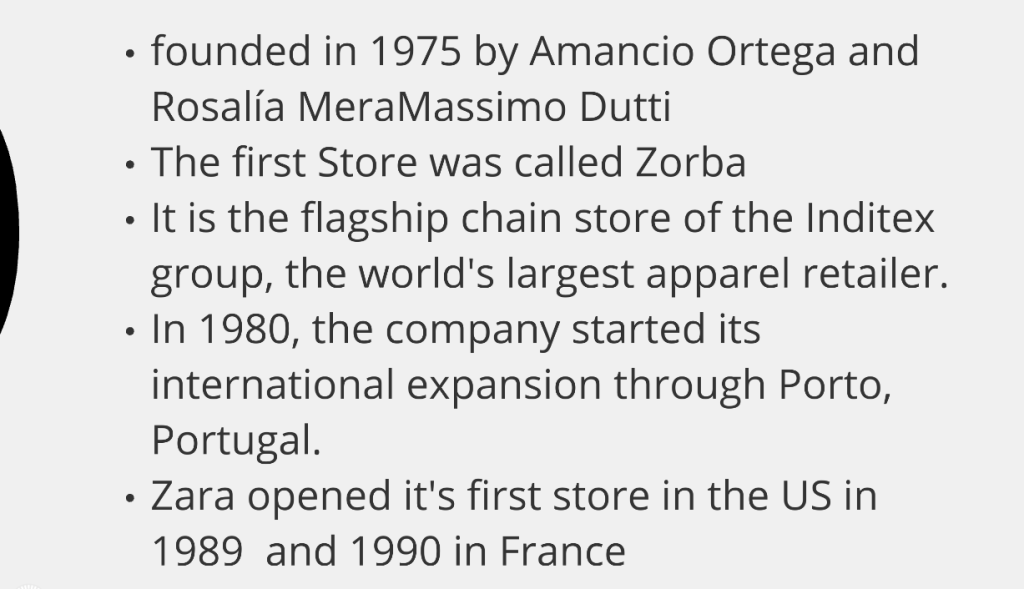
Zara’s History

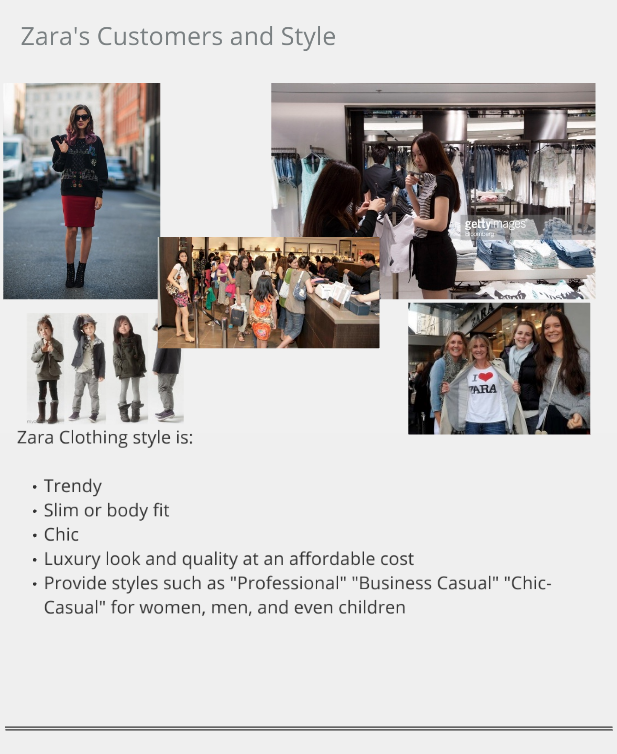
Zara is the richest valued stock in the apparel sector. They have 2,259 stores globally and 21 online stores. In 2019, the leading brand of the Inditex Group was Zara with a global net income of over 19.5 billion euros and almost 600 Zara Home stores in operation around the world.


Zara’s Customers


Understanding Expectations and Various Positions


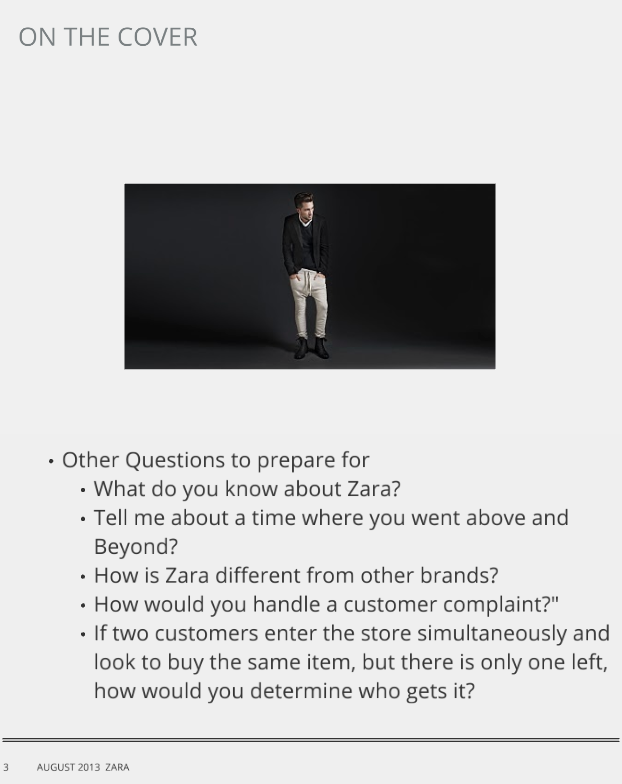
Preparing For the Interview

College Students Encounter Obstacles of Financial Insecurity

Image via The Balance

Amid the pandemic, college students are encountering food and housing insecurity — one of the main obstacles of graduating on time and succeeding as it hinders their long-term career goals/path.

This poses as a financial crisis to many college students and recent graduates. Once again, Millennials and Gen Z’s are bearing the brunt of those who came before them.

It is not hard to believe that many students have lost financial support from their parents as a result of the pandemic, and that it would lead to food scarcity for them and not being able to pay their full amount of their rent, mortgage or utility bills. They may have lost their own supplementary jobs as well due to the long hiring freeze of many companies since March 2020, although many sectors have been slowly picking back up.

The status of their financial well-being affects between 68-72% of their mental health, leading to anxiety and depression being the highest among college graduates. Entry-level hiring has been almost cut off entirely and even STEM majors are going to have an absolutely degrading experience looking for their first job right out of graduation.

For many college graduates/recent graduates, it seems that this financial crisis leads to no hope for them. And the term “financial crisis” fits this current circumstance as there is a net inflation of tuition for certain college degrees. We are about to hit the fourth wave of the virus, and while things still are not entirely back to normal, the goals that these students set have been energy draining instead of motivating them during this situation.

Graduating from the Class of 2020 is extremely hard as this was the year that led to burnout. Additionally, there were many instances where graduates have shared the same concern about closely giving up on the idea of becoming what they studied for, while endless applying for jobs in their field that led to rejection and being ghosted by the employer.

It is going to be a major crisis for the United States if we turn our backs on an entire generation when graduates are trying to enter the workforce.

So what if you are currently lost? What if the job/career that you are looking for is currently on a hiring freeze or a decline? No vacancies at the moment? You still need to make some kind of income to keep a roof over your head.

  1. You either get creative and start your own side gig/freelance project such as starting a website/blog and get paid for it. Or if you can create your own shampoo product or using your design skills to start your own clothing line online, go for it!
  2. Or you can take a step backwards, and apply for jobs to keep you busy. Even if it isn’t the job that you are looking for, it is still a good chance for you to develop new skills that you can display on your resume.

According to Dorie Clark’s article at Harvard Business Review, he mentions something similar that will probably speak out to the crowd who is going through a tough journey right now.

Dorie states, “Unfortunately, meeting those urgent needs sometimes means that longer-range goals get shunted aside. A year into the Covid-19 pandemic, many professionals have found themselves turning down coveted promotions in order to maintain flexible hours, accepting positions in fields they actually want to leave, or saying yes to jobs they’re overqualified for or unexcited about because they simply need the money.
Those decisions — while painful — may be necessary in the short term. But a temporary departure from your professional goals doesn’t mean that all is lost. It’s essential — and possible, even with a busy day job — to stay focused on your long-term career trajectory, so you can rebound quickly and get back on a path that feels right for you.”

Below, is a survey that illustrates the population that is most vulnerable to food and housing insecurity.

#RealCollege 2021: Basic Needs Insecurity During the Ongoing Pandemic

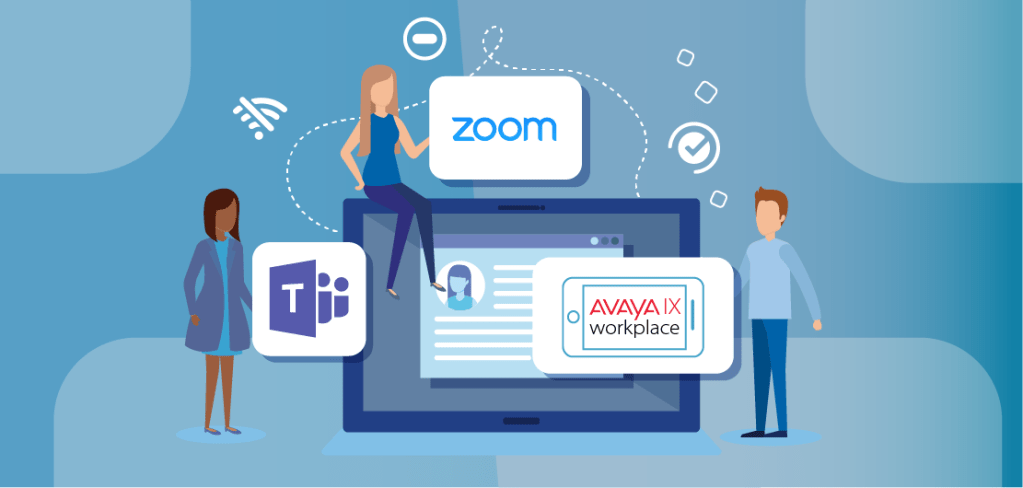
How Zoom And Other Software Tools Are On The Rise in a Post-Pandemic World

Image via NextPlane
Image via TechJockey

As the world reopens, many companies have learned that online collaboration works at a lower cost. Moving forward, tech darlings such as Zoom, Google Meet, Microsoft Teams and Cisco Webex can replace certain in-person meetings in which everyone or half the group traveled. In other words, the future will be more of like a hybrid environment. Some meetings could happen on Zoom, while others will remain better off as in-person.

Many current WFH employees have questioned if conferences will offer options of in-person or virtual. More employees will have the opportunity to attend at a lower price or even at no cost if virtual is a choice. However, many have also complained about developing Zoom fatigue due to burnout/companies overusing or improperly using the software.

Some agreed that there should be adoption and continuation of e-signature platforms in the post-pandemic world. Depending upon circumstances, suggested tech darlings will still have a role to play but at the same time, usage will drop off dramatically if folks seek ways to engage face-to-face.

Firms have also invested a lot in work-from-home infrastructure and they see that employee productivity hasn’t suffered. Moreover, company costs are plummeting as there is no longer a need for real estate. NYC is already seeing a huge decline in office space — leading to its devalue of commercial space. If working from home or remote work will continue into the future, this leads to the reason — finances.
Along the same lines, business travel won’t be coming back anytime soon to the levels that it used to be pre-pandemic — due to financial reasons as well.
A Regional Director at a software company stated that in a way, we are all victims of our own success, because if we weren’t able to conduct business using remote tools and our company’s bottom lines were hurting, we’d all be back on the airplanes tomorrow!

The pandemic has ushered in an era that was always technologically viable for the past decade, but culturally not acceptable. Yesterday’s “office” is not what tomorrow’s “office” will be. Remote work and Zoom is here to stay as we move forward.

For many employees currently working remotely, Zoom fatigue is real however they do not have to face nightmare traffic or the fear of being a few minutes late due to a train delay because of a sick passenger. The quality of life that zero-commuting hours have provided is not something that many want to give up.
Productivity has turned out to much higher for certain folks on a Zoom call when they do not have to pay attention to the portion of the meeting that doesn’t apply to them.
In addition, Zoom’s turning on/off camera feature allows folks to gain control over their participation level while yesterday’s “office” meetings did not give them that option.

Let’s put it this way — face-to-face has mostly qualitative benefits. Zoom and other tech darlings have more quantitative benefits as you can put a cost savings on how many less miles you have traveled, how much less utilities are being spent, etc. Many companies that were opposed to remote work are now implementing it as a standard form of work.
Even in the event that the current generation of business leaders usher in the return to offices and lead to a drop off of Zoom and other tech darlings, tomorrow’s business leaders (not to mention — the one’s that are more tech savvy), won’t forget that they could accomplish a lot of their work remotely.
In other words, Zoom and other tech darlings may face a slight drop off in the short-term, but their long-term future is looking bright.

All in all, companies will need to balance cost with profitability. So far, we have mentioned that there are folks with both sides of the spectrum.
There are those who feel that they need to have everybody in a room for brainstorming future projects and can’t get what they need done via Zoom meetings.
Then there are those who say in-person group meetings were a waste of time, and they can get much more done with a quick Zoom meeting where folks can say their part and tune out/leave if there are parts of the meeting that they are not accountable for.
Additionally, while some folks enjoy commuting to work, they will not want to spend wasted hours in traffic, so having a flexible and hybrid schedule kind of option would be beneficial to both parties.

This also leads to a theory that some folks have believed that while there will be some companies that will continue to allow their employees to work remotely, they are hoping that the option will become part of a company’s “benefits” package. This could be part of the new market as many job seekers are seeking remote positions.
Many businesses found Zoom to be a huge asset to them as their customer pool has expanded globally instead of locally, which helped their business grow immensely during the pandemic.
Even if some companies reduce their usage of Zoom, there are families who have adopted that software to stay in touch with loved ones at a distance.

Eventually, a return to workplaces and classrooms will decrease the need for Zoom meetings. However, the pandemic also showed so many companies how to do business with minimal travel travel and office costs — and this learning will continue to drive the market in many ways.

Word of the Day – EVOLVE

The most important thing/word I’ve learned in the workplace this week – Evolve.

Evolve immediately. You may have committed meetings/webinars/workshops to attend but if sometimes important internal meetings can occur last minute. Evolve, you get it done – then you flip back to where you need to be.

Many employees stay at a company where the company believes in their people. Employee retention matters to the company as well. Be at a company where you can grow from within and allows you to continue growing as a person. Be at a company where it feels like you found yourself in, where they can see that your values are aligned with their values/mission. Be at a company that stands for everything that you believe in as well.

For example – your favorite part of your role in the workplace could be engaging with consumers and that can help you develop to who you are today.

When you consider applying for jobs, think about “What does this employer look for in talent?” If you are looking to work directly with consumers – you may want to do more research on that specific company that you want to work for. That company may list their ideal characteristics on the description – to name a few: someone who is friendly, a team player, someone who cares about their customers by delivering the best experience, and being influential to others.

We all know that there is so much going on in the world today, let alone a pandemic that we are still going through. Ask yourself when applying to jobs or the current role you are in (whether you are entry-level, mid-level, management or executive level – “Can I be someone who can bring a positive light to someone else?” Now this question can only be answered by yourself. An employer can coach/train you on the responsibilities for the role, but something that cannot be taught is how you show up. Your punctuality/attendance is always on you. Once you get into work, there can be perks such as employee discounts – and this depends on your performance – which can be a competitive process.

If you are looking to go into leadership roles when it comes to moving up within the brand, knowing what you want – each sector/employer has so many different critical experiences that you get an opportunity and exposure to. For example, let’s say for the retail sector. You could be a sales associate but the merch team or visual team may come in and ask you some questions about, “Hey, what are consumers saying about this product? What is it that they want?”

Sometimes, you get those opportunities to have a conversation – and those are the opportunities that are the meaningful ones because once you share what you know and your insights, that team would not want you – but they NEED you.

Eighty percent of your development and your growth is on you and twenty percent is on your leader because there is a plethora of opportunities within the brand. When you share what you want to do with your manager/supervisor, you get to sit down and have that conversation with them. You need to own your career development, share with your leader what you want and what you are looking for, know where you want to go. Then based on what you want to do, your leader will try to help you get there however, the number one driver of that is going to be YOU.

Always latch onto a mentor at work – someone who is there that is doing the job that you want.

An NYC recruiter from a global retail brand that I work close with once told me, “When someone tells you that you want to be in a role, don’t see that as a threat. But see it as a great thing that someone wants to have the job that you have. As a leader, you do your job well so you can train someone else to do that job well. So when someone tells me that they want to be a recruiter, I say ‘Great, let me show you the basics – this is what we do – obviously we need to get approval from your leadership team/employer.’ We can spend some time to chat and once there is that opportunity to stretch or get that experience, I will share with them possible openings that they can apply to and if they get the job – then they can get that experience and grow from there.”

It can’t just be you knowing what you want, but your leadership team and those mentors that you surround yourself with should know as well.

Re-envisioning the Workforce Development Sector and Labor Market Updates (March 2021)

Please note this data applies to the Greater New York City Metropolitan area and the United States only.

For many workforce development agencies, there are many factors that prevent job seekers from pursuing their dream jobs/careers.

One of the top factors would be the lack of specialized training/certifications in the field that they are looking for. Workforce practitioners have also mentioned that there are young people who need to work and cannot afford the classes, the program hours are increased, they have language barriers, not work ready or do not meet specific qualifications of the training programs.
What can the workforce development agencies do to remove this barrier for job seekers? Part of it comes to strengthening partnerships with other workforce agencies and employers versus building new training programs that are relevant for job seekers. For example to be specific, organizations may want to look into building long-term and patient partnerships (ideally in retail or hospitality) if that is what their demographics are looking for.

The second top factor would be the lack of job specific work experience – and this applies to both what job seekers can offer to the employer, and what employers are looking for in the ideal candidate. Some candidates that workforce agencies work with, may have narrow goals and expectations but not having a plan B. On the other hand, employers want what they want and are not so interested/engaged in what the referral has to say about the candidate. This means the agencies need to have those conversations with the employers up front more, especially when initiating a relationship. It is not a product that workforce agencies are pushing — but more so a relationship and partnership that they want to build. Not all employers see it that way, they see it more as a product. The transactional product versus quality partnership experience problems definitely supplement and overlap.
Also, because of changes caused by this pandemic, we can see retail and hospitality declining (as data is indicated in the later part of the labor market review). For those from the world of NO, it is important to educate employers on what is reality – the unemployment rate.

The third top factor would be educational requirements. This is often the case as certain employers are looking for — let’s say someone in their Accounting department to do some bookkeeping, processing invoices, etc. If your organization offers a training/certification program that caters to job seekers that are looking to land an Accountant/Bookkeeper job right out of completion, chances are 50/50. There are employers that do not consider graduates who do not hold a degree in Accounting, so it can prevent job seekers from obtaining employment with just the certification.

The fourth top factor would be life circumstances — which all of us go through in our lifetime. We are humans. Health concerns (with COVID still around), lack of consistent support system (energy, engagement, inspiration, motivation, stability) and childcare concerns (child remote learning, and taking care of child while parent is working from home) all play a role in this factor.

What changes should be considered when re-envisioning the workforce development sector?

(Suggested from workforce development professionals)

  • More workforce agencies working collaboratively when approaching employers for sustainable business partnerships.
  • Sector-specific training and upskilling programs in deep partnership with businesses.
  • Improve funder relationships and expectations, inaccurate or unrealistic requirements and metrics based on the populations served/sectoral needs.
  • Increase the focus in career exploration with job seekers; training program development and re-programming to meet the future of workforce.
  • Deeper, structural partnerships and consistency between businesses, government, social service and educational institutions.
  • Build house account with employers on a daily basis to better track interviews/screenings while using that tool to evaluate candidates (Deliverables make it difficult to build what we really need for participants).
  • Quantifying the need for bridge programs for jobs that are in high-growth fields.
  • Improve business trust in workforce development providers’ participants.
  • Adjust business expectations for labor market.
  • Reduce organizational competition.

Labor Market Updates/Review

As of March 2021 — the overall NYC Labor Market indicates that in 2019, there were about 4.5 million jobs and by 2025, there will be an uptick to about 4.6 million jobs; which will result in about a 125,000+ gain.


NYC projected growth sectors by occupation, Standard Occupational Classification (SOC)

  • Community and Social Service Occupations
    • Overall 94,000+ jobs as of 2019 to 106,000+ jobs by 2025; resulting in 12,000+ jobs gain
    • Social and Human Service Assistants: 19,000+ jobs as of 2019 to 21,000+ jobs by 2025
    • Child, Family and School Social Workers: 15,000+ jobs as of 2019 to 13,000+ jobs by 2025; resulting in > 1,000+ jobs gain
    • Educational, Guidance and Career Counselors: 11,000+ jobs as of 2019 to 12,000+ jobs by 2025; resulting in > 1,000+ jobs gain
    • Mental Health and Substance Abuse Counselors, Community Health Workers, etc.
  • Construction (growth sector by business classification)
    • Overall: 138,000+ jobs as of 2019 to 133,000+ jobs by 2025; resulting in 5,000+ jobs decline
  • Healthcare Support
    • Overall: 446,000+ to 363,000+ jobs
    • Home Health and Personal Care: 287,000+ jobs as of 2019 to 363,000+ jobs by 2025; resulting in 124,000+ jobs gain
  • Computer and Mathematical Occupations, including technology
    • Overall: 146,000+ jobs as of 2019 to 170,000+ jobs by 2025; resulting in 24,000+ jobs gain
    • Software Developers, Analysts and Testers: About 45,000+ jobs as of 2019 to 56,000+ jobs by 2025; resulting in 11,000+ jobs gain

NYC projected loss sectors by occupation, SOC

  • Food Services
    • Overall: 243,000+ jobs as of 2019 to 300,000+ jobs by 2025; resulting in 43,000+ jobs decline
    • Fast Food and Counter Workers: 85,000+ jobs as of 2019 to 82,000+ jobs by 2025; resulting in 3,000+ jobs decline
    • Waiters: 77,000+ jobs as of 2019 to 61,000+ jobs by 2025; resulting in 16,000+ jobs decline
    • Cooks: 43,000+ jobs as of 2019 to 39,000+ jobs by 2025; resulting in 4,000+ jobs decline
    • Food Prep Workers: 28,000+ jobs as of 2019 to about 25,000+ jobs; resulting in 3,000+ jobs decline
    • Attendants and Helpers: 21,000+ jobs as of 2019 to 17,000+ jobs; resulting in 4,000+ jobs decline
    • Dishwashers: 15,000+ jobs as of 2019 to 12,000+ jobs by 2025; resulting in 3,000+ jobs decline
  • Office and Administrative Support (SOC 43)
    • Overall: 638,000+ jobs as of 2019 to 629,000+ jobs by 2025; resulting in 9,000+ jobs decline
    • Administrative Assistants and Secretaries: 134,000+ jobs as of 2019 to 125,000+ jobs by 2025; resulting in 9,000+ jobs decline
    • Others: Clerks, Human Resources Administrators, Payroll Assistants, Processors, Typists, etc.
  • Retail
    • Cashiers: 75,000+ jobs as of 2019 to 68,000+ jobs by 2025; resulting in 6,000+ jobs decline
    • Salespersons: 117,000+ jobs as of 2019 to 103,000+ jobs by 2025; resulting in 14,000+ jobs decline

3 Entry-Level Tips and a Guide to Joining the Real Estate Industry (NY Edition)

Guide to Joining the Real Estate Industry (NY Edition)

Over the past few months, there has been many questions from individuals who are thinking of joining the real estate field. The Head of Business Development at 4 Stories and a Licensed Real Estate Advisor, Leah Azizian has created a short guide and provided 3 entry-level tips for job seekers to consider below.


Leah’s 3 Entry Level Tips

  1. Consider whether you want to join the Residential field or the Commercial field.
    In a nutshell, the Residential route tends to be a lot more emotional based. There’s a lot more hand holding involved, so you’re helping people find their homes. You really need to put yourself in their shoes and understand their current living situation, and it’s a totally different ballpark.
    Commercial, on the other hand, you’re working with investors or you’re generally working with clients who are usually focused on the PRACTICALITY of a space and on the level of return that they will be achieving.
  2. Do a lot of research on the firms and brokerages that you want to join. Keep in mind that when you’re going on those interviews, you are learning from them as much as they are learning from you. So be sure to ask the right questions.
    You really want to be able to understand the level of training that they will be offering, you want to understand the culture of the company, and you want to understand what they will expect from you.
    Sometimes, they expect certain GCIs (Gross Commission Income) to be met, so keep that in mind.
  3. Whether you are a beginner agent or a seasoned agent, you might understand this. Think about whether you want to be an independent agent or if you want to join a team. There’s a lot to learn from both ends.
    Generally, when you are joining a team, you’re really shadowing experienced agents more and you’re helping them more just with the efficiency of their day, but you’re also learning a ton.
    As an independent agent, it’s a lot more hands on and initiative involved. There are a lot more mistakes you’ll likely incur, but there will be a lot more that you will be learning from.
    There are pluses to both, but if you can find a brokerage that incorporates both elements, and where you could lean towards both sides, and join a team that offers both – even better.

Leah’s Guide to Joining the Real Estate Industry (NY Edition)

1. Complete 72 Hours at a NYS Real Estate School – Do some research and look into different real estate schools nearby that you can attend. Schools usually offer in-person classes and online classes. Personally, the difference I experienced was that it was difficult to grasp the information during the online classes. The online instructors placed a lot of information on the slides and it was also not copy & paste-able, so a lot of time was spent typing notes from the slides and it wasn’t clear what was key information. But again, this was just my experience…

2. Take your School & State Exams – The rule of thumb is that the school exam will generally be more difficult than the state. The school does this in order to prep you for the state exam. In New York State, the passing measurement is 70% on the exam.

3. Associate with a Brokerage – Just as in step 1, it’s important that you do your research, interview, and speak to agents at different firms. The way I see it, there are usually two routes that an agent can take:

  • Option 1: Associate as an “Independent Agent” – which means starting off essentially on your own, building and relying on your own network, and taking on all essential tasks solo.
  • Option 2: Join a team that is already established and/or form a partnership with another agent you trust. Joining a team that is already established allows you to lean the ropes of the game and rely on a more developed network and steady cash flow. People tend to underestimate how much activity is involved with being a real estate agent. You are the CEO of your business; you are responsible for all tasks from marketing to creating your newsletter to growing your clientele to answering all emails to attending viewings, pitches, meetings etc. Having a team or forming a partnership with another agent, will allow you to juggle more and be more efficient.

Questions to keep in mind when interviewing with different brokerages, or teams:

1. What is the brokerage’s goals in the next year and 5-10 years? How is the brokerage planning to grow? This will help you get a better understanding of the company mission, and whether there is any potential opportunity for you to be directly involved in the company’s growth (this last part is for the overachievers & ambitious ones out there).

2. If interviewing a specific team, what role do they expect you take on when joining the team? What kind of schedules or systems do they have in place as a team to keep themselves organized and productive? What can you expect to learn most from joining the team?

3. As an independent agent, who will you be reporting to (who is your floor manager)? And, how often will you be touching base with them? 

4. As an independent agent, does the brokerage have any expectations from you as to what to produce in gross sales volume?

5. What resources does the brokerage or team offer to its agents; in terms of agent training, tech support, or marketing? (For new agents, understanding what type of training you can expect will be valuable when choosing a brokerage).

6. Does the brokerage or team supply client leads to its agents?

7. What is the commission split? (It’s important to understand this for leads provided by the firm v. leads closed from an agent’s network)

8. Are there any fees that you will be expected to pay (such as, desk fees, technical support, transactional fees)?


Personal Tip:

I can’t stress enough that if you’re thinking to joining the industry for a quick buck, think again. 

Being in the real estate field requires a lot of patience, hard work and hustle. Believe me when I say that clients will easily recognize if you’re in this to make your commission, or in it to genuinely help in their investment. NY has the most dense population of real estate agents, and it’s so easy to filter out which are in it for the long run and which aren’t.

I also get a lot of questions from people who aspire to be developers, investors, or “flippers”. In this case, I always suggest working for the person who holds the position you desire. If your goal is to become a developer, reach out to a development firm and see what they need help with (as an internship or volunteer work). While it isn’t a bad idea to become a salesperson and understand the buy/sell process, I believe you will learn a lot more in the field that you are specifically looking to be in. 


Hopefully, the tips that Leah has provided were helpful to readers who are considering to enter the field or are intrigued to learn more about the field. If you have any other questions or would like to speak more about what it’s like to be in the field, reach out to Leah at lazizian@lgfairmont.com or connect with Leah on LinkedIn.

3 Follow Up Email Templates to Send After Job Interviews (by Recruiter, Lee Ann Chan)

“What’s the best way to follow up with an employer after a job interview?” Recruiters like Lee Ann Chan and I personally receive this question a lot from job seekers that we coach and place, and according to Lee Ann, “most candidates don’t want to come off as desperate or annoying (their words, not mine!) but they also don’t know the best way to approach employers for their interview updates.”

Below are the recommended follow-up emails and templates from Lee Ann to use when you want to check on your status and keep establishing a professional presence.

New Year’s Resolution for Job Seekers

Image via Ashley Brooke Photography

Job searching in the middle of a pandemic has been the most challenging for job seekers. Job seekers have been blindly applying for 10 months or more and building their network. Some have been plugging away and applying to jobs since March and have had little success with interviews and no offers with no feedback. And some have been forced (by the pandemic) into starting their own businesses/side hustles to pay off student loans, rent, debt, etc.

Whatever the case may be, job searching has always been challenging. However, the best way for it to be a success is to remain positive, and to not give up. Giving up is not an option. Show employers that you are willing, wanting and able to work!

Here are some New Year’s resolutions to help jump start your motivation and pave way to a successful job search.


  1. Connections can help a great deal. Spend more time talking to people than submitting your application to posted job ads.
    • The quickest way to get back into the job market will be your network and your referrals. Who knows that a 30 minute coffee chat could turn into an opportunity of a lifetime.
    • You would be surprised that you will have connections in your circle who know about the existing job vacancies that aren’t posted on job boards. In other words, the hidden job market.
    • When reaching out to your connections, you may want to follow the email template below:
      • “Hi [Connection’s Name],

        I hope this email finds you well. How was your holiday season and New Year’s? It is shocking how 2020 flew by.

        I wanted to reach out because things have changed at [Current Company] and am specifically looking to transition to [Job Title] at [Industry/Sector/Company] where I can utilize my [Insert Relevant Skills] to be able to do [Insert Desired Activities].

        I wanted to reach out to see if you know of anyone who could connect me to such an opportunity. I understand that this is a big ask and your time is valuable. If it is too much right now, don’t feel any pressure as I totally understand.

        Either way, I hope you are staying healthy and safe. I look forward to catching up with you soon!

        Best Regards,
        [Your Name]”
  2. Update your resume.
    • Your resume should always be different and tailored based on the job description. Study the job description carefully and proofread your resume before uploading it on the job board because you want to get past the Applicant Tracking System.
      • Education: Don’t just focus on the schools and institutions that you have attended. Include organizations that you were involved with as well! If you had a GPA that is higher than a 3.0, showcase it and be proud of that achievement!
      • Work Experience: I mention this all the time but make sure your duties are not only duties, however make it into an accomplishment by incorporating quantifiable metrics using numbers and percentages. Also, tailor it towards the field that you are interested in.
      • Leadership Experience: This is important whether you are looking for a job or internship. If you were active in many organizations and clubs, list it and highlight that leadership because that is always going to be a plus.
      • Skills and Projects: Again, just like your work experience, tailor your relevant skills towards the field of interest. If you have worked on special projects that were tailored towards the specific field of interest, include that as well.
    • Have your peer, mentor, career coach or a professional critique your resume.
  3. Hone your interview skills.
    • Have a friend or family member interview you and provide feedback.
    • Participate in mock interviews. Especially during this pandemic, many virtual platforms are partnering with big companies (such as Moody’s, Google, McKinsey & Company, Credit Suisse) to connect with nonprofit organizations and social ventures to give back and provide these free services to job seekers.
  4. Sharpen your skills.
    • If there is a specific field you are looking to go into or a job that you want to apply for, study the job description closely and discover if your educations and skills are going to be a good match.
    • If you do not have the skills that the employers are looking for, you should look into taking online classes that will help you move forward in your intended field.
  5. Map out what you are looking for.
    • Don’t just randomly apply for jobs because you need a job. Seek purpose in the kind of job you want. Make sure your job search has a path. What is it that you really want in your job? Do you want to work entirely remote? Do you want to work on-site? Do you want to work flexible or set hours?
    • Follow the SMART goal outline via FlexJobs.
      • (S)pecific: What industry or sector do you want to work in? Do you want to stay local, or are you willing to move? How much do you need to earn?
      • (M)easurable: To meet your goal, how many resumes will you send out per week? How many networking events will you attend each month?
      • (A)ttainable: Do you understand the difference between your dreams and your goals? Keep in mind that some things are beyond your sphere of influence. You cannot control how many interviews or offers you get, but you can set a goal for the number of business connections you’ll make each month.
      • (R)ealistic: What can you achieve in this moment? If you have little experience, it’s unlikely you can move directly into a C-level job. Be honest with yourself about what you can achieve right now, but also plan for bigger and better goals in the future.
      • (T)imely: When is your deadline? This aspect of goal setting is often overlooked, but deadlines—even arbitrary ones—are important motivators. Since you can’t control when you’ll get hired, you may find that a resolution such as “I will find a job within the next six months” is less effective than “I will apply to at least five vacancies this week.”
  6. Target specific companies that you are interested in working for.
    • Make a list of your top target companies
    • Research, research, research them!!! Anything you can find such as articles, interviews with executives, surveys, podcasts, etc.
    • LinkedIn is a valuable platform for you to use in landing your dream job at your target company. From there, you may want to locate contacts who can refer you into your target role such as a hiring manager, team lead, recruiter or a friend who was hired there.
    • Reach out and cold email them.

4 Holiday Out-of-Office Templates By Recruiter, Lee Ann Chan

Lee Ann Chan, the Americas Campus & Diversity Recruiting Program Manager at Agilent Technologies (the Santa Clara, California office), has reminded all of us that while we are away during the holidays to spend time with our family members and loved ones, it is crucial to maintain that relationship — whether you are going to be away for a few weeks or even a month.

Lee Ann Chan is a huge people-person and spent several years in Acquisitions before being inspired by her mentor to change career paths and be a Recruiter, which she absolutely loves! She finds that it is an amazing feeling to help job seekers find opportunities for smart people to do awesome things, and she is grateful that she can be a part of it.

Lee Ann brings in her 13+ years of combined experience working with professionals in both the private and public industries and have placed over 1,200 individuals in permanent opportunities across the United States. The roles Lee Ann have recruited for include: Finance, Analytics, Accounting, Engineering, Human Resources, R&D, Data Science, Legal, Supply Chain Management, Security, Procurement, Facilities Management, Clandestine Service, Product Management, and Life Sciences.

In addition, Lee Ann provides career coaching services to those who are job searching, soul searching, leading and managing, or trying to find new ways to advance within their careers. She supports her clients by helping them revamp their resume, interview style, and job search strategies; make seamless career transitions out of specific industries or professions; develop powerful relationships with recruiters, hiring managers, bosses, and co-workers; and elevate their personal brand in the workplace and market.

Lee Ann’s specialties include the following: Talent Acquisition | Diversity & Inclusion Strategies | Campus Recruiting | Technical Recruiting | University Relations | Career Consultant | Career Coaching | Resume and Cover Letter Reviews | LinkedIn Training | Networking | Public Speaking | Professional Development | Social Media | Personal Branding | Program & Event Management | Relationship Management | Metrics & Data | Sourcing | Interviewing

If you feel that you are seeking for these kinds of services, please feel free to connect with Lee Ann on LinkedIn and shoot her an InMail and connect.

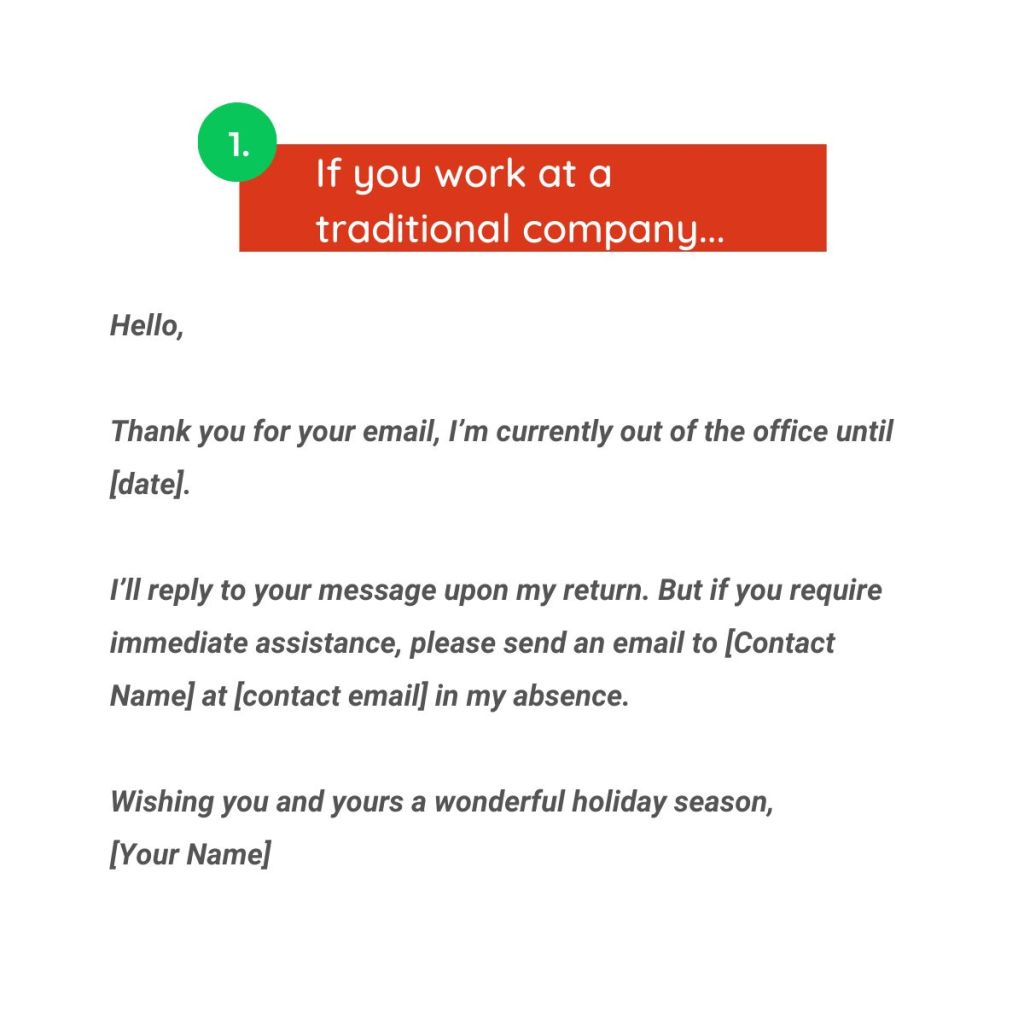
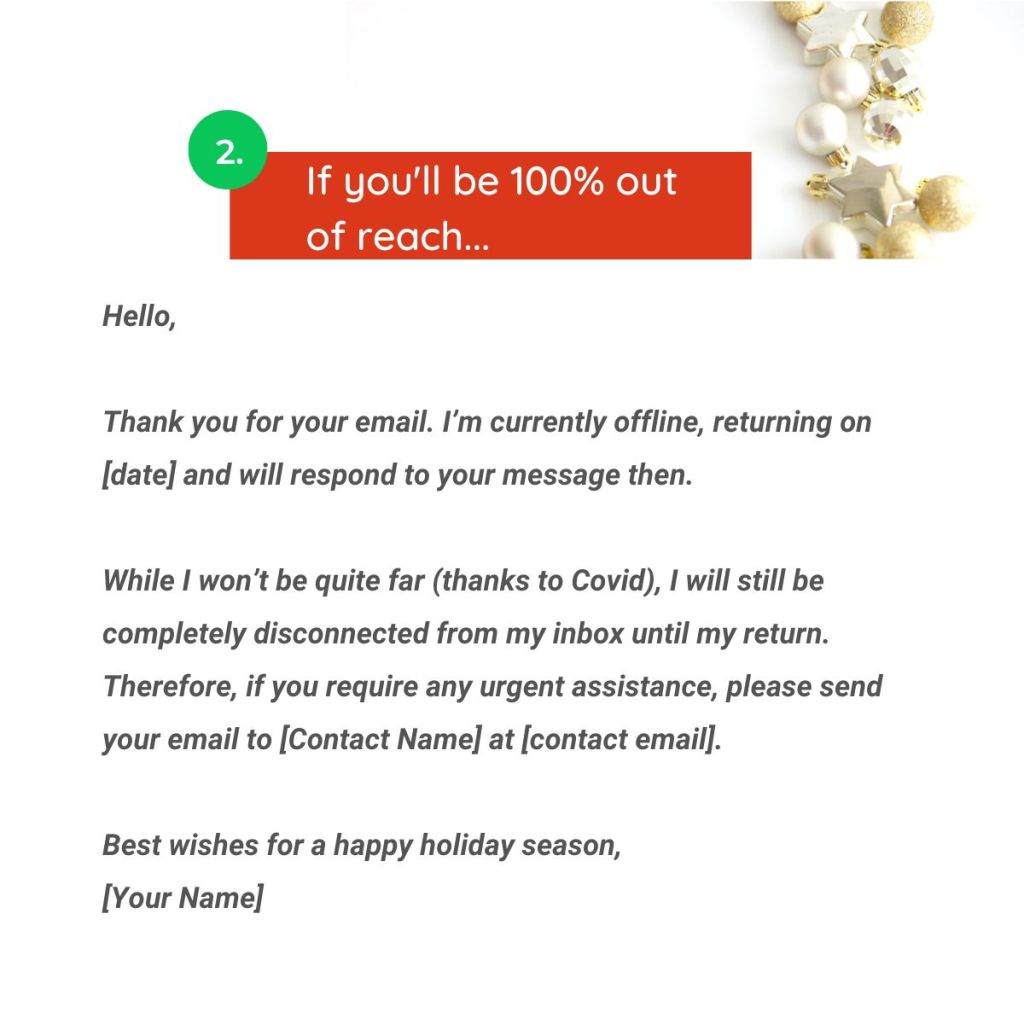
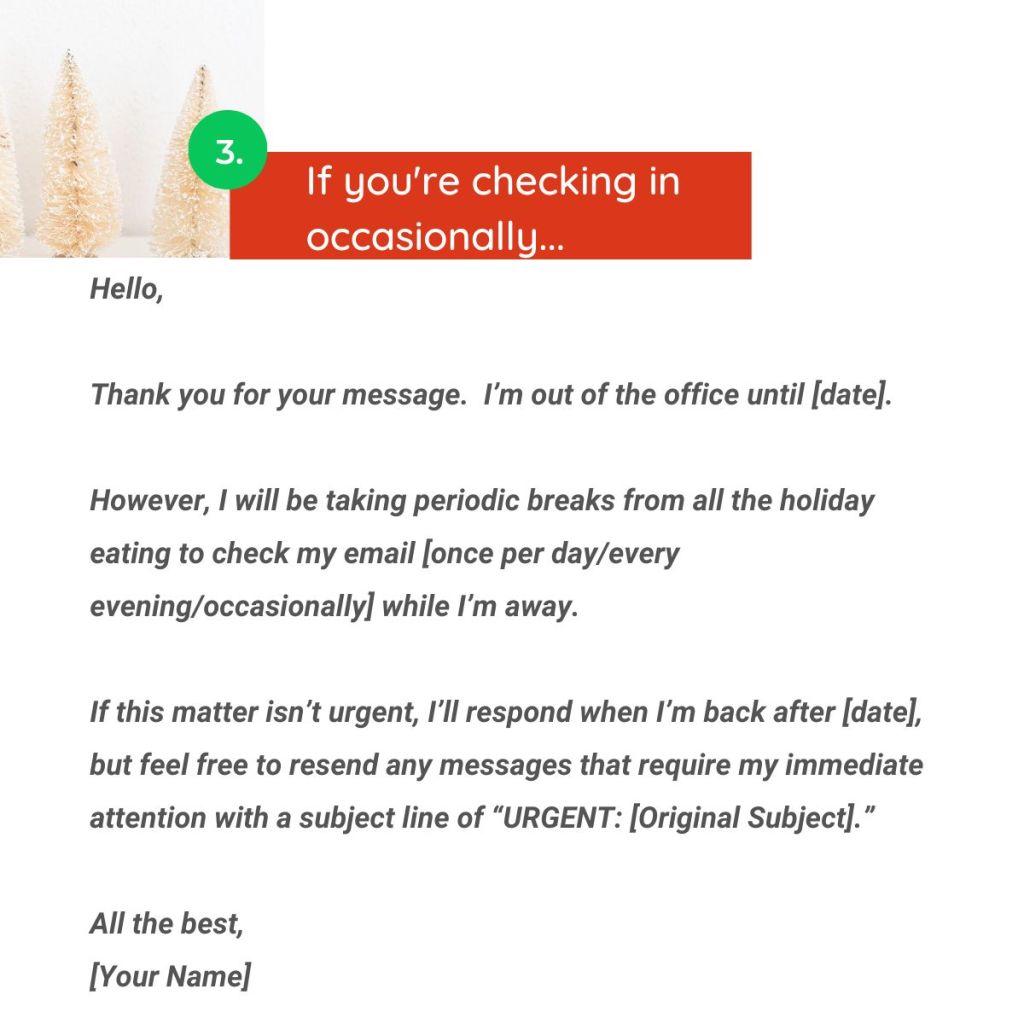
Below are some really insightful out-of-office templates that Lee Ann has created for employees that I will share below for you guys, which are free to use depending on what is best suited for you and your company — “while we are all finishing up some tasks and preparing for the holidays.”

Wishing you all a safe and wonderful holiday season and a prosperous New Year!