The Future is Hybrid

Image via The New Indian Express

Many working parents do attest that being able to work remotely or working from home was very labor-saving. They are able to dedicate time to work as well as be present for any schooling issues that their children are dealing with, on top of not having to deal with the stress of morning traffic. If they had a choice, they would prefer not to return to the office or in other words, the pre-pandemic Monday to Friday, 9-5 world.

However while there are many who praised working remotely/from home, there are many instances where employees miss/crave human interaction. There are some individuals who find that going into the office gets them out of their home. We all know that the thought of solely working from home full time would trigger mental health challenges as well.

Many employees are looking to a hybrid schedule — as it would be a nice middle ground for both companies and employees, especially where technology is available and accessible.

However, there are certain roles that make it impossible to work from home/remotely in the long term. Business domains, meeting clients, sales & marketing, human resources responsibilities, to name a few. Interaction can be hard if the client/candidate refuses to show their face on the Zoom camera, making it hard to make decisions without knowing their facial expressions.
Of course, you may be thinking it is possible through FaceTime but not everyone has an Apple device. Sales people don’t need to be in the office and HR has been working remotely for the past year.
Great, but have you ever thought about doing something and doing something well are two different things? Because it is very challenging to work with new grades in remote setup. Building trust and bonding is missing with the rest especially with new hires.

While it is completely understandable why so many folks desire to continue working remotely due to the convenience — it is functional, but far from optimal not only for the businesses but for all folks. Individuals who will continue to work remotely will find limited opportunities to grow in the firms as being out of sight, out of mind will have a new meaning. The interactions that happen on Zoom will never replace those that happen in a conference room or in the office, we all know that. There is concern for working parents where they will have a lot of time to tend to their kids and taking coffee breaks/bathroom breaks, but at difficult times like these, companies still seek ways to cut out those that they consider unproductive.

What we are seeing is a reflex reaction to the situation imposed upon us. There will always be some folks who perform better with greater flexibility, as well as those who need the structured environment. Just as those who enjoy the comfort of working in pajamas and those who feel more professional and productive in business casual. However, the reality is twofold. We have not yet seen the leveling out, which is a great argument for the hybrid environment. That being said, since adaption and adoption haven’t leveled out, there will be an ebb and flow. This may depend on developing new habits for productivity or even dependent upon what type of project/assignment is being worked on.

Employees are curious on how effective the hybrid model will be, since there will be those who get more face-to-face interactions with leadership may receive a natural competitive advantage for promotions. This raises a question — Will this create a divide? Where folks willing to go into the office, would volunteer to go in 5 days a week as a career development approach and the folks who prefers not to, will shift to companies with their entire workforce being remote?

The skills that we all have in our more traditional ways of working aren’t the same as the skills we need in a more flexible working environment. While many employers favored the positive impact location that independent work has had, they fear not being able to measure output the same (such as effective communication/engagement with internal staff).
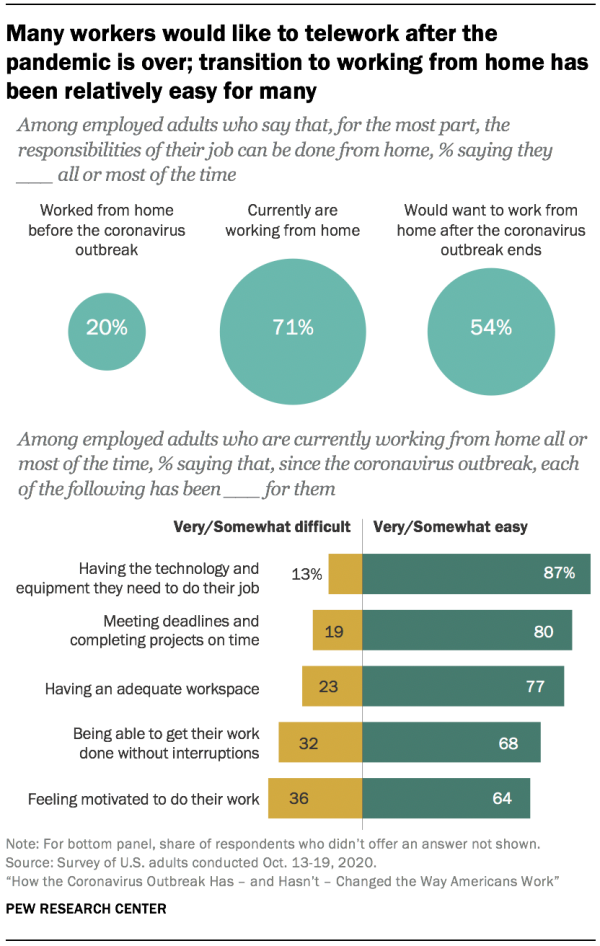
A hybrid future is most likely, why? It can provide an excellent alternative for those who need flexibility, but also enjoy coming into the office. Of course many miss the human interaction, but not many miss the 1-2 hours of traffic, budgeting for gas, car repairs, etc. The next crucial step toward building a hybrid work environment will need to be led by leadership, where they empower their workers to have full autonomy over their own schedule. This is how companies will help more workers enjoy the flexibility that they deserve while providing them the support they need to make a successful transition.

Many individuals couldn’t work their ideal roles because employers didn’t offer flexibility. Moving forward, a blended approach is a great way to show flexibility — which empowers employees as there is a shared sense of trust and responsibility when employers allow employees to find a greater balance between work and life.
As work life will change, it opens up our freedom of choice. Some days/weeks, it will be better for our mental and emotional health to either be in the office or to work remotely. This is the best option to keep everyone happy, but also be ready to pivot again if necessary.

There are also pitfalls for hybrid future, meaning there will be less office space needed. As they are consolidating and closing locations in major cities worldwide, commercial real estate investors are showing desperation in demand, bellowing and pleading that there will be a return to the old ways.

What would be interesting, is to see the effect and hopeful reduction in the burnout that could happen when saying you do not have to take a full vacation (working remotely for a few days and not burning out on your Paid Time Off). Time will definitely tell, for those hoping to see the work/life balance become healthier with such flexibility.
College Students Encounter Obstacles of Financial Insecurity

Image via The Balance

Amid the pandemic, college students are encountering food and housing insecurity — one of the main obstacles of graduating on time and succeeding as it hinders their long-term career goals/path.

This poses as a financial crisis to many college students and recent graduates. Once again, Millennials and Gen Z’s are bearing the brunt of those who came before them.

It is not hard to believe that many students have lost financial support from their parents as a result of the pandemic, and that it would lead to food scarcity for them and not being able to pay their full amount of their rent, mortgage or utility bills. They may have lost their own supplementary jobs as well due to the long hiring freeze of many companies since March 2020, although many sectors have been slowly picking back up.

The status of their financial well-being affects between 68-72% of their mental health, leading to anxiety and depression being the highest among college graduates. Entry-level hiring has been almost cut off entirely and even STEM majors are going to have an absolutely degrading experience looking for their first job right out of graduation.

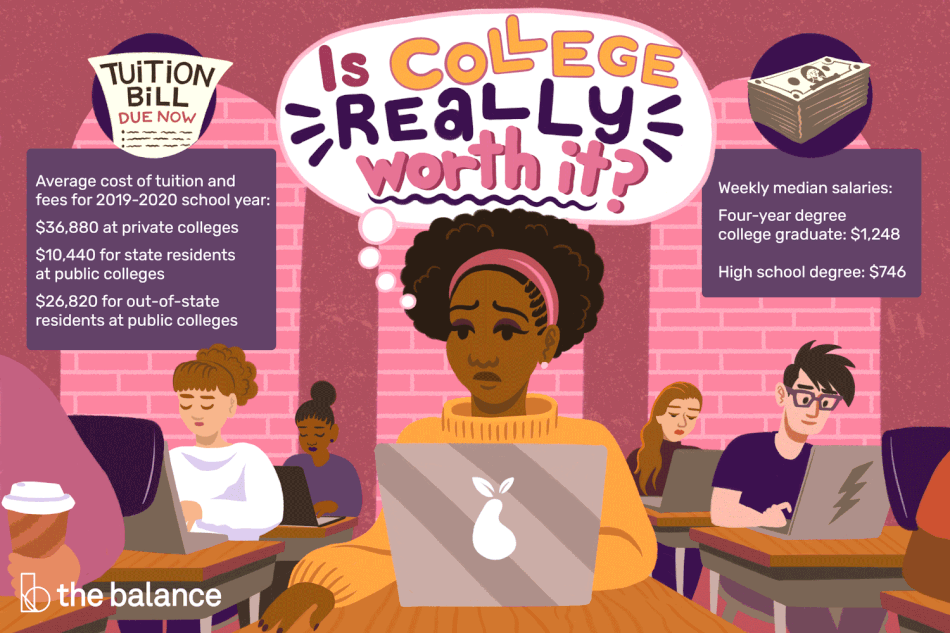
For many college graduates/recent graduates, it seems that this financial crisis leads to no hope for them. And the term “financial crisis” fits this current circumstance as there is a net inflation of tuition for certain college degrees. We are about to hit the fourth wave of the virus, and while things still are not entirely back to normal, the goals that these students set have been energy draining instead of motivating them during this situation.

Graduating from the Class of 2020 is extremely hard as this was the year that led to burnout. Additionally, there were many instances where graduates have shared the same concern about closely giving up on the idea of becoming what they studied for, while endless applying for jobs in their field that led to rejection and being ghosted by the employer.

It is going to be a major crisis for the United States if we turn our backs on an entire generation when graduates are trying to enter the workforce.

So what if you are currently lost? What if the job/career that you are looking for is currently on a hiring freeze or a decline? No vacancies at the moment? You still need to make some kind of income to keep a roof over your head.

  1. You either get creative and start your own side gig/freelance project such as starting a website/blog and get paid for it. Or if you can create your own shampoo product or using your design skills to start your own clothing line online, go for it!
  2. Or you can take a step backwards, and apply for jobs to keep you busy. Even if it isn’t the job that you are looking for, it is still a good chance for you to develop new skills that you can display on your resume.

According to Dorie Clark’s article at Harvard Business Review, he mentions something similar that will probably speak out to the crowd who is going through a tough journey right now.

Dorie states, “Unfortunately, meeting those urgent needs sometimes means that longer-range goals get shunted aside. A year into the Covid-19 pandemic, many professionals have found themselves turning down coveted promotions in order to maintain flexible hours, accepting positions in fields they actually want to leave, or saying yes to jobs they’re overqualified for or unexcited about because they simply need the money.
Those decisions — while painful — may be necessary in the short term. But a temporary departure from your professional goals doesn’t mean that all is lost. It’s essential — and possible, even with a busy day job — to stay focused on your long-term career trajectory, so you can rebound quickly and get back on a path that feels right for you.”

Below, is a survey that illustrates the population that is most vulnerable to food and housing insecurity.

#RealCollege 2021: Basic Needs Insecurity During the Ongoing Pandemic

How Zoom And Other Software Tools Are On The Rise in a Post-Pandemic World

Image via NextPlane
Image via TechJockey

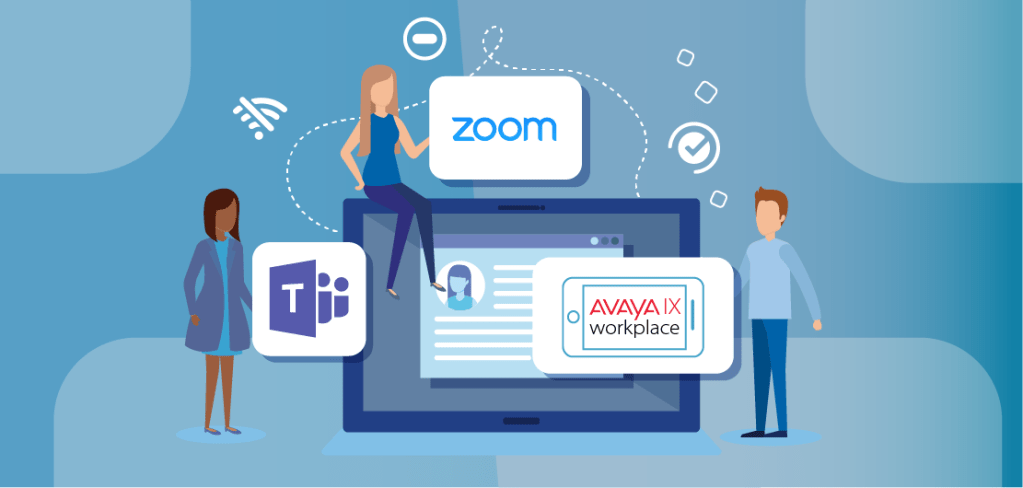
As the world reopens, many companies have learned that online collaboration works at a lower cost. Moving forward, tech darlings such as Zoom, Google Meet, Microsoft Teams and Cisco Webex can replace certain in-person meetings in which everyone or half the group traveled. In other words, the future will be more of like a hybrid environment. Some meetings could happen on Zoom, while others will remain better off as in-person.

Many current WFH employees have questioned if conferences will offer options of in-person or virtual. More employees will have the opportunity to attend at a lower price or even at no cost if virtual is a choice. However, many have also complained about developing Zoom fatigue due to burnout/companies overusing or improperly using the software.

Some agreed that there should be adoption and continuation of e-signature platforms in the post-pandemic world. Depending upon circumstances, suggested tech darlings will still have a role to play but at the same time, usage will drop off dramatically if folks seek ways to engage face-to-face.

Firms have also invested a lot in work-from-home infrastructure and they see that employee productivity hasn’t suffered. Moreover, company costs are plummeting as there is no longer a need for real estate. NYC is already seeing a huge decline in office space — leading to its devalue of commercial space. If working from home or remote work will continue into the future, this leads to the reason — finances.
Along the same lines, business travel won’t be coming back anytime soon to the levels that it used to be pre-pandemic — due to financial reasons as well.
A Regional Director at a software company stated that in a way, we are all victims of our own success, because if we weren’t able to conduct business using remote tools and our company’s bottom lines were hurting, we’d all be back on the airplanes tomorrow!

The pandemic has ushered in an era that was always technologically viable for the past decade, but culturally not acceptable. Yesterday’s “office” is not what tomorrow’s “office” will be. Remote work and Zoom is here to stay as we move forward.

For many employees currently working remotely, Zoom fatigue is real however they do not have to face nightmare traffic or the fear of being a few minutes late due to a train delay because of a sick passenger. The quality of life that zero-commuting hours have provided is not something that many want to give up.
Productivity has turned out to much higher for certain folks on a Zoom call when they do not have to pay attention to the portion of the meeting that doesn’t apply to them.
In addition, Zoom’s turning on/off camera feature allows folks to gain control over their participation level while yesterday’s “office” meetings did not give them that option.

Let’s put it this way — face-to-face has mostly qualitative benefits. Zoom and other tech darlings have more quantitative benefits as you can put a cost savings on how many less miles you have traveled, how much less utilities are being spent, etc. Many companies that were opposed to remote work are now implementing it as a standard form of work.
Even in the event that the current generation of business leaders usher in the return to offices and lead to a drop off of Zoom and other tech darlings, tomorrow’s business leaders (not to mention — the one’s that are more tech savvy), won’t forget that they could accomplish a lot of their work remotely.
In other words, Zoom and other tech darlings may face a slight drop off in the short-term, but their long-term future is looking bright.

All in all, companies will need to balance cost with profitability. So far, we have mentioned that there are folks with both sides of the spectrum.
There are those who feel that they need to have everybody in a room for brainstorming future projects and can’t get what they need done via Zoom meetings.
Then there are those who say in-person group meetings were a waste of time, and they can get much more done with a quick Zoom meeting where folks can say their part and tune out/leave if there are parts of the meeting that they are not accountable for.
Additionally, while some folks enjoy commuting to work, they will not want to spend wasted hours in traffic, so having a flexible and hybrid schedule kind of option would be beneficial to both parties.

This also leads to a theory that some folks have believed that while there will be some companies that will continue to allow their employees to work remotely, they are hoping that the option will become part of a company’s “benefits” package. This could be part of the new market as many job seekers are seeking remote positions.
Many businesses found Zoom to be a huge asset to them as their customer pool has expanded globally instead of locally, which helped their business grow immensely during the pandemic.
Even if some companies reduce their usage of Zoom, there are families who have adopted that software to stay in touch with loved ones at a distance.

Eventually, a return to workplaces and classrooms will decrease the need for Zoom meetings. However, the pandemic also showed so many companies how to do business with minimal travel travel and office costs — and this learning will continue to drive the market in many ways.

Re-envisioning the Workforce Development Sector and Labor Market Updates (March 2021)

Please note this data applies to the Greater New York City Metropolitan area and the United States only.

For many workforce development agencies, there are many factors that prevent job seekers from pursuing their dream jobs/careers.

One of the top factors would be the lack of specialized training/certifications in the field that they are looking for. Workforce practitioners have also mentioned that there are young people who need to work and cannot afford the classes, the program hours are increased, they have language barriers, not work ready or do not meet specific qualifications of the training programs.
What can the workforce development agencies do to remove this barrier for job seekers? Part of it comes to strengthening partnerships with other workforce agencies and employers versus building new training programs that are relevant for job seekers. For example to be specific, organizations may want to look into building long-term and patient partnerships (ideally in retail or hospitality) if that is what their demographics are looking for.

The second top factor would be the lack of job specific work experience – and this applies to both what job seekers can offer to the employer, and what employers are looking for in the ideal candidate. Some candidates that workforce agencies work with, may have narrow goals and expectations but not having a plan B. On the other hand, employers want what they want and are not so interested/engaged in what the referral has to say about the candidate. This means the agencies need to have those conversations with the employers up front more, especially when initiating a relationship. It is not a product that workforce agencies are pushing — but more so a relationship and partnership that they want to build. Not all employers see it that way, they see it more as a product. The transactional product versus quality partnership experience problems definitely supplement and overlap.
Also, because of changes caused by this pandemic, we can see retail and hospitality declining (as data is indicated in the later part of the labor market review). For those from the world of NO, it is important to educate employers on what is reality – the unemployment rate.

The third top factor would be educational requirements. This is often the case as certain employers are looking for — let’s say someone in their Accounting department to do some bookkeeping, processing invoices, etc. If your organization offers a training/certification program that caters to job seekers that are looking to land an Accountant/Bookkeeper job right out of completion, chances are 50/50. There are employers that do not consider graduates who do not hold a degree in Accounting, so it can prevent job seekers from obtaining employment with just the certification.

The fourth top factor would be life circumstances — which all of us go through in our lifetime. We are humans. Health concerns (with COVID still around), lack of consistent support system (energy, engagement, inspiration, motivation, stability) and childcare concerns (child remote learning, and taking care of child while parent is working from home) all play a role in this factor.

What changes should be considered when re-envisioning the workforce development sector?

(Suggested from workforce development professionals)

  • More workforce agencies working collaboratively when approaching employers for sustainable business partnerships.
  • Sector-specific training and upskilling programs in deep partnership with businesses.
  • Improve funder relationships and expectations, inaccurate or unrealistic requirements and metrics based on the populations served/sectoral needs.
  • Increase the focus in career exploration with job seekers; training program development and re-programming to meet the future of workforce.
  • Deeper, structural partnerships and consistency between businesses, government, social service and educational institutions.
  • Build house account with employers on a daily basis to better track interviews/screenings while using that tool to evaluate candidates (Deliverables make it difficult to build what we really need for participants).
  • Quantifying the need for bridge programs for jobs that are in high-growth fields.
  • Improve business trust in workforce development providers’ participants.
  • Adjust business expectations for labor market.
  • Reduce organizational competition.

Labor Market Updates/Review

As of March 2021 — the overall NYC Labor Market indicates that in 2019, there were about 4.5 million jobs and by 2025, there will be an uptick to about 4.6 million jobs; which will result in about a 125,000+ gain.


NYC projected growth sectors by occupation, Standard Occupational Classification (SOC)

  • Community and Social Service Occupations
    • Overall 94,000+ jobs as of 2019 to 106,000+ jobs by 2025; resulting in 12,000+ jobs gain
    • Social and Human Service Assistants: 19,000+ jobs as of 2019 to 21,000+ jobs by 2025
    • Child, Family and School Social Workers: 15,000+ jobs as of 2019 to 13,000+ jobs by 2025; resulting in > 1,000+ jobs gain
    • Educational, Guidance and Career Counselors: 11,000+ jobs as of 2019 to 12,000+ jobs by 2025; resulting in > 1,000+ jobs gain
    • Mental Health and Substance Abuse Counselors, Community Health Workers, etc.
  • Construction (growth sector by business classification)
    • Overall: 138,000+ jobs as of 2019 to 133,000+ jobs by 2025; resulting in 5,000+ jobs decline
  • Healthcare Support
    • Overall: 446,000+ to 363,000+ jobs
    • Home Health and Personal Care: 287,000+ jobs as of 2019 to 363,000+ jobs by 2025; resulting in 124,000+ jobs gain
  • Computer and Mathematical Occupations, including technology
    • Overall: 146,000+ jobs as of 2019 to 170,000+ jobs by 2025; resulting in 24,000+ jobs gain
    • Software Developers, Analysts and Testers: About 45,000+ jobs as of 2019 to 56,000+ jobs by 2025; resulting in 11,000+ jobs gain

NYC projected loss sectors by occupation, SOC

  • Food Services
    • Overall: 243,000+ jobs as of 2019 to 300,000+ jobs by 2025; resulting in 43,000+ jobs decline
    • Fast Food and Counter Workers: 85,000+ jobs as of 2019 to 82,000+ jobs by 2025; resulting in 3,000+ jobs decline
    • Waiters: 77,000+ jobs as of 2019 to 61,000+ jobs by 2025; resulting in 16,000+ jobs decline
    • Cooks: 43,000+ jobs as of 2019 to 39,000+ jobs by 2025; resulting in 4,000+ jobs decline
    • Food Prep Workers: 28,000+ jobs as of 2019 to about 25,000+ jobs; resulting in 3,000+ jobs decline
    • Attendants and Helpers: 21,000+ jobs as of 2019 to 17,000+ jobs; resulting in 4,000+ jobs decline
    • Dishwashers: 15,000+ jobs as of 2019 to 12,000+ jobs by 2025; resulting in 3,000+ jobs decline
  • Office and Administrative Support (SOC 43)
    • Overall: 638,000+ jobs as of 2019 to 629,000+ jobs by 2025; resulting in 9,000+ jobs decline
    • Administrative Assistants and Secretaries: 134,000+ jobs as of 2019 to 125,000+ jobs by 2025; resulting in 9,000+ jobs decline
    • Others: Clerks, Human Resources Administrators, Payroll Assistants, Processors, Typists, etc.
  • Retail
    • Cashiers: 75,000+ jobs as of 2019 to 68,000+ jobs by 2025; resulting in 6,000+ jobs decline
    • Salespersons: 117,000+ jobs as of 2019 to 103,000+ jobs by 2025; resulting in 14,000+ jobs decline

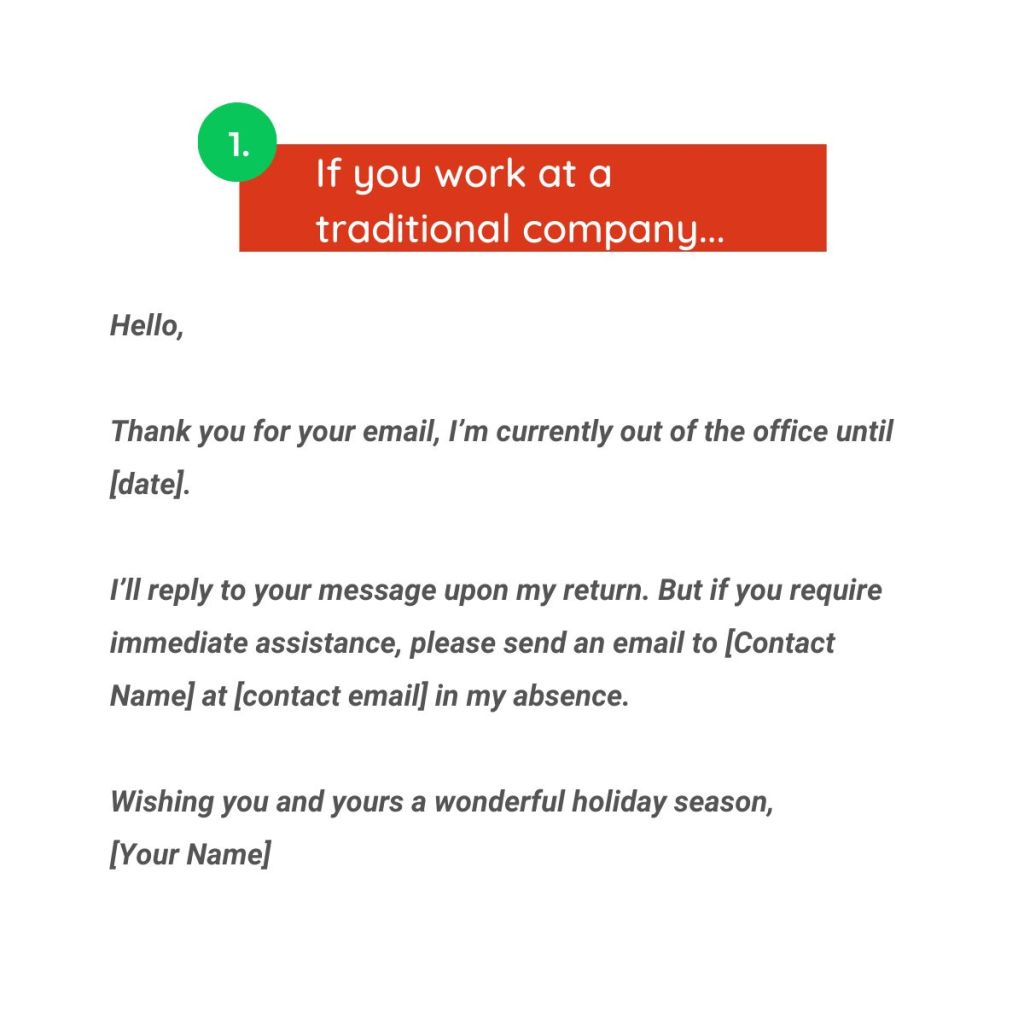
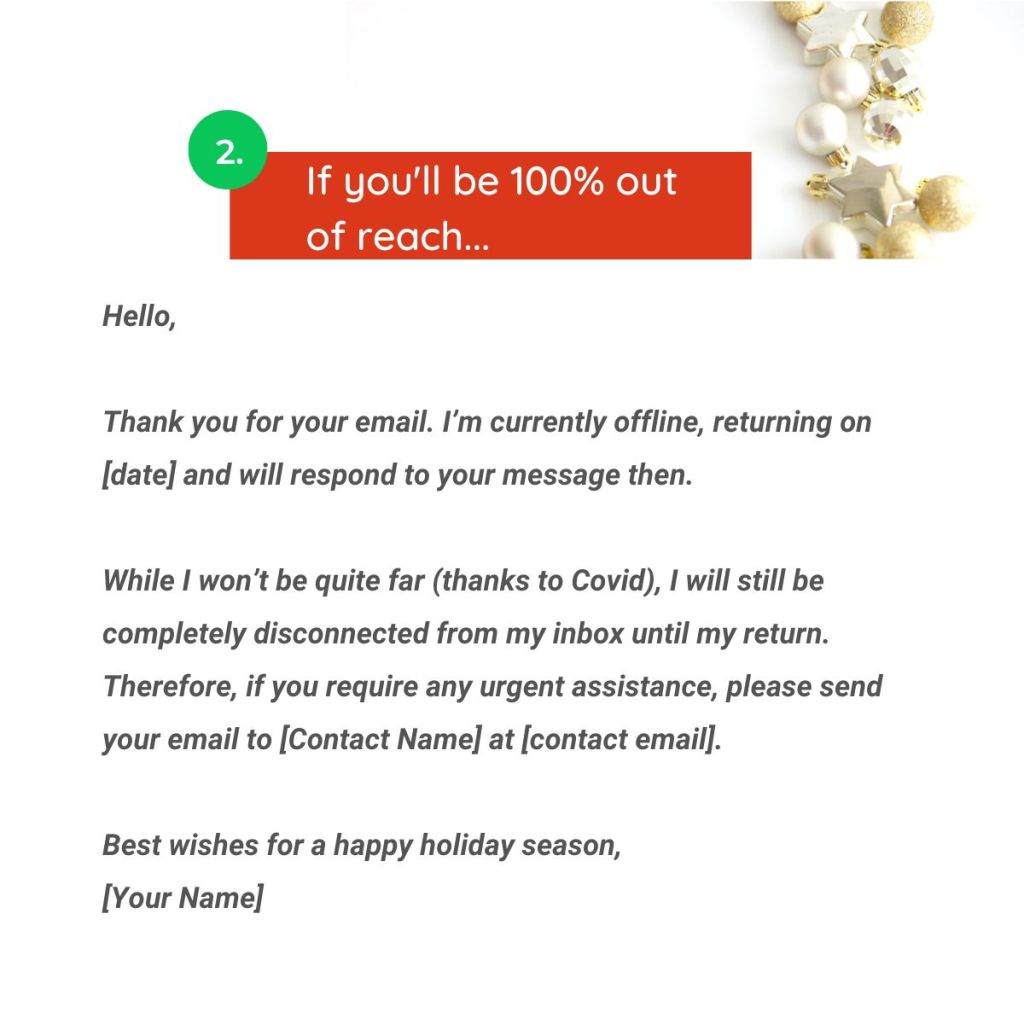
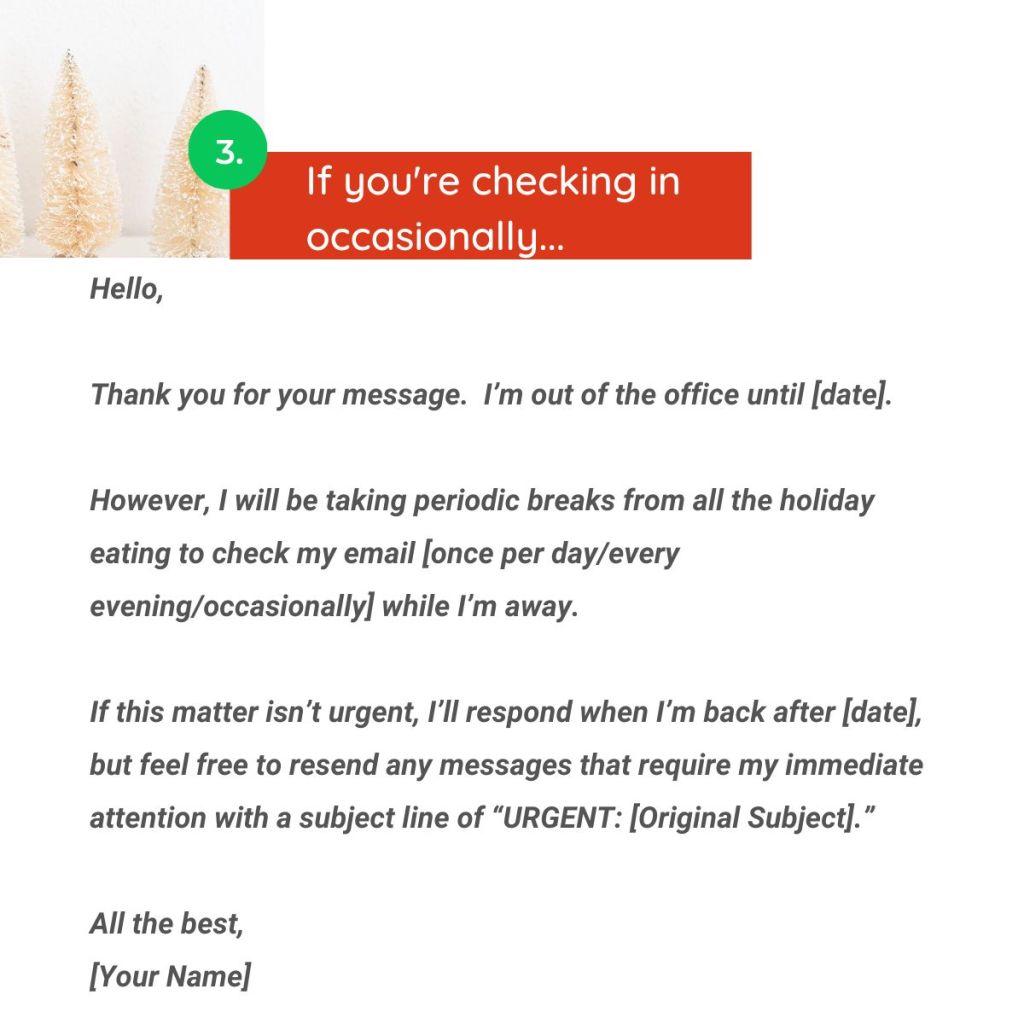
4 Holiday Out-of-Office Templates By Recruiter, Lee Ann Chan

Lee Ann Chan, the Americas Campus & Diversity Recruiting Program Manager at Agilent Technologies (the Santa Clara, California office), has reminded all of us that while we are away during the holidays to spend time with our family members and loved ones, it is crucial to maintain that relationship — whether you are going to be away for a few weeks or even a month.

Lee Ann Chan is a huge people-person and spent several years in Acquisitions before being inspired by her mentor to change career paths and be a Recruiter, which she absolutely loves! She finds that it is an amazing feeling to help job seekers find opportunities for smart people to do awesome things, and she is grateful that she can be a part of it.

Lee Ann brings in her 13+ years of combined experience working with professionals in both the private and public industries and have placed over 1,200 individuals in permanent opportunities across the United States. The roles Lee Ann have recruited for include: Finance, Analytics, Accounting, Engineering, Human Resources, R&D, Data Science, Legal, Supply Chain Management, Security, Procurement, Facilities Management, Clandestine Service, Product Management, and Life Sciences.

In addition, Lee Ann provides career coaching services to those who are job searching, soul searching, leading and managing, or trying to find new ways to advance within their careers. She supports her clients by helping them revamp their resume, interview style, and job search strategies; make seamless career transitions out of specific industries or professions; develop powerful relationships with recruiters, hiring managers, bosses, and co-workers; and elevate their personal brand in the workplace and market.

Lee Ann’s specialties include the following: Talent Acquisition | Diversity & Inclusion Strategies | Campus Recruiting | Technical Recruiting | University Relations | Career Consultant | Career Coaching | Resume and Cover Letter Reviews | LinkedIn Training | Networking | Public Speaking | Professional Development | Social Media | Personal Branding | Program & Event Management | Relationship Management | Metrics & Data | Sourcing | Interviewing

If you feel that you are seeking for these kinds of services, please feel free to connect with Lee Ann on LinkedIn and shoot her an InMail and connect.

Below are some really insightful out-of-office templates that Lee Ann has created for employees that I will share below for you guys, which are free to use depending on what is best suited for you and your company — “while we are all finishing up some tasks and preparing for the holidays.”

Wishing you all a safe and wonderful holiday season and a prosperous New Year!


Breaking Into the Tech Industry (Microsoft)

Image via Dribbble

Emily Chan is a Talent Sourcer for Engineering and Operations at Microsoft. In Emily’s role, she pipelines top engineering talent through various online sourcing methods (her favorite one being LinkedIn) and find these candidates a home at Microsoft.

During her free time, you can find Emily drinking coffee, buying (too many) plants, and working on a passion project called Sparkline! Sparkline (formerly CEO Mindsets) is an initiative that focuses on empowering students to secure their dream jobs and internships through practical resume, interview, and networking tips. Recently, they have been hosting different workshops on personal branding, LinkedIn, etc. at different colleges and it’s really great to have the opportunity to interact with their audience.

Sparkline is looking forward to expanding their reach to more colleges in the new year! If you’re interested in collaborating with them, feel free to reach out at hello@sparklineco.com and they’ll work together to bring your idea to life!

Emily Chan (Talent Sourcer for Engineering and Operations at Microsoft)

Now, we will delve deeper into the Q&A below where I have asked Emily to provide her input for those who are looking to pursue a career in tech or those who are interested in heading into tech. Emily is excited to share a bit about the tech industry and offer some insight for those who are interested in breaking into this dynamic industry!


What are the kinds of careers that Microsoft offers for those who are interested in applying for a tech role there? What are the specific digital skills needed?

Microsoft offers a lot of different kinds of careers in tech – some examples are software engineering, mechanical engineering, hardware engineering, etc. You name it, Microsoft probably has a role. I specifically focus on recruiting for software engineers. In terms of skills needed for it, most of my roles require working knowledge of an object-oriented language like Java, C++, or C# and experience working with highly available and scalable distributed systems. There aren’t too many hard requirements because we recognize everyone has a different story and we want to focus on hiring engineers with a growth mindset and good potential!


Last month, Microsoft announced that they want to help create millions of tech jobs in the UK. How do you think this will help shape the industry?

This is an amazing initiative that will not only boost the tech industry, but help the UK’s economy as well. Technology is the future and businesses will only be able to sustain themselves if they include tech in their business strategies. This initiative will not only help expand and accelerate the path into the tech industry but will also aid in creating a more diverse talent pipeline in tech.


Is training offered for those who are looking to pivot their career direction or those with zero experience in tech?

Although Microsoft offers extensive training for new employees to learn our tech stack, we do expect candidates to know the fundamentals of computer science and to have some experience working in tech.

If you are a recent graduate with no experience in tech, I encourage you to apply to our amazing internship programs! That’ll help you get your foot in the door for full time opportunities.

If you’re in the middle of your career looking to switch into tech, I recommend either 1) going back to school to learn the basic fundamentals of computer science and then applying for our internships/full time roles or 2) taking a coding boot camp and gaining some industry experience at smaller tech companies before applying to Microsoft. 


How do you get your foot in the door?

Network, network, network! LinkedIn is a great place to get in touch with people working at your dream companies. Do some research about them and reach out for a coffee chat to learn more about them, the role, and the company. Build and maintain that relationship and more often than not, they’ll be happy to give you a referral. 

One disclaimer I want to make for this is that you want to make sure you meet all the basic qualifications first! If you don’t, you can network all you want, but it’ll be very hard to land the role. This is because those are the basic skills you need to succeed in that role and companies are not going to bring a candidate into situations where they won’t succeed.


What should a job seeker be aware of when working at a tech company?

Be comfortable with ambiguity and be able to adapt quickly. Things are always changing whether it be a customer requirement or a new technology.


How does the job market look currently for tech?

More now than ever, the tech space is growing at an increasingly fast rate. Especially with the pandemic, everything has shifted to virtual and people are relying more and more on tech. Companies are working on innovative products to adjust to the modern workplace and modern society so there is such a high demand for good engineers in the tech industry. It’s a really exciting time to be in this space!


Technology is one of the top growing industries currently. How much has it grown compared to pre-pandemic? What are the most in-demand careers and skills right now?

As I discussed earlier, tech is in demand now more than ever. Everything is virtual now and even after the world goes back to “normal,” a lot of things will remain virtual.

I can’t speak for different companies since the tech stack varies, but overall, Microsoft looks for working knowledge of an object-oriented programming language and industry experience with highly available and scalable distributed systems.

How To Land a Job at Spectrum and How The Process Works

Have you been laid off, permanently furloughed or looking to pivot into a new career in 2020? You may want to consider a career in cable because Spectrum is always looking to building a bright future in spite of change. They build it with their products and services, however they can’t build them unless they have people like you.

Below are Q&A’s that a recruiter has answered on behalf of the job seekers.


  1. Suppose you come in as a Customer Service Representative, with minimal experience from at least 6 months to 1 year. If you are looking to go into another department, do you offer training for that?
    In fact, the customer service job posting only says you need 6 months of experience working with customers. It didn’t have to be from a call center and you don’t need to have a tech background. Once you go onboard, and generally after 6 months you go on an internal career progression.
    There will be courses that you are required to take to move up. For example, in customer service – there are 4 levels of customer service. During your tenure, you do get merit increases but your bigger jumps in pay come as you complete the industry courses that we pay for and have you assigned to, so it’s really up to you where you go.
    The key here is, once you get to Customer Service Level 4, that’s where you can start applying for let’s say a Floor Coach — which is lower than a Supervisor or you can decide whether you want to move over to the Quality Assurance Department, another department — but those are not internal progression roles. So for folks that are in the Customer Service Level 2 for two years, the company doesn’t prevent you from applying for a Supervisor — but in many cases, those who applied for the role, have already completed Customer Service Level 4, they’ve finished all their courses, and they’ve already moved over to Quality Assurance or something like that … so your internal competition tends to be as strong as you coming in externally, because you are competing with everybody who has the same and higher skills.
  2. What percentage of Spectrum jobs require a college degree?
    I will not be able to give you a specific percentage however, I’ve went through the number of departments I’ve been in — Sales, Customer Service, IT, Engineering, Field Operations, etc., but in all of those I can only recall where it’s a Manager or Director role where a degree is required.
    Most of the other departments will say that they prefer an Associate’s or Higher, except for the Entry-Level roles. In their case, they prefer a GED or higher.
    But remember, “prefer” doesn’t mean you can get the role without it because they will appear on every job you look on the website. It will either say “A degree is required” OR “With a degree OR equivalent experience”.
    By enlarge, most people aren’t bringing in a degree when it’s lower than a manager or director. They’re bringing some technical certifications with them, they’re bringing a high school diploma/some college, because we are focused to train you ourselves. We’ve got so many courses that we want you to take, that the department offers. You’ll be trained to become an industry expert sometime within the first 5 years.
  3. Does the Spectrum Careers page indicate the salary range?
    No they don’t. However, I suggest that you check O*NET OnLine because Spectrum is a federal contractor and our jobs are linked to that website. So if you see a job title, let’s say 70,000 technicians and you see that their average salary is $30,000 a year. It gives you an idea.
  4. I come from a Graphic Design background and I want to go into a career change — possibly heading towards becoming a future technician? Are there any trainings that Spectrum offers?
    Yes and no. If you’re going for a different career, there’s going to be some minimum qualifications there. You will hear that you can create a Functional Resume that focuses on your career skills as opposed as to where you work.
    Look at the job description as it’s posted and you’ll see all the skills on that job description that you know that you can do.
    Once you craft that resume, you can show those skills and how long you’ve used them. And your work history will be on the bottom.
    Once you upload that resume, the recruiter will go through that folder and the system will flag you (to have your resume looked at) because you have the skills that the job has posted. That is how you get your foot in the door, I’ll be straightforward as a recruiter; we are required to look at every single resume. We have to interview those who are the most qualified first.
    Once you have those crossover skills that you have listed on your resume, it will increase your chances of getting noticed and that phone call for the interview since you are showing them that you can bring that talent, those skills, those tools to the table.
    You will then fall into the range of 1-100 of being the most qualified because you are still competing with how many people applied to that position — how much experience and skills they have. There’s a little bit of luck in terms of changing roles as well.
  5. Are there any trading schools for skills training related to what Spectrum is looking for in Field Tech? For example, if I want to become a low voltage technician?
    Absolutely. Thankfully, there is the Workforce Investment Act that is funneled through the U.S. Department of Labor and the Workforce 1 stations where you can get training for those specific skills. You are capitalizing on what the federal government has already put in place.
    So when we post a job for a technician, I’m going to be looking for someone who has about 6 months of technical experience where we typically find folks in that minimum range who graduated from APEX Technical School. Let me be specific. So a person who has graduated with a certification in low voltage from APEX Technical which is a 900 hour course, they may come in as Tech Level 1 if they have no other technical experience. But they are still considered because they have the minimum experience. So we interview that person. Again, don’t forget — it depends how many jobs that are there and how many people that applied at the same time.
    But I am the one who usually call those candidates myself — to bring folks in from Tech Level 1 so by the time they are in Tech Level 5, we train them up from the beginning. Generally, it would be $17.50 for this role.
    However, if a person graduates with their Network+ certification, that’s going to start at $26.50 since they will come in as Tech Level 4. Now, you would have made a difference of starting at $17.50 an hour to $26.50 an hour — just by doing that on your own. We also pay for the courses. However, if you paid for them yourself you will now just start at a higher level.
  6. If I do not have any experience. Will any trade school experience be credited? Are low voltage cable installer courses helpful?
    APEX Technical, Comptia Network+, Comptia A+ Certifications, NEW (Non-Traditional Employment for Women), BICSI  – are all certificate programs / providers we like to interview for the entry-level Field Tech.   They will come in with only their Technical training cert between $17-$26.50 (depending on several variables).
    Workforce Investment Act will pay for many of the training programs on your behalf through a Workforce 1 Center and their “training voucher” program. Stop by your WF1 office for details.
  7. How much of a hindrance would something like a very long period of unemployment be in getting hired? No one would hire me because I have been unemployed for a while and my unemployment just keeps getting longer and longer because of this. It’s a vicious cycle.
    It is, and I understand that 100 percent. Good thing I will tell here is, that answer will vary depending on what company you go to – but as of 2013, you might see on our website – that we do not discriminate against anyone based on their employment history.
    Now, it’s not uncommon for people to be a Director and they’re applying for an entry-level role. Many employers will say they would be overqualified. However, Spectrum doesn’t do that.
    Some of them who are out of the workforce for 4 or 5 years, many employers would say they are unreliable. Spectrum doesn’t do that. We only go based on the job description and your qualifications.
    So if you apply for something within Spectrum that you’ve done or did in the past, you will get a call. You just have to be ready to perform and bring up those skills in you. You wouldn’t get declined based on your length of unemployment. You will get the offer or not, based on how you perform on the interview.
  8. I saw a Customer Service position in a Spectrum store. Are they salary based or just commission based?
    The Retail Store / Cable Store rep has both part time openings and full time openings.  There are two types of roles.
    One is a Customer Experience Rep – that will be the title when it’s posted. It’s entry level and is wage based. No sales. You might also see it posted from time to time as a “store greeter”.
    The Retail Store Rep is the other (so titled; in some areas of the country its called simply “Cable Store Rep”. NYC its called “Retail Store Rep”. This is also hourly wage. No upselling is a requirement for the role, however, should you upsell and close the sale, you would get commission on the upsell. So, in this case it’s “base + Commission” in practice, but technically, its just hourly wage.
  9. Will AI automation take over all customer service jobs? I always prefer people to people.
    Great question! And your suggest of preferring “people to people” indicates there will be in person service reps for the foreseeable future for us.  
    Remember, Spectrum needs customers to be able to connect with their services and with the company in a way that best benefits the customer experience.
    A number for customers are not tech savvy and still mail letters at the post office, and some are “customer service savvy” and would rather not wait in line for a chat or a phone call, so its easier for them to just go into the store, since they know that will be the solution to their problem anyway. And some are very Tech saavy, and would not want to speak with anyone in person, or via phone – they get their need met via chat only.
    So for now, Spectrum Stores and store associates are an important part of the Charter organization. Additionally, we have the Customer Help Desk who uses both phone and Chat to manage customer needs.
    Spectrum Store employees help the Sales & Marketing organization drive sales, retain customers and provide personal interaction and knowledge through exceptional customer service. With more than 3,500 retail employees and nearly 700 stores nationwide, Charter has more locations than many top retailers. To find a Spectrum Store near you, click here. You can also find some details on Cable Store Reps.
    That said, while Call Center, and Cable Stores and the in-person experience are an essential customer link for us right now, as noted in the presentation, the future changes due to changes in consumer tastes and interests.  For sure we will anticipate the change, and adapt to it as need dictates in order to relevant.
  10. Will they train and field technical without any background experience?
    It’s not out of the question; and it has been done frequently in the past. However, the key factor here is how many spots do we have open when you apply.
    Let’s say we have 100 Field Tech spots available. We fill 80 of them with people with some experience.  If we still have open spots and no new candidates with experience apply, then, the hiring managers start to look at “cross-over skills”… that is what OTHER skills do you bring as shown on your resume? Does your resume show a history of consistently sticking to your goals; do you stay on jobs for a long time or short; during the interview, did you come across as teachable and focused on success, or “just need a job” attitude.
    So, technically, the answer is YES, but in practice, usually we don’t post so many Techs spots that we run out of candidates with “some” experience.
  11. What if someone has over 20 years experience in customer service not call center experience?
    That’s a win-win for us – depends how it works for you.
    The customer Service – Video Repair rep is hourly pay; no commission or sales.  It currently pays $20/hr.
    If you have 20+ years in customer service, customer account management, resolving customer concerns.  You’ll do well on the interview.
    But, there is a computerized assessment you would have to first pass to get the interview.  The test is designed to answer the question, “Has this applicant the aptitude and / or experience to work in a call center?”
    If you’ve worked in a call center (like 311, Geico, Telemarketing, Survey Center), for certain you’ll pass the assessment based on your experience alone – but if you’ve never worked in a call center but have the aptitude for it, you’ll still pass the assessment. But, if that really just isn’t your thing, for sure you wouldn’t pass the assessment – then, the system will notify you your application will not be moved forward.
    If all of those factors work for you, then, you should give it a try and apply.
  12. Is Spectrum currently hiring for interns in marketing/communications? If so, how much training is provided to assist new hires?
    Yes and no.
    We have an annual internship program across the country.  The internships post the first week of February, and interns are selected for the summer internship by May.  They start their paid internships in June and continue until the middle of august.  This year’s internship ended on Friday, August 14th, 2020.  We did have Marketing interns this year.
    However, how the program works, is, in December, each department that WANTS to have an intern will submit the request for an intern at that time (to ensure it gets costed into the budget for the next year.)
    Then, when budget review is complete, those departments whose budget allowed for an intern will then send a request to the Talent Acquisition department to secure an intern for the program.
    So, while its very usual to have Marketing interns each year, it’s not ALWAYS the case, and we don’t actually know yet what departments will request interns. So, best bet is to wait till February, then visit the website and search for the word INTERN. All internship roles will be posted. Apply to the one you meet the job requirement.  (Generally, there is a lot of competition because very little experience is required – instead they are looking at educational goals, volunteer experiences, what you major currently is in school… that sort of thing. Obviously having some prior experience related to the Major will be a plus).
    The only other option is Spectrum Networks usually has a 1 year internship. But, its not paid. You work in the Broadcast media division for 1 year as an apprentice – kind of, I should say. Then, a job full time job is offered to you after you graduate in the department you’ve been working in. It’s a lot of work, and not everyone’s cup of tea. But, it can work for the right person. It will also post usually in February when they have it.
    In either case, though, training is part of the internship – its designed to give you real work experience in a role / department related to your degree.
  13. What the hourly rate are for Customer Service Representative? How many hours per can you work? What are times for work schedule?
    If you apply to the NYC locations for example, the CSR is $18.50/hr base pay + $0.75 for Night Differential base on shift
    Current Training Schedule Six (6) weeks
    100% attendance mandatory
    TUESDAY – SATURDAY 10:00 a.m. to 7:00 p.m.
    After Training Work Shift: 1:00 pm – 10:00 pm (anticipate having this shift for at least 6 months or more before having a chance to change shifts.) | (Two consecutive weekdays off, will be required to work Saturday & Sunday as part of the work schedule and most holidays)
    Normally a 40 hr work week; but overtime is available at times. Generally, floor leadership will seek volunteers for overtime and Exceptional Employees sign themselves up for it.
  14. How should I apply & what are recruiters exactly looking for on resume or cover letter?
    Apply here: General job applications are found at the website : jobs.spectrum.com.   Once they apply, they can let you and I know, and I’ll take a look and offer advice or make connections deemed appropriate.
    In general, a good resume must have : 1) Contact Section 2) Chronological Experience Section (covering at least the last 7 years), and 3) Education / Additional Skills, Certifications section

a.       I advise to read the job description first. Each job will have a section that shows “required qualifications/skills” and possibly a “preferred qualifications” section as well.

b.       The Resume MUST list how your job experience matched those hiring manager requested skills and experiences.  (other sections will include education and training as well.)

c.       Remember to list accomplishments as well on your resume – they should tell us

                                                               i.      What you did

                                                             ii.      How well you did it

                                                           iii.      Its impact on the business / project

So, the resume is the first chance the hiring manager gets to see if you can perform the duties of the role.  Use it as your marketing tool to highlight how you’ve done what they’re requesting.

The MTA Is Expecting To Lay Off Thousands of Workers and Cutting Services in Mid-December

Image via Pinterest

Around mid-March when the NYC lockdown happened due to the highest cases, subway riders have descended rapidly to over 90 percent. As the phases slowly reopened in the recent months, subway riders still remained below 70 percent compared to pre-pandemic. Road traffic, including the tunnel and bridges have plummeted significantly throughout the months.

MTA service reduction and layoffs are all dependent on the federal government’s funding and the economic activity across the New York County. The MTA is expected to lay off at least more than 9000 workers if they do not receive any significant amount of funding because they need $12 billion in federal emergency funds to keep the system running as is.


According to Fox5, NBC (Source 1) and (Source 2), and CBS, below are the statistics:

  • “MTA officials have asked Congress to cough up $12 billion in federal aid by the end of 2021 to stay afloat.”
    • “The MTA has been asking for a bailout from the federal government. It did receive $4 billion in stimulus funds, but for the additional $12 billion to be approved it would likely need to pass through the Senate.”
  • “Some of the other cuts will reportedly include laying off more than 8,200 workers on subway and buses… and more than 1,100 Metro-North and LIRR employees.”
  • “Some weekend service would be slashed entirely while weekday train schedules would be cut by about 40%.”
  • “Fare hikes are also a possibility. In August, transit officials said a Metro-Card swipe could go up from $2.75 to $3.75.”
  • “The MTA received $4 billion from the federal government earlier this year but has asked for an additional $12 billion. It is uncertain whether additional money for transit assistance will be included in future COVID-19 stimulus bills.”
  • “Motorists and mass transit riders in New York are already facing fare and toll increases next year. Tolls and fares are planned to increase 4 percent in both years, New York State Comptroller Thomas DiNapoli said earlier this month.”
    • “The board is considering a number of options to raise fares on buses, subways, the LIRR and Metro-North by 4%. Tolls could go up as much as 8% or $6.70.”
    • “The projected fare and toll increases would raise $145 million in 2021 and rise to $650 million by 2024, according to the report.”
  • “Even if normal ridership returns by 2023, the MTA still projects budget deficits totaling more than $19 billion through 2024, according to DiNapoli’s report. Included in that is a projected $6.3 billion deficit in 2021, which would be more than 50 percent of total revenues. The report called the gaps ‘historic in nature.'”
  • “‘Increased cleaning and disinfecting of the subway, rail and bus systems — which has included the rare step of closing subways overnight — is costing the MTA about $1 billion in unplanned expenses,’ DiNapoli said. He didn’t have an estimate for how much the MTA is saving by the overnight closures, but said any savings are likely being offset by the costs of cleaning.”

The Remote Work World For The Younger Generations

Image via Pinterest

Now that working from home is a safety measure for the nation, this is a good time to scale tools, resources and people. It is an opportunity to have good, quality work done versus policing when and where. Of course, this cannot be done in all sectors/industries but wherever possible, it should be considered.

This is the time to figure out how everyone, not just future generations but also older generations, experienced and inexperienced can thrive in this rapidly changing labor market. The economy is becoming flatter and stagnant, so that will account for slower growth in many organizations.

It is immensely challenging for new hires and job seekers to make connections, regardless of age. And this especially applies to folks who are left with increased childcare responsibilities due to COVID-19 mandated school closures. With this new structure of a global online presence, everything has to be scheduled and pre-planned, including opportunities needed to socialize.

Now, how will this affect the Generation Z? Young individuals typically like to socialize and enjoy being around other individuals. However, the remote learning is causing a massive isolation — leaving them feeling stranded and lost with no plans or road map to guide them. We are losing teenagers to increased depression and suicidal rates as this is affecting their mental health.

Generally, it is hard to fathom a majority of individuals at age, to thrive in the “new normal”. We are humans that are wired for connecting/interacting face-to-face. Young individuals are grown into a highly connected and social interactive environment. The fully shifted remote work and learning can create a regimented, limiting experience for all. Feeling less connected may drive self-initiative and self reliance further and faster.

However in a way, Generation Z’s are able to thrive during this time with their digital literacy as they have grown up surrounded by technology which shows that they are capable of and more equipped for remote work, networking and learning.

For 2020 graduates — they might be able to handle this new normal of remote and digital based working, but many do not have jobs yet and are still struggling to find them. But why? Remote work can present so many opportunities and open up roles for those who do not need to be locate in that specific region to work there. However, it seems that many employers are still hiring based on a candidate’s competencies, abilities and talents rather than where they are physically located. This poses a disadvantage for recent grads with limited to no experience, since this limits their options.

A Gen Z student (’97) who has recently graduated from Hunter College, City University of New York on May 2020 says, “Upon my graduation, I recently enrolled into this program called COOP in which it is geared toward finding employment for people, and I have recognized that it is more difficult now to find a job than it might have been before. A lot of places have let their employees go, and/or started hiring freezes as well as promotional freezes. Other than that, you also have the consequence of having to do everything from home and I don’t personally live in the most ideal environment for working from home, as I imagine that this is the same for many others too.”

He argues that this remote work option is affecting him and individuals his age because they are hiring selectively based on experience/skills. “A lot of organizations will recognize that they don’t actually need as much office space as they currently have, so many places will be inclined to keep the WFH model or at least offer it as an alternative. This means you can apply to more jobs now than you might have been able to before since you won’t be limited geographically. However, this also creates more competition for every job seeker out there because we want to take this opportunity to be challenged and learn something new — but the job descriptions say otherwise. It seems like they do not want to welcome this opportunity to recent grads like us.”

The job search process has been increasingly overwhelming and stressful for young generations, however don’t lose motivation, or quit. Job seekers often give up easily. Remember why you started in the first place. Your purpose in life is to find your purpose. Stay patient and trust the journey that you’re taking. You will eventually get a job.


Your age doesn’t matter. It’s your energy and determination.

Cordia Harrington, Founder and CEO of The Bakery Cos

Going forward, employers need to implement new ways to reduce the risk of digital overwhelm and effective onboarding for new hires. They should provide a framework for remote work to help the younger generations adapt to the environment. This has to be taught instead of expecting them to find their own rhythm and process — and to do this, the employer needs to invest in those supportive tools, channels and a structured plan in place to enhance collaboration and communication.

How The COVID-19 Pandemic Will Affect Millennial and Generation Z Job Seekers And What They Should Do

Image via Dribbble

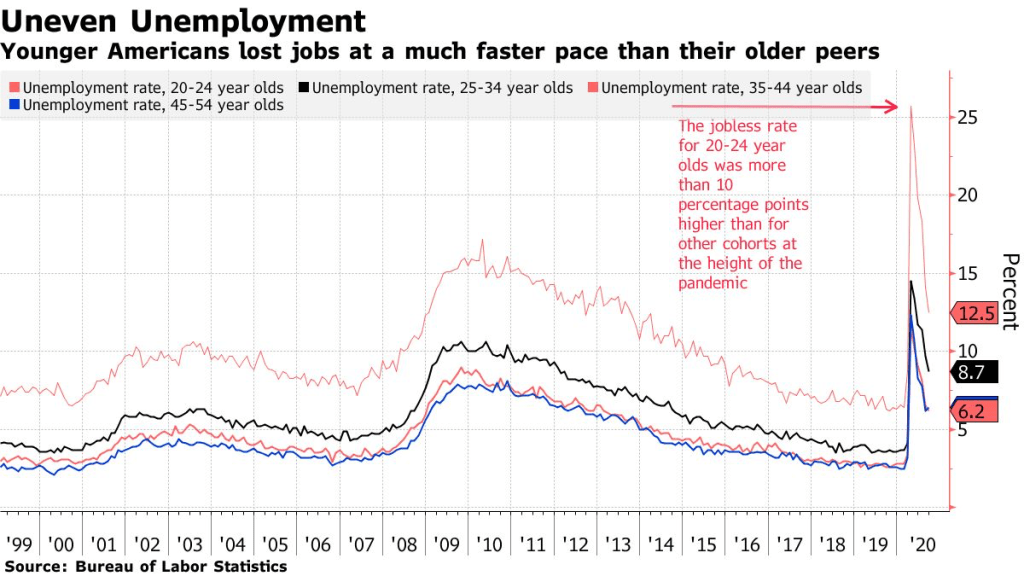
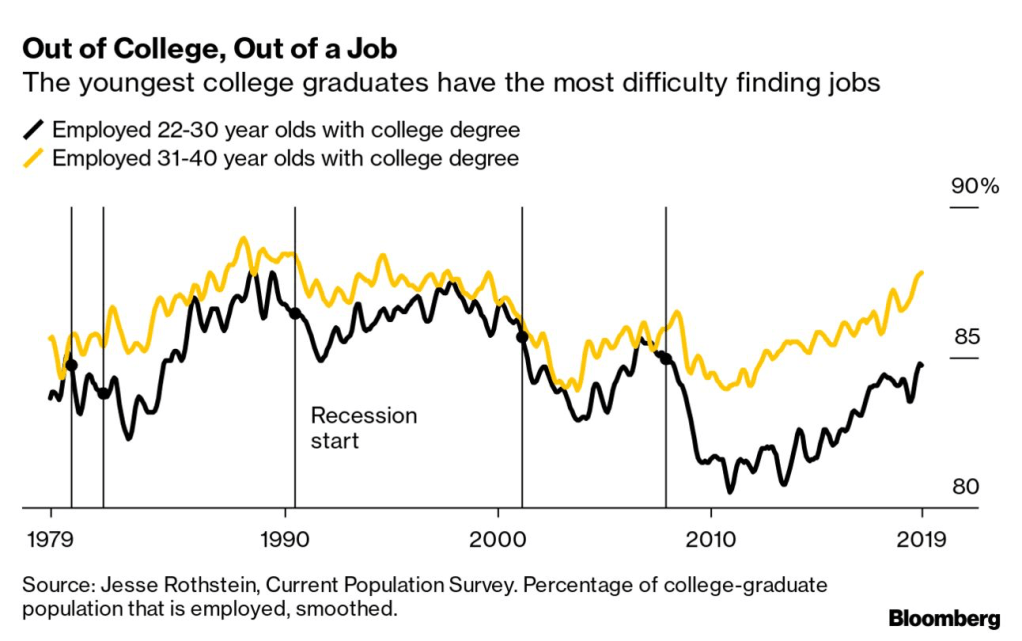
Research has shown that the Millennial and Generation Z’s who have just graduated at the end of 2019, during 2020, or in the next coming years, will be facing high unemployment rates which can affect the U.S. economy in the long-run.

Image via Bloomberg

According to Bloomberg, economists say the longer that young people are forced to delay their careers, the worse their prospects will be in the future to hold a job, accumulate wealth, or even get married or start a family.

Long periods of unemployment, or working part-time gigs or temporarily in jobs outside their desired fields, can jeopardize young professionals’ future salary increases and opportunities for them to build key relationships.

For college students and recent graduates, choosing a major based on availability of jobs is a recipe for an unsatisfying life. Instead, search for something you truly enjoy, something you find exciting, and the job will come, in due time.

Image via Shutterstock

Some of you are thinking that graduating in this global health and economic crisis may have delayed your career growth, however it is definitely not a career death sentence. Take as much time as you need to chase your dreams! Everyone you know may be interested in finance, STEM, healthcare, etc. but follow your own roadmap because these paths are certainly not for everybody. It may take you a month, 6 months or 1 year after graduation to find a job amid the pandemic. Many companies have resumed their hiring and have pivoted new ways in doing so. In addition, a lot of companies are hiring workers to work from home as well, which can be a new way of reducing unemployment.


Advice and Tips For Recent Graduates

  • You should definitely continue to explore your interests, values and motivators if you did not spend as much time in the exploration process before your graduation. Through networking and pivoting, chances are you may find roles that weren’t even on your radar and; potential opportunities — that are even better than the ones that you have initially considered.
  • You want to actively connect on LinkedIn with everyone from your college community — students, classmates, recent graduates, professors, mentors, connections from your school internships, career advisors, and career centers! The best chance of success is typically from a referral.
    • Take full advantage of your college career center. Even though you have graduated, you are still part of their alumni network!
    • Take full advantage of employment centers/workforce providers that are located in your area!
      • The services that your college career center and workforce providers (non-profit based) offer are completely FREE in terms of resume critique, mock interviews, career advisement, mentorship, networking help, job placement assistance and referrals, and many more.
  • You want to actively connect on LinkedIn with your outside connections — former colleagues, friends, family members, neighbors! Set up virtual appointments on Zoom, Cisco Webex, Google Meet, Slack, and virtual happy hour, etc. You want to inform everyone that you are currently job searching and let them know what kinds of jobs you are looking for. They may know of someone who is hiring for what you are looking for and they may end up passing along a lead.
  • Do something different and take free courses that will get you out of your comfort zone. Whatever it is that you are doing, traveling, eating, cooking, working with animals/pets, people, your true passion unfolds.
    • If you can’t discover anything you like, you should consider volunteering although nobody likes to work for zero profit. At a time like this, putting your gifts, talents and skills to help a nonprofit organization really helps many folks figure out what their purposes are.
      • This will lead folks to reflect on their passions and realizing how this experience ignites them, as this is a way of connecting them to their future career paths. Not many think of this, however volunteer experience actually offers you the opportunity to lead, grow and evolve as an individual — whether it is impacting the lives of young people, helping the less fortunate or patients/elderly, will allow you to continue to pave your way forward.
      • Also, volunteer work opens many doors for you! There are individuals that I know who have volunteered throughout their whole life, which has led them into their current leadership roles.
  • Keep in mind that there are many companies that have IT, finance, project management, HR, marketing, public relations, etc. Just because the sector/industry for that position isn’t what you are ideally looking for, this is a good time to still apply to that potential employer. The point is to not overlook them!

We all know that 2020 is undoubtedly a financial and emotional struggle for many college graduates. Many students are struggling to find employment and has also lost their jobs due to the pandemic. This has increased financial stress for students who are paying bills; financially helping their parents/family; paying for their tuition (which resulted in 68% returning to their home, 22% staying off campus, 7% staying on campus, 3% went elsewhere), etc.

According to Student Loan Hero:

However, do not be afraid to ask for help. If you feel that you are struggling with food and housing insecurity, paying for online classes, paying your rent, there are many resources to help you. You may want to look into Supplemental Nutrition Assistance Program (SNAP), Unemployment Insurance and Emergency Financial Aid.


Additional Resources for NYC and U.S. Residents

  • If you live in the NYC area, there are free meals where meals can be picked up at all Meal Hubs 9:00am to 12:00pm, Monday through Friday. Meal Hubs will operate for children, families and adults.
  • If you live in the NYC area and you, or a friend or family member has a small business that has been impacted by COVID-19, they may want to seek assistance and guidance from NYC Small Business Services. You may apply for emergency loans, like the Paycheck Protection Program as well as requesting financing assistance.