
Alignment of Core Values and Recommendations on Improving Behavioral Expectations Internally

Image via Nvolvegroup

What are the ideal core values that employers are looking for in candidates? Each employer has different behavioral expectations, however this has to align with what the candidate is looking for as well.

For instance, let’s look at the retail sector. For example, CVS Health vs. Nordstrom.

CVS Health is more than just retail, as it is truly focused on healthcare. CVS Health’s 5 core values are Innovation, Collaboration, Caring, Integrity, Accountability.

You want to work for a company that has and shares the same values that you have – so you want to research and make sure that company’s values match your values and style. Basically, you need to do your homework by thinking deeper on what that means. CVS Health can acquire and adopt new practices if you are looking for innovation.

Nordstrom is highly focused on their core values as well – Customer Obsessed, Owners At Heart, Curious and Ever Changing, Here To Win. If you are applying for a job, they usually list their core values on the bottom of the description.

CUSTOMER OBSESSED
We strive to know our customers better than anyone else. We listen, anticipate, build trust and move with speed to deliver on their needs.

OWNERS AT HEART
We treat every interaction as an opportunity to make an impact and deliver excellence.

CURIOUS AND EVER CHANGING
We approach problems with curiosity and create solutions. We unlock potential to be bold, think big and inspire innovation.

HERE TO WIN
We’re committed to delivering results, both today and tomorrow. We win as a team by supporting and challenging one another to be better every day.

Nordstrom Careers

Now, when you are applying for a job – you do not just want to solely focus on submitting 50 resumes via Monster.com or Indeed.com without knowing the purpose of the company! This is one of the biggest mistakes a job applicant can make. If you think that relying on online applications with just your resume and cover letter is enough to land you an interview in 2020, you need to try harder. With the highest unemployment rate in history, there are more available job seekers than job openings. You are competing with many hungry job seekers. And talent acquisition is not going back to the way it was, pre-covid.

Keep in mind that when applying, most applications require you to complete a Virtual Job Tryout (It is typically valid for 3 months if you score well. If you don’t score well, you can reapply 6 months after your application date) – It feels like an assessment, but what it’s really like is that it’s a way to find out what it would feel for you to work there and see what you’ll most likely do and what you’ll least likely do.

For example, CVS Health implements Virtual Job Tryouts to deliver better quality candidates and fill roles quicker.

“What work style is most like you?” It’s just mostly looking for you to answer consistently and honestly. Don’t lie, keep your professional hat on so that the results can determine what you are able to do in your job. For example, you want to put yourself in the customer’s shoes and think of what it would be if you were a family member shopping at your local retail store.

Once you have applied, please don’t forget to go on LinkedIn – begin to reach out and start building relationships with your potential hiring manager or colleagues in the recruitment/HR team. Let them know that you understand their needs, mission and goals and find ways to emphasize your value in relation to them.

The retail sector among many others, are one of the hardest hit right now – with some temporary or permanent closures of hundreds to thousands of stores, production coming to a halt, getting ready for a second or third stage of layoffs; in which all of these factors are causing bankruptcies, putting businesses in massive debts – resulting in thousands and millions unemployed as businesses are no longer in service.

However, research shows that the healthcare sector is high in demand and the demand will continue to surge in the next 5+ years. Healthcare is so crucial to the economy and the New York job market growth as well as many states.

Luckily, if you have worked in retail for many years – you are still in luck! CVS Health is still actively hiring. Sometimes when applying online, hiring managers receive a lot of applications and it will take them a long time to filter through the applicants’ applications. So a pro tip is when you are going to the store to do some shopping, you want to also let the manager know – by introducing yourself, give your elevator speech about how you have applied for a role with them. Keep in mind that you are sort of interviewing with that person already. You want to show them your first impression.


On the other hand, let’s look at Spectrum (Charter Communications). Spectrum offers four primary value propositions: accessibility, convenience, performance, and brand/status. Let’s say you are looking to apply for a Customer Service role there. Here are some tips, coming from Spectrum’s recruiter.

  • If you have 20+ years in customer service, customer account management, resolving customer concerns – you’ll do well on the interview.
  • But, there is a computerized assessment you would have to first pass to get the interview.  The test is designed to answer the question, “has this applicant the aptitude and / or experience to work in a call center?”
  • If you’ve worked in a call center (like 311, Geico, Telemarketing, Survey Center), for certain you’ll pass the assessment based on your experience alone – however if you’ve never worked in a call center but have the aptitude for it, you’ll still pass the assessment. If that really isn’t your thing, for sure you wouldn’t pass the assessment – then, the system will notify you your application will not be moved forward.
  • If all of those factors work for you, then, you should give it a try. Click here to apply.

But before you apply, I want you to make sure that the employers that you apply for, has core values that aligns with your values. You want to ask yourself, “What values do I look for in my future workplace?”

This is important to so many job seekers that I have assisted. Many candidates look for employers that not only care about their employees especially during this challenging time, however the employers must have missions and values that align with the candidate’s personal values as well. There are so many well rounded candidates out there that are looking to work on products that matter, especially when they are deciding where they want to head towards in their career path.


Transparency of core values are important, but not all employers express it in their job descriptions. Below are some of the company values that HR professionals and recruiters from different states/countries and sectors/industries, provided 1-2 of their multiple perspectives – in which they are looking to improving their behavioral expectations for their employees and organization in the long-term:

  • Me: “Stay committed to eliminating barriers that restrict the employment opportunities available to the disabled and minorities, by making sure that all individuals are supported and feel included regardless of age, race, gender, religion etc. – which ultimately leads to a bigger step in being a better employer.”
  • Manager from the Recruiting Operations team at a technology-based consulting company: “Improving behavioral expectations could revolve around a rewards based system for positive customer praise. This could be a public practice where an employee is acknowledged company wide for going above and beyond for customer, receiving the deserved approval. This illustrates the importance of the company’s values with recognized appreciation. For the specific role of Program Manager, a financial reward could be given acknowledging the positive impact their behaviors have had on the customer. This would promote the continued effort of the behavior producing favored results for all parties.”
  • Be transparent in compensation to gain employee trust.
    • Recruiter at an automotive insurance agency: “My recommendation is to really stay true to our min, mid, max points of roles and to share with the candidates a narrowed range that their compensation will increase before they interview. This gives them a chance to decide if the position aligns with what they are hoping to get out of it and also it doesn’t take away from their moment of celebration if they are shocked at the amount they are offered. I think the fear from our company is that we don’t want to create an environment of people pursuing roles solely for the pay and we want people to pursue their talents and interests. I happen to agree with this, but I think it’s also realistic to believe that we’re all here in someway for a paycheck and a candidate is agreeing, before seeing a salary range, to give 40+ hours a week to this team and their promise to ‘work with purpose and energy’ (our value) but we need to offer them the same respect of giving some indication of what we feel that is worth as far as a salary goes.”
  • Human Resources Recruiter/Employment Specialist at a College: “We currently have a bonus program in which employees who interact positively with our clients are eligible for a significant bonus. However, not all positions interact with clients, so a number of employees are automatically ineligible.  Instead, it may be beneficial to have some kind of reward or recognition program for colleagues who have a positive impact on their coworkers and/or who show respect to everyone that they interact with. This would reinforce the importance of those interpersonal skills. 
    To improve sustainability we could have a program where individuals who come up with a sustainability program or initiative to receive a portion of the money that was saved due to the implementation of their suggestion or some kind of recognition. We often talk about the importance of sustainability but demonstrating some real-life situations may help employees understand why it is important and increase their usage of the various strategies as well as our employee’s commitment to finding new ways for environmental and financial sustainability.”
  • Talent Acquisition Specialist at a management consulting firm: “To improve and sustain each employees behaviour with a clear focus on the three school pillars, an ongoing mentoring program among staff and faculty could be taking place so  each employee can learn from others on different behavioural situations that they’ve experienced in the past. Another one could be to extend a situational assessment test during the recruitment process of new staff or faculty  members. Therefore the test could more precisely and effectively identify staff behaviours when exposed in different situations.”
  • Talent Acquisition Service Manager in a globally operating technology company: “Area of improvement is to have a culture meeting that would allow employees from different areas of the organization experience more these values and shared with others outside of their own organization and that would help embed more these values within the employees so it becomes part of their DNA of service and mentality. Have these values as a permanent part of the employee’s performance metrics of each objective. Communication tends to focus on a specific strategy and can feel disassociated from the values which can tend to cause confusion if these are not constantly articulated by Leadership.”
  • Talent Acquisition Specialist at a mobile telecommunications operator company: “Firstly, many employees do not see a link between the values and their role, so a good way of communicating these values would be to include them in the individual employee’s Job Description. Each task Listed can have a box next to it which identifies the value (if applicable).
    Secondly, Employee Value Proposition campaigns should not be run once and forgotten, they need to happen annually to remind employees.”
  • Director of Talent Management at a software startup company: “Our company is still in its early stages and our core values were recently introduced. One way in which we could improve behavioral expectations is by incorporating our core values and expectations into our recruiting process. Our values should be represented within our job postings, discussed during the screen process and be a part of our actual interview questions so that we can establish how a person will fit into our culture. This would also ensure that employees know what’s expected of them on their first day. Another way we can incorporate these expectations is through our performance management processes including 30-60-90 day plans for new hires, performance reviews, performance plans, manager/employee 1:1s and promotions. The first step would be to include the expectations in our goal setting, 1:1 and performance reviews. Goal setting is a great way to tie individual goals to our values. The 1:1s are really a follow up on those goals as well as reinforcing the manager’s commitment and responsibility to the employee’s success. Finally, the performance reviews are a review of the goal attainment and a culmination of the continuous feedback via the 1:1s.”
  • Benefits Manager at a book publishing company: “More transparency at my company is overdue. This is a hugely missed opportunity for the incumbent talent to really feel valued and supported; and that their longevity and careers are equally important. We often find that people who sit in privilege or have been given the privileged of exposure to those making decisions are the ones who repeatedly get recognized or are invited to sit on different committees impacting change.  Something that is currently in the works is rebuilding the structural foundation of mapping out career opportunities and planning.  I think when we become more transparent than more employees will be able to assess what they are trying to aspire to attain and then curate a path to reach their goals. In addition we have to invest in the tools to take on more accountability of performance reviews and put more weight on their value – it’s unfair for an employee to put the time and effort into answering the questions if they are going to go unnoticed.”
  • Human Resources Manager at a real estate – bustling urban playhouse: “I think the organization does a good job with communicating the behavioral expectations. We have a monthly micro-bonus incentive in place that monetarily rewards employees who are mentioned by name in a 5-star online review. My suggestion would be to continue to reward and praise these behaviors, so our employees stay motivated and feel fulfilled. Another suggestion would be to be clearer in communicating our pay scales with regards to long-term growth in positions; this would help employees understand the timeline in which they are encouraged to achieve certain goals/metrics in order to advance within the organization.”
  • HR Professional in the Cannabis Industry: “My recommendations for improving compliance and consumer education are to introduce regular training outside of the new hire period and to make products available at a steeper discount for Retail Associates to try.
    Regular training outside of the new hire period would include an overview of state regulation and refreshers on existing products, their effects, and their recommended use. It would also occur as new products are released for sale. This training would occur in the form of a short seminar, which would include written materials, a presentation by a product expert, and a question and answer session.
    Most of our Retail Associates are product users and have requested to purchase discounted product to test it and report back on its effects. Our regulations stipulate that we cannot give product away for free for this purpose, but discounting is permissible.
    Customers continually ask employees how a product has worked for them, and empowering employees with both the high-level training as well as the hands-on experience will improve the customer education experience.”
  • Lead HR Consultant at a small HR consulting firm: “I felt as though these expected behaviors could have been better communicated throughout the entire recruitment process, starting at the job posting phase. In addition to better communicating our expected behaviors through the recruitment process, a more rigorous performance management system involving bi-monthly ‘check-ins’ would be beneficial. Typically, any given mandate does not last more than 90 days, so having more frequent touch points would be helpful in ensuring the quality of our final product is where we would like it to be.”
  • HR Specialist at a 5 star hotel: “Leading by example – management should clearly stick to the desired behaviors and especially stick to the “top 12″ ones. They should know them by heart so that they can cite the according behavior or standard in case of negligence demonstrated by an employee. This will make it easier for managers to be heard and have their criticism accepted, because they base their recommendation on organization wide common knowledge.  Incorporate the desired behaviors in all kinds of trainings: classroom trainings, mentorings and coachings as well as cross departmental trainings. Use a blend of theoretical reminders as well as practical exercises where the values are connected to resulting behaviors.”
  • Talent Acquisition Partner at a beauty and cosmetic company: “The first recommendation I have for my company when it comes to improving behavioral expectations is tied to the Covid-19 Pandemic: I think it’s important to harp on the fact that just because you’re working from home doesn’t mean you need to work 12 hours a day. Though we will go back to the office at some point, WFH is going to be huge going forward. We care a lot about employee mental and overall health, and I fear we aren’t communicating enough that people need to take breaks throughout the day and stop working at a certain point. We say that behaviorally we want people to not overwork, but we need to communicate that more (over slack, emails, announcements, etc.).
    The second recommendation I have is to be clearer about Career Paths. Our Director of HR was just brought on about 4 months ago and I was only brought on 1 month ago, so this is something we know is really important for us to get done. Part of what I’m implementing is when a new opportunity opens up at the company, the Hiring Manager needs to provide me with a 3-5 year career path for this person. Once I have that, I can communicate it with potential candidates. That said, for anyone in the organization that communication isn’t there, and we really need to reinforce this fact that we want people to stay and grow with us.”
  • Director of HR: “One of two recommendations I would give to the company is around the issue of avenues of communication. We have a strong desire for people to speak and be heard but we primarily rely on the singular form of communication in person or through email. Although this is great I believe more communication avenues would bring about a greater sense of people’s value within the company. Some online company forums and anonymous drop boxes for suggestions and complaints would encourage people’s honesty and make people feel like the company desires to hear from them. 
    The second recommendation an administrative one. On some occasions, we have neglected to reward people for the actions because we simply didn’t have proper administration set in place. This leaves people feeling like they have been neglected within the company. There should be a better format for administering rewards to employees. All those who have achieved something deserving of recognition should be placed within a program that reminds management until they physically check it off as complete.  That way no one will feel neglected by the company but would always receive recognition for a job well done.”
  • Founder and Director of legal services: “At my company, we have 3 pillars that serve as our company values. First, we use technology and operational excellent to deliver a delightful customer experience. Second, we embrace and relish change, growth, and celebrate failures as opportunities to grow. Three, we share goals, support each other across organizational boundaries and we win and lose together. In order to fully embrace our three pillars, employees need to be open minded, accept radical change often and look at mistakes or failures as opportunities instead of as a shameful occurrence. For all of this to happen, communication and transparency are key. In order to improve expectations and measure performance, the use of periodic check ins, and conversations about performance are very important. In addition, I believe strongly in 360 degree feedback, although it requires a mature team, and a commitment to personal and professional development. My organization does not engage in 360s now, however, I think it would be a huge improvement if we did.”
  • Practice Lead on Compensation and Benefits at a multinational corporation that provides next-generation digital services and consulting: “I work for one of the leading service based organization where it is more valued and believe in company cultural Values in the form of “C-LIFE”. Each letter of the word representing a value and it stands for the following: C – Customer delight, L – Leadership by example, I – Integrity and Transparency, F – Fairness to all transactions and E – focus on Excellency. 
    > Compensation plays a critical role in attracting and retaining the right talent to meet organizational goals and also it is important to think about the employee as they are one of the important key stakeholders of the company who has major role to play and align to meet the organization goals Hence it is recommended to demonstrate individual with transparency and fairness in all the transaction with an effective compensation strategy and communication.
    > An effective compensation strategy and communication. should connect the individual performance and organizational outcomes. In order for a total rewards system to function efficiently and effectively, we need to ensure through effective communication on the process / Policy / Training on the company value system.”
  • Recruiting Manager at a College admissions service company: “My recommendations are focused on how we communicate the above behavior expectations/core values. I would first recommenced that we glorify the teacher as well as the student when highlighting student success stories because right now we make a big deal about the student who got into the Ivy league school or had the most score improvement but not the teacher that helped get them there. Additionally, I would recommend highlighting a student who succeeded under extraordinary circumstances (someone in a low income area, etc) event if that success looks a bit more average. We have a tendency to focus on the students who got into Ivy League schools but I think that our average student’s idea of success is simply getting into college or getting a merit based scholarship. We make an effort to help undeserved communities but we never highlight those student’s successes and I think that is more reflective of the average student than the highest achieving student who came to us with a 1400 already and we got them to a 1500 after their wealthy parents purchased the most expensive private tutoring packages.”
  • Talent Management Specialist of Organizational Development at a multinational corporation that provides next-generation digital services and consulting: “Behaviour expectations from employees are largely communicated through managers. Two improvements that can be done – (1) Introduce success stories of folks who have emulated these values and been successful in the organization – this can be communicated to the larger organization for others to learn (2) Introduce a positive reinforcement in terms of an additional incentive for achieving certain specific outcomes that drive those values.”
  • Human Resources Manager at a Staffing Agency that provides nurses for facilities and homes: “One recommendation for improving behavioral goals is by offering a monetary reward when a scheduler finds a replacement for nurses that call out.  Some schedulers just leave a position open due to someone calling out.  Others go the extra mile and call another nurse that can cover the shift.  If a scheduler goes the extra mile, we could give them an extra $50 because they are showing a commitment to the organization. 
    The second recommendation would be to have a quarterly bonus for the percentage of open cases they fill.  As with any job you can work fast or drag your feet.  If a scheduler stays busy they should be able to cover all our open cases.  By choosing to be prudent with their time they are making a decision that aligns with our core beliefs which is to help as many people as possible.”
  • Employee Experience & Organizational Development Specialist at a nursing home facility: “A recommendation that I would put forth as to how we could improve behavioral expectations is to create consistency throughout the organization. It appears that certain teams make up their own rule and expectations, which causes a bit of turmoil when other departments observe these actions/behaviors and try to do the same but can’t ‘get away with it’ because their leader adheres to the company’s standards.  I think this comes down to not all leaders feeling comfortable with having difficult conversations and holding their employees accountable. 
    I believe another area of opportunity is how we communicate these expectations.  We are a large organization – 1200 employees across three different campuses.  We have many front line workers who do not have computer access so simply sending out an email is not good enough.  In theory, leaders should be conveying information with their direct teams but I am doubtful that is actually happening.  I would suggest creating a standard of behavior and having a core team meet with every single team directly and sharing the same consistent message.  From there, I think leaders should be held accountable themselves to ensure this behavior standard is always being met.”
  • Area Manager in the Logistics Department at an e-commerce company: “What could be done better is the transparency to all members of management when seeking diversity within the management staff.  Internally they do make a focus on diversity and inclusion with multiple diversity groups within the organization, in which members of management have open round tables of discussions and panels to illuminate their experiences, as well give insight for entry-level associates feedback on how to help achieve their goals as well.  When hiring externally the recruiter and upper level management have clear data and make a conscious effort to have the population of the management team mirror the population of the employees as a whole.  Where there is a disconnect on the transparency is between the department managers when they are trying to identify all-star associates that they want to train and develop into assistants or entry level management.  If all members of management are aware of the current management profile and the goals of diversity and inclusion, they can evaluate the decisions of who they could possible identify as those future leaders.  This will also in turn help morale of the associates because they will not just see those leaders hired in externally that they can relate to, but know that with hard work they can advance and achieve it as well themselves.
    The other opportunity I see is the practice of hiring entry-level associates.  I do not have the access in data of cost/benefit analysis which I am sure has been performed for the practice of working with a sourcing agency when it comes to hiring in contrast to the internal recruitment department which handles management and higher technical positions within the company.  The sourcing agency I am sure yields a higher quantity of individuals especially to meet production demands at various peak seasons of the year, but due to attrition, cos to hire/train new associates, their productivity, capacity to advance into leadership roles, and whether or not these individuals are in as much alignment with the company values if it would be more efficient or not to invest more time and money into screening to yield better qualified associates that align with company values.  If we are then increasing the quality of the entry level associates that we bring in, then in turn if we as managers are doing our job of proving the coaching and training needed to develop those associates to set them up for success, we wouldn’t have to hire externally as much when it came to managerial roles.”
  • HR Associate for a Meat Manufacturing Company: “I think that we have pretty basic values, but we don’t do a very good job a explaining how and why they are so important to our employees. One way we could improve on this is to start an initiative where we post the values around the office and manufacturing facility with their definitions and ways that employees  help contribute to the values. Another way that we can improve behavioral expectations is to create a recognition program. We can create value cards where people can recognize something a coworker did that exemplified a company value. Drawing attention to good behavior will lead to more good behavior in line with company values.”

What To Do If Your Internship or Job Offer Was Rescinded Due to the Recession: VOLUNTEER

COVID-19 has done collateral damage to our economy and markets, with the labor market being one of the many that has been heavily impacted. This leaves our job seekers feeling stranded and hopeless. If you are seeking an internship or if you are having a tough time throughout your job search because your offer has been rescinded due to the hiring freeze, I understand how strenuous this can be. However, volunteering would be your best bet at the moment to building your career. Yes, no one likes unpaid work however, being involved with your community can actually help you not only build your experience and skill sets, but it will also help build potential connections that could open doors for your future career.

Many students or recent graduates who have received an internship/job offer right before the global health crisis hit OR those who have even lost their jobs that they love and have been working with their employer for over a decade, is HARD. You are not alone. There are over 30 million others in the U.S. who are in the same boat as you. It is extremely detrimental and discouraging for those who have been out of the workforce for so long, and those who have social anxiety and depression because this can cause low self esteem issues during their job search.

Job searching is not easy because it is still a full-time job for the unemployed. Oftentimes, thoughts like these can cloud the mind – “I’m afraid of rejection”, “Most of these jobs don’t sit well with me”, “I don’t know where/how to begin”, “No one will hire me, I’m worthless”, “I don’t have the skills that they are looking for”, “I have employment gaps”. Do not become your own opponent. Do not let those negative thoughts consume you. It is okay to start from square one. It is okay if you feel like you are behind all of your friends who are working in big corporations. You are not behind. This is not a race because everyone’s careers have different outsets and paths. And of course, employment gaps are definitely understandable during this time, IT IS NOT YOUR FAULT that this recession occurred.

So, with all of the free time that you have at the moment – why not consider volunteering? If you are looking for something productive to do, this is it. This is how you can keep yourself sane during unprecedented times like this, let alone your unemployment period.

Like I have mentioned earlier, volunteer work actually helps you gain access to a bigger network – which will open doors to your next job/career that may be waiting for you. For example, if you are an aspiring journalist – you may want to pitch yourself to an organization or business within the industry to write articles or press releases for free. Volunteering makes it easier for you during your future job search since every new connection you make at the organization can become one of your potential references.

Volunteering also helps you acquire skill sets, such as soft skills that will be transferable within the labor market. These soft skills include paying close attention to detail, excellent communication skills, good listening skills, time management, etc.

All in all, volunteering is not just a gap filler for your resume or LinkedIn – however it is a good way for employers to see in general. It is still “work” after all. Volunteers hold the soft skills that employers look for in an ideal candidate. It tells the employer that this candidate is someone who takes initiative and is driven by the work/passion that they deliver to the communities.

When we all think of volunteering, the purpose of doing so is for a good cause, right? Many job seekers tell me that they are embarrassed to include it in their resumes or LinkedIn profiles. There should be no reason to feel that way. It is something you should be proud of when highlighting your volunteer experience on your resume. Think of it as an accomplishment and showcase your leadership – that you have proven to take ownership by helping vulnerable communities and those in need, because chances are that you will outshine the other candidates; in addition to getting noticed by potential employers and recruiters.

While this economic recession and global health crisis will continue to impact our economies and markets, it is important that we collectively remain hopeful and build our self-confidence as we travel through this period of uncertainty together.

2020 Resume/Career Advice For Beginners

Image via Vecteezy

While there are certain sectors or industries on the rise, job searching can be tough during this current economic uncertainty. With over 30 million Americans unemployed, many may not have the experience or knowledge base for the role that they are applying for because 1) the job that they were temporarily/permanently laid off or furloughed are currently unavailable since there are no openings due to COVID-19; OR 2) the available jobs available in the labor market is not what they are ideally searching for.

This has been extremely overwhelming for the whole nation and this especially makes it harder for individuals who have to keep a roof over their families’ heads, have babies/children to feed, pay rent and bills, etc.

The key component that is really important right now, is your RESUME. As we all know, it is mid-July now… we are all home since mid-March, which has been 4 months. There are ways that job seekers can change their adaptations of their resumes from what used to be on their resumes. Back then, we generally like to include as many details as possible and what we are proficient in to tailor it according to the job description.

Ideally during then, you want your resume to look presentable to the employer. However, the main issue has always been that job seekers struggle very hard on translating or interpreting that information to their interviews. Now, with COVID-19 and people being home, what job seekers need to do is to draw themselves between two things. Either you are a good public speaker and you should just have general stuff listed on your resume so that you can save it all for the interview to showcase your excellent communication skills; or if you are more shy/introverted, you might have all detailed information on your resume but you will need to practice more on improving your communication effectively during your interview.

Many individuals oftentimes get so nervous about changing their resumes. It shouldn’t be hard when they have it on their flash drives or saved onto their desktops. Many of them right now just do not want to go back to square one again and I totally feel for them. And that can pose issues for those who may have criminal justice record, failing a drug test and anyone who refuses to start from scratch all over again.

On the other hand, those who are still working in their part-time jobs or have reduced hours, are the ones who are still hungry and are currently looking for work. They’re hungry by saying – “Now is not only about experience and not about your resume, because everyone not only in New York City but the U.S. is looking for a job right now. It’s you versus everyone.” Unless you have a good relationship with people and can build or have built some kind of connection with them through LinkedIn or by volunteering, it will be difficult.

So let’s say, what if you only have 1 month of experience at a retail store because it was a seasonal role? What if you do have experience but you couldn’t translate that into a resume? Especially with difficult times like these, you really want to hone in on your job description and you want to place emphasis on the skills that you know the employer wants – which is conveyed in the job description. For instance for a cashier role, if they are seeking someone who is great with the cashiering, customer service skills and using numbers to define how much revenue you increased for the company – you want to really emphasize those things on the resume but you have to tailor it each time because each job, each employer desires different things. And if it’s a customer service job, you will want to shift the customer service bullet up to the top and if it’s not, then you either take it off or shift it to the bottom. This is what would be recommended for someone who does not have a whole lot of experience, on how to at least get the resume to help them advance to the next step.

One of the most resourceful and quickest ways in landing your job/career if you have not built your network, is to seek a career coach to assist you with your resume since they are armed with many valuable resources. On top of that, they have connections with many employers from different industries and sectors – which they can help place you in a job that you are looking for. Many non-profit organizations that are workforce providers offer free services on career development such as resume/cover letter writing, honing your interview skills, career advice, work readiness training and even job placement assistance.

Career coaches are very helpful during this time since they have employer partners who reach out to them for recruitment assistance. They are the ones who are consistently up to date with the labor market trends and which industries/sectors are hiring and not hiring. Career coaches and job placement specialists have seen and judged resumes that they thought would not make it to a job, that actually made it. If they are referring the job seeker to an employer, a useful way with helping them tailor the resumes are by looking at the job description as mentioned earlier. If the job description doesn’t convey honestly what the employer wants, your career coach can help you find out what the employer wants. Career coaches will take their time to coach and counsel you to the best version of yourself and make sure that you know every single thing before you walk into the interview.

They will be there to teach you not to give up, to really hang in there for the long haul, keep applying, keep at it – although we know at this time it is terribly difficult.

Normally, job seekers are asked “What have you been doing ever since you’ve lost your job and how do you fill in that gap?” and now we want to replace it with “What have you been doing since COVID-19 has invaded our lives?”
If you are learning how to use Zoom, remote work or even taking courses to enhance your digital literacy skills, then that is a resume builder. If you are currently taking care of family, then you are a caretaker.

To wrap this up, this is about teaching yourself how to fail. This is about teaching yourself how to not be afraid, how to throw your chances out there and be hungry. If you’re not taught to fail and you’re just going to hold onto that one job, what if they never practiced their interview skills after working in that same job for 2 years?

Moral of the story is, don’t be afraid to throw your resume to every single job opportunity out there in every field because guess what? You may end up liking that job that you’d never imagine that you would be doing. In many cases, there is always room for advancement regardless of what your title is, what department you work for or which industry/sector you are coming from. Your learning experiences come through your resume, you’re receiving feedback during your interviews and if a job really wants you, then you will possess that confidence.

It has been such a fast and deep downturn and that’s what’s unprecedented – we can’t compare it to any other downturn because of that. The problem is that we don’t know what the next 6 to 24 months are going to look like but the job search/hunt process and every new growing opportunity out there is, has always been and will be limitless.

Virtual Interview Tips For Job Seekers and Interviewees

Image via Shutterstock

Due to COVID-19, many individuals have been permanently/temporarily laid off and furloughed by their employers. I have seen and heard from a handful of individuals who have been raving about offering advice in enhancing their interview skills.

As many sectors and industries are starting to bustle and slowly pick back up on their hiring, many of us are all still on a stay at home order, this could be a great opportunity to practice and enhance our virtual interview skills on during our downtime.

Below, are outlined pointers and constructive suggestions on what many interviewees may be lacking on. Hopefully, these will provide actionable insights on their blind spots.


  • A strategy that interviewees can use to respond to the behavioral questions, are by using the STAR method (specific Situation, Task, Action, and Result of the situation you are describing) and break down examples into a 1, 2, 3 process – three strengths and accomplishments.
  • Interviewees would need to come up with an overview of experiences and look into the camera and the interviewer. Have specific examples of strengths at the workplace; don’t start talking about weaknesses. Make sure to highlight your contributions in handling difficult situations and be specific. Every answer should highlight your skills in some way and how you’ve used it in the work environment.
  • Think about common interview questions as starting points, and the interview might go in different directions based on the interviewee’s responses. This way, the interviewee can think about he/she wants to expand on. For instance, if you talk about your degree, you could explain how it ties in to your prospective job. If you discuss about empathizing with a customer making a complaint, the follow-up questions might be on how you handled the complaint.
  • Before considering submitting your application before wondering if you’d get selected to the interview, ALWAYS be sure to highlight achievements on the resume and make sure your resume have consistent formatting style.
    • The resume needs to explain what motivated you to apply for the X position and why you feel that you are a good fit.
    • The resume needs to highlight the achievements and recognition that you have received in your previous roles.
  • Provide more relevant examples when answering these interview questions. Emphasize motivations of the job application.
    • Use storytelling skills to help the interviewer better understand your experience.
    • When telling your story, do not repeat your resume. Talk beyond your resume! Show your background interest and indicate a turning point/motivation as to why you’re here.
  • It is crucial to give more context and nuances of your experiences and highlighting your skills. Some interviewees tend to answer questions by giving quick answers in a list format. This makes it hard for the interviewer to extract the interviewee’s skill sets from those kinds of responses.
    • Your answers should not lack details. Being more abstract in your answers could help the interviewer to better understand you by preparing a story (with numbers, how you helped benefit the company, client testimonials, etc) that can be used to convince the interviewer.
    • Brainstorm some good projects during school, your contribution, how/why the project was challenging and how you tackled it. It would be ideal if you can highlight these utilizing numbers.
  • You should tie the relevance of your studies/degrees together (those who are college graduates), answers should be focused on your experience (whether it was short or extensive), providing good specific answers and supportive examples, showing your independent work skills, freelance/self-employed work (if applicable) and teamwork skills.
    • If you are a bilingual/trilingual/multilingual native speaker, you should emphasize that! Especially for those who have bilingual experience. This is very important to highlight since this is an asset to have for many employers.
  • Here is the part that most interviewees lack on. What you should do is to be more prepared for questions related to the role that you are applying for. You should be able to prove your knowledge and passion for the field/role in general. Be ready with 2-3 examples of how your previous projects/work will be able to help with that respective job/role related to your field of interest.
  • Interviewees sometimes answer their weakness questions too quickly however, be sure to expand on how you will work on that in your future interviews! How will you work to improve on that weakness and what you can learn from that weakness?
    • For example, you may want to explain how you are developing your own skills outside of work or during your downtime (learning Microsoft suite, attending relevant webinars) in between jobs – this shows you’re taking initiative and that you care about personal growth.
    • Interviewees should try to be more concise with responses to really get the point across. Explain your experience in chronological order to tell a better story of all the skills that have been developed. How will these developed skills help with future roles? Practice telling stories of situations at work that will prove the skills that you have. Have 2-3 examples/stories prepared, so you can answer behavioral questions. Approach questions with confidence – don’t let them know that you’re thinking about an answer or that a question is making you nervous.
  • Be ready to clarify any questions that may arise about your resume. Like, what does CMS stand for? It can stand for a lot of things. Customer Management Services, for instance. It is recommended that you should spell it out so that the interviewer does not have a hard time figuring it out.
    • Generally speaking, you should avoid acronyms on resumes especially if you are applying through their website since chances are – you will have to go through an Applicant Tracking System because it is tailored to the job description’s needs so you want to include everything word for word.
  • Don’t be too insecure! You have the experience already! Now you should just practice more, and work on being more concise with your answers. Focus on the opportunity that you’re interviewing for, what you like about the company and the job description, instead of focusing on the loss.
  • Spend more time talking about yourself, than others in your team. Don’t give them too much credit. You are who the interviewer is more interested in learning about, not your team. They want to know what skills you can bring to the table.
  • While answering questions, interviewees should shorten the context that they give and focus on telling the story in a way that answers the question. You should keep in mind to always be as specific as possible when talking about what you’ve done/accomplished and touch on why it mattered or how you helped other people/the outcome of a project.
    • You should bring up concrete examples that can address the question and keep highlighting the impact of your actions. Interviewees should specify about how they went about doing something (such as examples of steps they took to accomplish or overcome something and what they learned from that) or their rationale for convincing others to do the same.
  • Interviewees may start off with an excellent way of introducing themselves, however they can work on reordering and structuring their introductions to be more cohesive.
  • Highlight your skills and experiences that will be applicable to the role that you are looking for (need to brag a little, don’t be shy, don’t short sell)
  • Call out soft skills as a bonus, highlight “hard” skills relevant for the role first. For instance, if you are applying for finance/analyst roles, highlight the analytical skills and experiences first; instead of highlighting having empathy or being well-rounded first. If looking into compliance roles, highlight your auditing related experiences first.
  • As we all know, a good interviewee is a clear communicator and gives thoughtful answers. Be more confident – don’t say you think you’re not qualified for role because a lot of job seekers tend to accidentally blurt that out because of their loss of hope after receiving multiple rejections.
    • Interviewees should show their self-motivation through various examples by emphasizing that more instead of keeping it implicit, so the interviewee can try to touch on these through the interviewer’s questions – in such a way where they can think about how their work experience in other fields carries over to their desired role.
  • For those who are applying for software development/engineer roles, a good interviewee expresses their interest clearly in different topics and by keeping up-to-date with new technologies.
    • For this particular role, expect the interviews to be more technical rather than behavioral. Talk more and sustain a back-and-forth with the interviewer. (Ask questions, share thoughts aloud, etc). You should possess good ideas related and think through the problem well.
    • In case you are asked to perform unit tests in the interview, it is better to be prepared because it is all about first impression. Practice verifying the code without relying on a compiler. Are you able to supply your own test cases? Can you run through your code with a test case and spot bugs without running the code?
  • It is recommended that interviewees should always ask follow up questions toward the end when an interviewer asks “Do you have any questions?” to show them your continued interest and your consideration for the job; this also helps the interviewee understand real intentions behind a question.
  • This is obvious, however to bring this up as a reminder – regardless of which spectrum you lie on, you should never bring up politics on interviews.

How Emily Chan Discovered That Human Resources Management & Entrepreneurship Was The One

Emily Chan has recently graduated Magna Cum Laude from Rutgers University with a Bachelor of Arts in Human Resources Management and Entrepreneurship. Four years ago if you had told her this, she would’ve thought that you were crazy! Growing up, Emily had always wanted to be a doctor and her parents have always wanted her to be a doctor. It was the only career path she really knew that she was certain about so for the first two years of college, Emily was taking pre-medical classes like Chemistry, Biology, Physics, etc. and all of her extracurricular activities were focused around this field. Emily volunteered at Saint Peter’s University Hospital near her campus, she worked part time at an ophthalmology office, she performed research at a campus lab through the Aresty Research program, and she was involved with various on-campus medical organizations like the American Medical Student Association.

Despite immersing herself fully in this career path that she always thought she wanted, she was incredibly unhappy, stressed, and unfulfilled. Emily started questioning herself whether or not she was making the right decision and whether medicine was truly what she wanted to pursue for the rest of her life. These feelings intensified throughout sophomore year and it was a period of uncertainty and fear, but also growth.

Emily felt an overwhelming urge to explore other areas of study, but she had no clue where to start! There was so much pressure to find her “passion” and being that she has already spent two years taking classes that she no longer needed anymore, she felt even more pressured to quickly discover something that she liked. Therefore, she began reaching out to her advisor as well as her network of older friends and classmates to seek for advice. Talking through her strengths and weaknesses, as well as her likes and dislikes has really narrowed down the list for her. Emily came to the realization that she wanted to be in a position that is focused around people and that was how she landed her career in Human Resources Management!

Emily began enrolling in introductory HR classes and she received an internship outside of school to supplement her knowledge. She wanted to gain a 360 experience of in-class knowledge as well as real world experiences to see if HR was what she really wanted to pursue. Obviously, Emily ended up sticking with it and she can gladly say it was one of the best decisions that she has made in college!

Right out of graduation, Emily was offered a full-time opportunity with Microsoft as a Talent Sourcer for Engineering and Operations and she has recently launched a passion project called CEO Mindsets that is focused on providing digestible and actionable career advice. She can definitely say that she has come a long way since she first started college and she is really excited to see how her career will grow in the future! Connect with Emily on LinkedIn if you are seeking for career advice!


• What role has your education at Rutgers University and your colleagues/mentors/family/friends played in your career path?

Both my personal and professional network have been an immense help in getting me to where I am today. When I first started thinking about switching career paths, I didn’t even have a resume or know how to properly write one! I asked so many different people for help to write and review my resume and to this day, I still use all of the advice I received when I’m editing my own resume or reviewing other people’s resumes. Something I’ve realized is that most people are more than willing to help if you just ask. I’m so grateful for all the help and support I’ve received throughout these last couple of years from both my personal and professional network.


• How has your HR internships prepared you for your role as a Talent Sourcer for Engineering and Operations at Microsoft?

Through my various internship experiences, I’ve gotten a behind the scenes look at how different recruiting processes can be at different companies. Not one company is perfect, but each one has their strengths. I can take the strengths that I’ve picked up from each company and bring them all to my work as a Talent Sourcer at Microsoft. My various HR internships have also taught me to be confident in the workplace and understand that I can bring value to the table despite my young age. 


• What are you hoping to accomplish and contribute during your time at Microsoft?

During my time at Microsoft, I am hoping to add to the diversity at the company through recruiting. It already seems like a company that values diversity and I want to supplement that. Diversity is so important in and out of the workplace and I want to create an environment where people feel comfortable being their authentic selves. I also want to create a group at Microsoft that focuses on community service through crafting, which are two of my biggest passions. All throughout college, I was part of a school organization called Craft to Cure that creates functional crafts like hand warmers, dog toys, etc. to donate to local charities and it would be amazing to find a community passionate about crafting and community service at Microsoft!


• What are your long-term goals at the moment?

My first long term goal is to become a full-time entrepreneur. After my internships, I’ve realized that I really didn’t like being confined to a 9-5 job. I definitely learned a lot while working in corporate jobs and I really appreciate the network I’ve built as well as establishing a routine. However, the ultimate vision for me is to be my own boss. I enjoy the autonomy of it and I can really pursue anything I can dream of! One idea that has been in the back of my mind is opening my own coffee shop that features Asian flavors as a tribute to my culture. I really enjoy coffee and have an Instagram page dedicated to it – @ssmolbeans.

My second long term goal is to be more financially literate. Money has always been a sensitive topic for me. I’ve noticed that a lot of women shy away from this topic. My goal is to learn more about personal finance, how to invest, and how to build and maintain wealth. I recently started following personal finance Instagrammers and Youtubers and have learned so much so far, but I still have a long way to go! I’m excited to start on this journey of being more transparent about money and having a healthier relationship with money overall.


• Congratulations on launching your business venture, CEO Mindsets! Could you tell us more about what drove you and your friend to start this? What is the purpose/goal of this business?

One of my biggest inspirations to start CEO Mindsets is @girlmeetswealth on Instagram. This is a personal finance page run by someone I knew from high school and she posts tons of awesome tips that have helped me start my personal finance journey. I’ve always loved content creation and posting on my personal Instagram and after following @girlmeetswealth for a couple months, I was inspired to do something similar but for my area of expertise: job searching. I was also inspired by a post I saw on LinkedIn that listed some really great companies that were founded during a recession and I thought to myself, “Now is as good of a time as ever. If other people can do it, I can do it too.” So I told my friend how I wanted to do this and she wanted to join in and the rest is history!

The goal of CEO Mindsets is to provide digestible and actionable tips about careers, job searching, networking, professional development, etc. A lot of students don’t know where to start when it comes to any of this or feel extremely overwhelmed. I was definitely in a similar situation when I was in school and did a lot of soul searching to find what works for me. We want to help students and graduates bridge the gap between their passions and careers!


• You have experienced the same path as many other students, where you were certain that you would become who you thought you would be as an undergrad – however things took off in a different direction. What would you tell those group of individuals?

Take your time and don’t worry about having things figured out. Everyone moves at a different pace through life and there is no need to feel rushed because other people already know what they want to do. You have your story and they have theirs. Take it day by day and trust that everything will work out!


• You hold a Bachelor of Arts in Human Resources Management and Entrepreneurship. This is an interesting combination. What led you to go towards these 2 fields of your studies?

I chose Human Resources Management because I wanted to be in a position that is focused around people. I love being able to help others and I find it very fulfilling. I chose Entrepreneurship because of an elective I took that was part of that curriculum called Creativity, Innovation, and Entrepreneurship. This class changed my mindset so much. It taught me to go out of my comfort zone to become better. It taught me that it’s okay to not have everything figured out. It taught me to chase after the things I want. Human Resources Management can be a little outdated sometimes and I want to be able to apply a fresh and innovative entrepreneurial mindset to the industry.


• You were very active throughout your college career as a peer mentor and president for clubs/organizations. How did these extracurricular activities help you develop professionally and support your success?

These extracurricular activities taught me how to manage my time better. Having a full calendar can be really fun and rewarding, but also overwhelming at times. Because of all of my responsibilities, I had to learn how to use my time more efficiently and separate my time for work and fun. It’s really a balancing act but once you master it, you won’t be stressed about work when you’re relaxing and vice versa. This will be extremely useful in establishing a work life balance when I start working full time!


• Are there any advice you would like to share for students or final undergrads?

Two pieces of advice:

  1. Everything is a lesson. Try to learn as much as you can from every win and every loss.
  2. One of my favorite professors once told me this: In your life you will be faced with, on average, 10 opportunities that will change your life. It’s your job to recognize these opportunities and say yes to them.

Tips on How to Build Your LinkedIn Profile

Is this your first time hearing about LinkedIn? Did your high school academic counselor encourage you to create a LinkedIn account for your professional networking and job search because it will be useful for you in the long-term? Or are you just never active on social media? Many did not feel the “need” to use the platform as often until they started to discover their career interests during their undergraduate years in college. Well, if you are unsure about where to begin with your LinkedIn page, I can walk you through some tips on how to step up your profile game!

When setting up your LinkedIn profile, make sure you have a professional head shot with the appropriate attire (dress for the job you want) in place, clear of background distractions. It should be a plain, solid, simple background or even a bokeh background would be fine. Your face should be the main focus. Adding a professional profile photo makes your profile more likely to be found and viewed on LinkedIn, as well as being accepted/receive connection requests from other LinkedIn members.

LinkedIn is a more thorough and extensive version of your resume. In other words, your LinkedIn profile is basically your curriculum vitae (CV). A resume is typically 1-2 pages showcasing a candidate’s competencies: their skill sets (technical skills, and in some cases – soft skills if you are applying for a CNA role), education, notable achievements and work experience; this is basically a first impression kind of thing.

On the other hand, a curriculum vitae is lengthier than a resume. Why do I say LinkedIn is much like a CV? Because the LinkedIn layout allows you to specify yourself and explains your story in your words. You are your own author of your LinkedIn story. Like a CV, LinkedIn is a place where you can include publications, fellowships, licenses, grants, etc. that is relevant to the job or industry that you are looking to go towards.

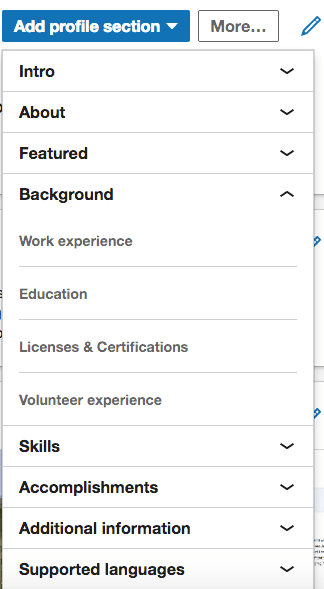
When you are on the right side of your page, you want to point your cursor to “Add Profile Section” and all of the sections/categories appear where you can begin editing your profile and include your information.

Remember, if you are job searching at a specific location, you want to set your location on LinkedIn – so that way, your profile will appear in more relevant searches.

LinkedIn allows you to display your Headline (your profile is the front page of your story and your headline is the first thing that appears to the audience! Make sure whatever you include in your headline should display great value and passion in one quick line) along with your Current Position, summarize your About (don’t summarize, sell yourself!), including a lengthy description on each of your Work Experience, your Education and Volunteering sections. You want to illustrate your work experience, internships and volunteer work in sentences rather than bullet points because this is not your resume. This is the part where it similarly matches up with the CV template format. In addition, LinkedIn provides you a section to include any Licenses and Certifications that you have earned, in addition to listing out your Skills. For the skills section, the cool part is that your connections may endorse you for the skills that they think you are highly skilled at. LinkedIn also gives you the option to choose your top 3 skills to feature on your page as well as rearranging your skills within a category. This is a great way to display yourself if a recruiter/hiring manager browses that section, so they will know what your top skills and strengths are for the job or sector/industry you are applying for.

After the skills section, you can even have your connections write you Recommendations to showcase potential employers who are viewing your profile to get a grasp of who you are as an individual – beyond just your resume. And of course, LinkedIn allows you to list your Accomplishments such as Languages that you are proficient in (a huge asset to the working world today since many employers are looking for bilingual or even multilingual candidates for certain roles), Honors and Awards that you have received throughout your academic career as well as in your professional career and organizations/clubs that you were a part of.

With that being said, your LinkedIn profile allows you to brand and market yourself. It speaks volumes to all potential employers while your resume only speaks to a single employer. Your LinkedIn profile also allows you to go more into detail with all of the mentioned above. More importantly, this platform allows other professionals not only within your region, but globally. This is a good chance for them to interact with/contact you and also learning about you while you are also learning about them and the company that they are working for. The intriguing part is towards the bottom of your profile, where you can spice it up with endorsements and recommendations from your connections.

When writing your summary on the About section, please keep in mind that this is the part where you interact on your professional brand and storytelling your background (experience and academia) to your advantage. Generally, I would advise that you should introduce yourself in 1-2 sentences; followed by a 2-3 sentences about your passions, work experience and your top skills; and lastly describe/explain in a couple of sentences about your long-term goals and how you want other LinkedIn members to become involved with you.

Feel free to refer to this LinkedIn Talent Blog article on some good examples of how you should write your summary!

Another way to communicate your professional brand is if you have published articles or posts, or if you were featured in an article/newsletter, or you wanted to showcase an event that you appeared in as a guest speaker or panelist and you feel proud of the work that you have done, all of this can be included in the Feature section of your page as a form of recognition.

Of course, your summary, experience, education and skills are not enough to tell your story. Include rich media into your employment history to highlight the visuals, by including pictures, presentations, videos or portfolios. Add as much detail as you can, especially to recent roles. Request a recommendation from your existing connections! Or if you have not connected with anyone yet, please start to build your network by discovering existing connections and locating new connections that can be there to help you succeed. Connect with your family members, friends, former/current colleagues, teachers, professors, mentors, classmates, clients, etc. You’ll never know if those connections may be a step closer to what you are seeking for. They may know of someone who they can connect you with to help you achieve your goals. When requesting for recommendations, you want to make sure they are those that can aid you in to shape your credibility and validate your competencies.

Once you have your network in place, don’t stop there. The larger your network, the better. Keep expanding your network and do so in a strategic way. What I mean by this is you want to search for connections who share common interests/things with you; those who work at a company that you are interested in working for; those who are in a role that you want to land yourself into; and those who are able to introduce you to someone to help set you up for success.

A tip to discover/search for existing or new connections that you may know is that overtime, LinkedIn’s feature and algorithms will improve and prioritize which individuals you should connect with on “People you may know in (Region You Reside In)” list.

When you “Connect” with professionals, they give you the option to “Add a note”. It is highly recommended that you include a personalized note to let them know why you are connecting with them. You want to let them know who you are, how you discovered them and how they can assist you.

LinkedIn is not just only for networking. You can use LinkedIn to build a resume, apply for jobs, take free online courses to enhance your digital literacy skills and other technical skills as well as catch up on current events via “LinkedIn News” on the top right hand section of your homepage.

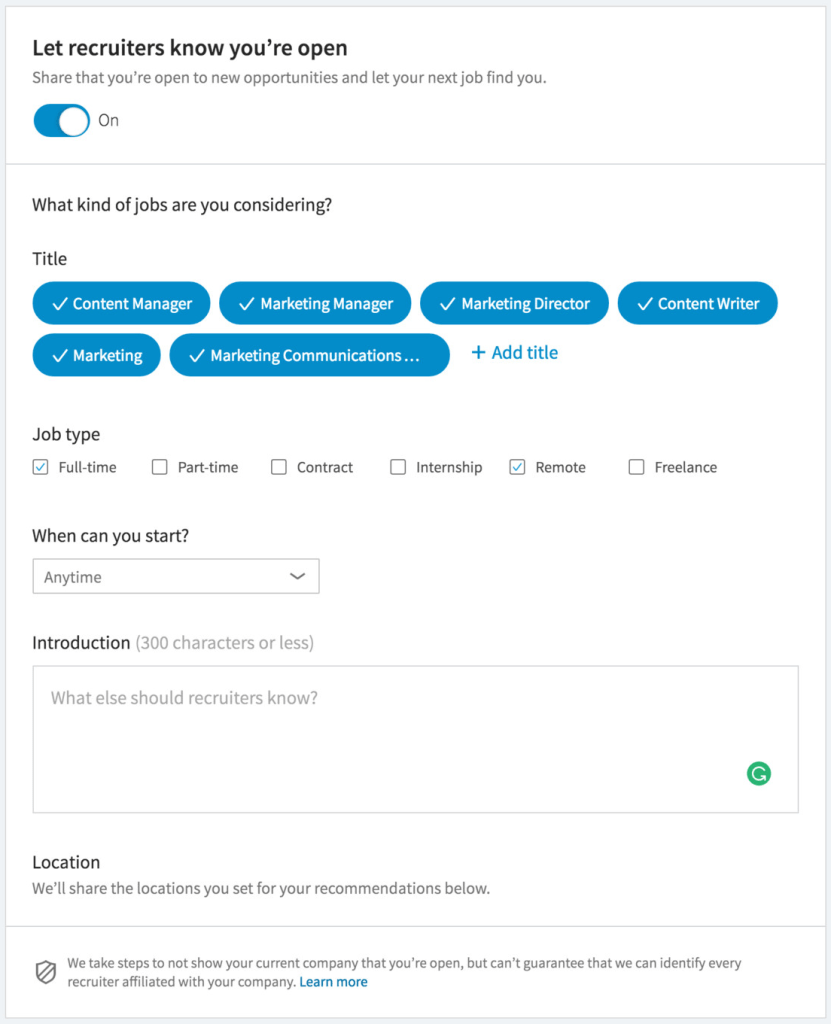
Last but not least, on your job seeking preferences setup, you can change it to make it visible to recruiters and let them know what kind of job opportunities you are looking for. In addition, they also give you the option to filter it by industry or by the position.

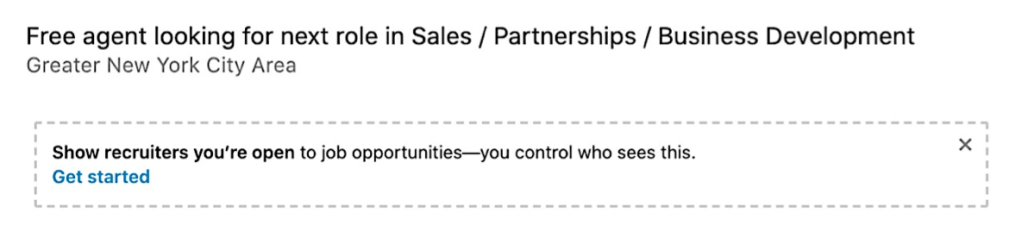
First, update your profile headline and map out a plan for your job search
On the introduction textbox, you want to let recruiters know what you are looking for in your next job and provide some context

Job searching especially during uncertain times like this – coupled with a tough, volatile job market due to the global health crisis and economic recession remains unhopeful to many. However, it is important that job seekers continue to stay motivated during their job hunt and nevertheless be prepared for virtual interviews! Best of luck in your job hunt and utilizing LinkedIn to your advantage. This is one of the many ways in laying the foundation for your future success.

How to Find a Job or Career If You Are Not a People Person

There are individuals who are very sociable, super energetic and outgoing – the extroverts. They share their endless ideas aloud and want to be noticed by others. And there are the introverts, those individuals who don’t really like to talk or socialize with others. They prefer to be alone and do their individual things. They are more silent and reserved. They think out loud with their minds rather than they do with their voice.

I do have a few clients who were seeking job placement assistance from me and I oftentimes receive this message, “I’m looking for a job that’s not customer service related or engaging with people.”

Well, that is definitely okay, because not everyone is built to thrive as a people person. However, it could be a challenge for them during their job search since they will most likely not want to network with professionals – and we all know that this is the quickest way to landing a job.

Especially since the global health and economic crisis that’s still going on currently, you can look into Work-From-Home jobs that do not require you to be client facing.

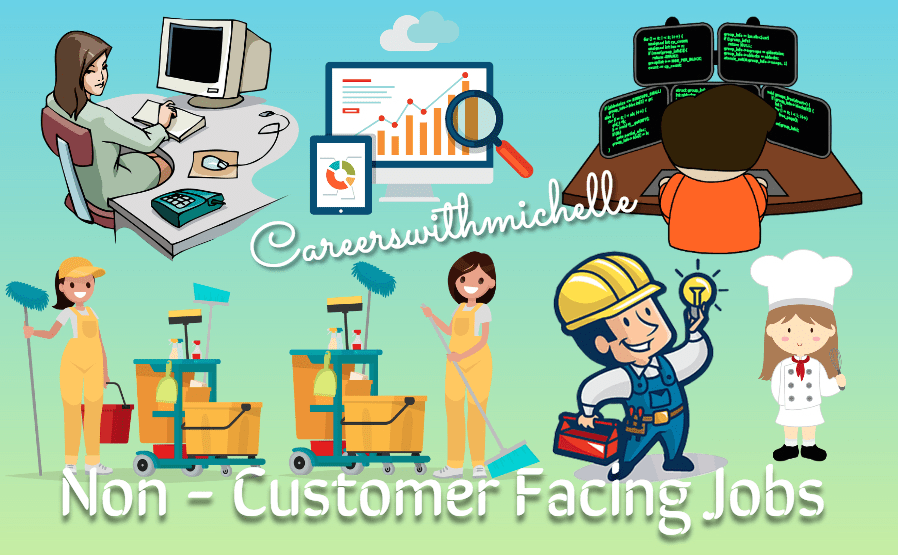
In addition, I have compiled a list of jobs and careers that do not require folks to be client facing. (Please note that all salary and educational percentages are obtained from Career One Stop and Bureau of Labor Statistics)

Data Entry Clerks – Basically, this is a very simple and straightforward kind of job. Although it’s not client facing, data entry clerks need to possess basic digital literacy skills – which requires their knowledge in spreadsheets, proficiency in typing, organization/administrative skills and word processing.
This role consists of compiling data, information or other documentation to report to their colleagues and of course ensure accuracy by checking/verifying the data for any errors. The median annual salary varies however, it typically is around $38,000-$39,000 in the NY Metropolitan Area. Over 50% of the workers in this field have a HS diploma (which is a requirement) or with some kind of college degree.
Click here to see how to build a resume focused on data entry clerk roles!

Actuary – This career requires not only a Bachelor’s degree, but they also need to pass a series of 2-3 exams in the U.S. to become a Certified Actuarial Analyst. That is their passport to landing a financial services career. The median annual salary in the NY Metropolitan Area is $130,100. Actuaries are keen in business (economics, finance, accounting), they are mathematicians (well grounded in algebra, calculus, statistics, probability) and possess strong computer skills since they need to be familiar with statistical analysis programs and many programming languages, as well as manipulating data. Now that you have an idea of their skills and competencies, actuaries combine mathematical reasoning and financial principles to help analyze financial costs of risk for their clients and businesses, and discover solutions to reduce that risk.
Click here to see a guide for those looking to pursue a career in the actuarial field!
Click here to see how to build a resume focused on actuarial science for students!
Click here to see how to build an Analyst Actuarial focused resume!

Software Developer/Engineer – They manage the systems software and applications by analyzing, developing, designing, creating and implementing software solutions. The thing about this career is that even though they build these programs for people, they do not need to talk to people while they are performing their duties. What they are engaging with is technology – the network systems, devices and programming. Typically, software developers need a Bachelor’s degree from Computer Science, Software/Computer Engineering or a related field. The median annual salary is typically around $117,680 in the NY Metropolitan Area.
Click here to see how to build a software developer/engineer focused resume!

Computer Programmer – Rather than engaging with people daily, a computer programmer will be engaging with coding languages instead. They are responsible for developing and writing computer programs/applications and assisting software developers to recoup specific data, documents and information as well designing software solutions. Computer programmers are familiar with coding, mathematics and engineering. They will need at least a Bachelor’s degree from Computer Science, Software/Computer Engineering or a related field. The median annual salary is typically around $92,100 in the NY Metropolitan Area.
Click here to see how to build an entry-level computer programmer focused resume!
Click here to see how to build an experienced computer programmer focused resume!

Janitor/Custodian/Cleaner – Obviously, this job does not require any kind of formal education and definitely not client facing needed since they are solely focused on making everything spotless, dust free and keeping everything in good condition. There are apprenticeships and certifications that they can take to pick up their skills, so that way they can prove to employers that they are competent and are able to do the job. This job is mainly based on experience and their ability to do the job, since it is labor intensive. Janitors, custodians and cleaners usually need to be able to stand for long hours since they clean everything – buildings, sweeping/mopping floors, windows, walls, doors, mowing grass, cleaning restrooms, removing snow, removing debris, etc. Depending on the employer, some might actually need to have a driver’s license since they might need to drive vehicles to other worksites. In addition, in many cases, they will need to know how to repair things, by putting on their maintenance hats. Over 60% of janitors/custodians/cleaners have a high school diploma or less. About 25% have a college degree, and those are probably students who need a job to pay off their student loans/tuition or to pay rent. The median annual salary is $34,030 in the NY Metropolitan area.
Click here to see how to build an entry-level janitorial focused resume!
Click here to see how to build a custodian focused resume!

Technical Writer – Instead of having to communicate with people, all technical writers need to do is to pivot their communication through written expression. They write about technical products. They create step-by-step guides, journal articles, instruction manuals and other electronic matters to make people’s lives easier. Almost 50% of folks in this field typically hold a Bachelor’s degree in Journalism, Corporate Communications or a relevant field specifically related to scientific writing, engineering, business, computer science, medicine. Over 30% of folks in this field hold a Master’s degree/Doctoral or other related professional degree. However, you can’t get away with just a degree. Experience is more relevant. To write about these inanimate objects, technical writers need to possess technical knowledge of how electronic equipment works, be good researchers and organized as they will need to stay up to date with new technologies and consistently compile technical information and other documentation. The median annual salary is $80,710 in the NY Metropolitan Area.
Click here to see how to build a technical writer focused resume!

Interpreter – This is for those who are bilingual, trilingual and even multilingual! If you love communicating in different languages, if you love translating and if you are sensitive to cultural differences, this could be the career for you. Interpreters are responsible for translating oral or written material from one language to another. On average, over 30% of workers in this field possess a Bachelor’s degree in Foreign Language. Interpreters and translators are very keen on the subject of the structure and subject matter of foreign language. Strong written, verbal and listening abilities are a must to do well in this role. They are also usually very knowledgeable on all aspects of the English language as it is very crucial in analyzing the rules of the framework/anatomy, grammar and pronunciation of each language. The median annual salary is $75,180 in the NY Metropolitan Area.
Click here to see how to build an interpreter focused resume!

Image Reviewer – The good thing about this job is it can be remote and done on a freelance basis! If you love photography, editing and touching up photos and approving images according to the company’s guidelines, this could serve as a good gig for you! According to Real Ways to Earn Money Online, image reviewers are responsible for evaluating the images for overall quality, technical execution, commercial suitability and adherence to the company’s acceptance standards. A popular company to work for in this role would be Shutterstock. In order to qualify, typically 2 or more years of photography experience is highly recommended. Photography careers are very dynamic, but to be very specific, if you have experience as a stock agency contributor, photo editor, portrait photographer, photojournalist/news photographer, freelance photographer or a photo researcher, you should go for it. The median annual salary is $54,845 in the U.S.
Click here to see how to build a photographer focused resume!

Film and Video Editors – If you have a creative mind for storytelling, altering motion pictures as well as synchronizing soundtracks with them, this is how they do it! Over 50% of those in this field hold a Bachelor’s degree in Film Studies. Film and video editors are very well versed with media production, electronic/broadcasting equipment and English language (to edit video & audio recordings). The median annual salary is $75,380 in the NY Metropolitan area.
Click here to see one way on how to build a video editor focused resume!
Click here to see another way on how to build a video editor focused resume!

Electricians – Instead of working with customers, electricians work with their hands. Electricians work on many electrical repair projects such as, installing street traffic lights, intercom systems repairing electrical wiring systems and control systems. They have to be knowledgeable in troubleshooting and figuring out what is causing the system/programs to not work – which says a lot about their judgment and critical thinking/decision making skills since they have to come up with quick ways to deliver a solution. Folks in this field are usually keen on tools that are associated with construction repair and mechanics – they must be familiar with the machines and tools that they are using to repair (whether it is a highway, road, street lights, etc.). Strong mathematical ability is a highly preferred skillset although not needed. A solid grasp of sums and geometry are helpful for calculating the areas/lengths for securing circuit breakers and wire installations. Algebra is also a big help for computing electrical loads and currents. About 70% of electricians hold a high school diploma/equivalent, or some kind of college degree (Associate’s & Bachelor’s). The median annual salary is $76,610 in the NY Metropolitan area.
Click here to see one way on how to build an “eye-grabbing” electrician focused resume!
Click here to see another way on how to build an electrician focused resume!

Head Chefs – If you are one of those who enjoy cooking and coming up with new recipes to showcase your creative cooking ideas, this may be the right fit for you. Plus, who doesn’t love food? Head chefs prepare ingredients and cook all kinds of meals and desserts. However, they do more than just those. They are responsible for monitoring other staff members to ensure that they are on the right track to provide customer satisfaction, and to swiftly handle any food-related issues. The median annual salary is $58,190 in the NY Metropolitan area. Over 30% of those in this field have a high school diploma or equivalent. No college degree is needed for this, however there are many vocational training schools below offered by Career One Stop that prepare others for this: