CareersWithMichelle consists of workforce related topics such as Q&A's, Career Development Resources, Job Search Tips/Strategies and Labor Market Information
Although the holiday season is the most exciting time of the year, don’t be fooled. It is also the busiest time for many people. The job market is indeed, the most active during this season.
While COVID-19 has caused considerable disruption to services for many employers, you may be thinking — Will this impact holiday hiring?
According to iCIMS’s Monthly Snapshot Report for September, “During the height of the pandemic, hiring for full-time retail roles dropped to account for only 28% of hiring activity during April and May. In August, we’re seeing an increase in the demand for full-time employees, now making up 34% of all hires—still 10 percentage points away from pre-pandemic levels.” The retail industry is going to be busy as they are in dire need of seasonal workers especially during the holiday season.
This is a good time to apply for jobs since job seekers often suspend their job search during the holidays and will be spending time with their loved ones. This often means that there is less competition for jobs however, this can also lead to missed opportunities. This also means that there will be fewer resumes to compete with, and your skills/experience may be a potential match to the employer (since many employers are STILL looking to fill their roles before the New Year).
It is completely understandable that job searching during the holidays are not meant for everyone. If you are one of the job seekers who are planning to suspend your job search for the season, you want to take this time to stay on top of your organizational skills. Revamp your resume and cover letter so that when you are back in your job hunt, you won’t have to stress over proofreading and overlooking the little details. Set yourself reminders, organize your notes/folders and prioritize your goals so that you can avoid making the same mistakes that you have previously made throughout your job search.
While it is important to spend quality time with your family and loved ones, if you are one of the job seekers who has too much free time — during your downtime, don’t forget to stay productive and continue your job search in hopes that your holiday gift will be landing a new job!
So, what if you were interviewed right before the holidays and are in the process of waiting to hear back? This is the most stressful stage for job seekers, especially for those who anticipate that they may not have gotten the job. But then, you don’t want to come off pushy. What is the best way to follow up? If you were out of the workforce for a while and want to reconnect/network, how do I approach them during the holiday season?
❄ Send Holiday Greeting Cards to Recruiters/Hiring Managers ࿏࿏Not all recruiters/hiring managers will remember you since they have met a lot of other faces as well. Be sure to include a brief reminder of who you are, your point of contact at the company. ࿏࿏ As you pick out your holiday card, please be sure that the card is appropriate and generic. ࿏࿏ Not all job seekers will invest their time and effort to do this, so this can potentially set you apart from others.
❄ Discuss About Your Employment Status / Job Search At Holiday Gatherings ࿏࿏ It is important to let your friends, family and distant relatives know that you are looking for a job. You will never know who they may know. They may know of someone who is working at your target employer. Or, they may even be an employee of your target employer. ࿏࿏ Making new connections or re-establishing old connections can actually land you a job offer even by just casually speaking to them about what you are looking for.
❄ Use This Time As a Networking Opportunity ࿏࿏ Virtual fundraisers and virtual Zoom holiday parties with friends during this time allows you to connect and mingle with many like-minded individuals that you connect you to potential jobs that you want to work at. ࿏࿏ While it is a holiday party, make sure you don’t come off as too professional and stiff. Remember, this is a time to gather and enjoy your time with friends. You do not want to come off as desperate, however you just want this topic to casually arise in the conversation.
While the trends in the industry are swiftly shifting, so will the career trends. Job seekers, if you are looking to pursue a career in the field — please refer to the chart I have created below regarding the job outlook between 2019 to 2029. Disclaimer: All information are obtained from the U.S. Bureau of Labor Statistics (I have included links for more information)
“Film and video editors and camera operators manipulate moving images that entertain or inform an audience.”
Bachelor’s Degree
– $59,810 per year – $28.76 per hour
“Overall employment of film and video editors and camera operators is projected to grow 18 percent (+12,400) from 2019 to 2029, much faster than the average for all occupations. The number of Internet-only platforms, such as streaming services, is likely to increase, along with the number of shows produced for these platforms. This growth may lead to more work for editors and camera operators.”
“Broadcast and sound engineering technicians set up, operate, and maintain the electrical equipment for media programs.”
Post-secondary non-degree award or certificate
– $45,510 per year – $21.88 per hour
“Overall employment of broadcast and sound engineering technicians is projected to grow 9 (+13,200) percent from 2019 to 2029, much faster than the average for all occupations. Growth is expected to stem from businesses, schools, and entertainment industries seeking to improve their audio and video capabilities. They will need technicians to set up, operate, and maintain equipment.”
“Editors plan, review, and revise content for publication.”
Bachelor’s Degree
– $61,370 per year – $29.50 per hour
“Employment of editors is projected to decline 7 percent (-8,700) from 2019 to 2029. Despite some job growth in online media, declines in traditional print magazines and newspapers will temper employment growth.”
“Multimedia artists and animators create images that appear to move and visual effects for various forms of media and entertainment.”
Bachelor’s Degree
– $75,270 per year – $36.19 per hour
“Employment of multimedia artists and animators is projected to grow 4 percent (+2,800) from 2019 to 2029, about as fast as the average for all occupations. Projected growth will be due to increased demand for animation and visual effects in video games, movies, and television.”
“Producers and directors create motion pictures, television shows, live theater, commercials, and other performing arts productions.”
Bachelor’s Degree
– $74,420 per year – $35.78 per hour
“Employment of producers and directors is projected to grow 10 percent (+16,000) from 2019 to 2029, much faster than the average for all occupations. Job growth in the motion picture and video industry is expected to stem from strong demand from the public for more movies and television shows, as well as an increased demand from foreign audiences for U.S.-produced films.”
“Reporters, correspondents, and broadcast news analysts inform the public about news and events.”
Bachelor’s Degree
– $46,270 per year – $22.25 per hour
“Overall employment of reporters, correspondents, and broadcast news analysts is projected to decline 11 percent (-5,800) from 2019 to 2029. Declining advertising revenue in radio, newspapers, and television will have a negative impact on employment growth for these occupations.”
“Art directors are responsible for the visual style and images in magazines, newspapers, product packaging, and movie and television productions.”
Bachelor’s Degree
– $94,220 per year – $45.30 per hour
“Employment of art directors is projected to decline 2 percent (-1,800) from 2019 to 2029. As traditional print publications lose ground to other media forms, employment of art directors is projected to decrease in the newspaper, periodical, book, and directory publishers industry.”
“Announcers present music, news, and sports and may provide commentary or interview guests.”
Educational requirements for announcers vary. Radio and television announcers typically need a bachelor’s degree in journalism, broadcasting, or communications, along with other experience gained from internships or working at their college radio or television station. Public address announcers typically need a high school diploma with some short-term on-the-job training.
– $39,790 per year – $19.13 per hour
Overall employment of announcers is projected to grow 1 percent (+700) from 2019 to 2029, slower than the average for all occupations.
“Interpreters and translators convert information from one language into another language.”
Bachelor’s Degree
– $51,830 per year – $24.92 per hour
“Employment of interpreters and translators is projected to grow 20 percent (+15,500) from 2019 to 2029, much faster than the average for all occupations. Globalization and large increases in the number of non-English-speaking people in the United States will drive employment growth. Job prospects should be best for those who have professional certification.”
“Public relations specialists create and maintain a favorable public image for the organization they represent.”
Bachelor’s Degree
– $61,150 per year – $29.40 per hour
“Employment of public relations specialists is projected to grow 7 percent (+19,700) from 2019 to 2029, faster than the average for all occupations. The need for organizations to maintain their public image will continue to drive employment growth. Candidates can expect strong competition for jobs at advertising and public relations firms and organizations with large media exposure.”
“Technical writers prepare instruction manuals, how-to guides, journal articles, and other supporting documents to communicate complex and technical information more easily.”
Bachelor’s Degree
– $72,850 per year – $35.03 per hour
“Employment of technical writers is projected to grow 7 percent (+4,300) from 2019 to 2029, faster than the average for all occupations. Employment growth will be driven by the continuing expansion of scientific and technical products. An increase in Web-based product support should also increase demand for technical writers. Job opportunities, especially for applicants with technical skills, are expected to be good.”
via U.S. Bureau Labor of Statistic’s Occupational Handbook
Below I have asked a recruiting professional to provide some insight and updates about the media and entertainment industry as of today. Danny Gonzalez has been in the Recruiting industry since 2016. He started his recruiting career at Univision, a broadcast media company, where he has recruited for several roles within the business, i.e. Accounting, Finance, Public Relations, Sales, etc. He continued on with his experience and talent atJP Morgan Chase & Co., Morgan Stanley,Amazon Web Services,LiveRamp and CyraCom.
Feel free to connect with Danny afterwards on LinkedIn.
Michelle: What does the future of the Media and Entertainment Industry look like in a post-pandemic world?
Danny: From a half glass full standpoint and depending on which services are being provided; both good and bad. Whether you are a TikTok influencer or a company like Netflix, the script has been flipped. Nielsen, a known and reliable resource for media giants, announced their plan to combine traditional and digital TV ratings, to accurately reflect a world in which audiences are watching TV both live and on-demand, across a variety of different streaming services and devices. I anticipate Marketing to be a very demanding profession in the next coming years.
Michelle: Many aspects of this industry heavily hinged on physical attendance to produce profits – such as sports arenas, concerts and movie theaters. But because of COVID-19, it has imposed restrictions on public gatherings. How will this affect their services?
Danny: Great question! It is true that these type of services that rely heavily on physical attendance, i.e. movie theaters. AMC took a huge hit and is still suffering from this, however, another company like Universal, are striking while the iron is hot. For example, their digital marketing has picked up through social media, and are inclined to the option to share their movies-on-demand. Streaming Services, i.e. Netflix, Hulu, HBO Max more than ever are bringing in exclusive movies that you can only watch through their services. Most notably, Wonder Woman 1984 will be going straight to HBO Max with fans excited about this.
Michelle: What are the pros and cons of media shifting fully virtual?
Danny:
Pros — On-demand and access mean exactly that. No longer the need to wait in queues or tickets being sold out for events.
Cons — While the price of a movie ticket may be on the high side, as a consumer, is the trade-off worth paying the same price to watch at home? There are certain experiences that are worth in-person vs. digitally.
Michelle: On the bright side, the digital takeover makes a positive impact for consumers who are still committed to their TVs and online shows. Today, many consumers are viewing, sharing and listening to more online content and with COVID-19, it is forcing those who don’t use technology, to use technology. Do you think artificial intelligence and automated jobs will take over many existing jobs in the industry?
Danny: This has always been the thought/concern for several years now, however, it will take some time before we get there. In any event, I recommend folks to brush up on their communications skills now more than ever and see which tools are and have been the most efficient and effective, i.e. e-mail, phone, conferencing platforms, and whether to go with audio only or audio and visual.
Michelle: Where do you see opportunities for advancement/growth for this industry moving forward?
Danny: Personally, the opportunities that I see for advancement/growth in this industry moving forward are in —
Digital Marketing
Customer Service
Conferencing Platforms
Michelle: What is your advice for those who are interested in pursuing a career in the industry?
Danny: I totally encourage it!! In fact, there is a great organization, T. Howard Foundation, whose mission is to promote diversity in media and entertainment for underrepresented groups and underserved communities within the media and entertainment industry. Check them out! I have personally engaged with the T. Howard Foundation and some of my family members and friends have secured job placements through T. Howard. Good luck!!!
Emily Chan is a Talent Sourcer for Engineering and Operations at Microsoft. In Emily’s role, she pipelines top engineering talent through various online sourcing methods (her favorite one being LinkedIn) and find these candidates a home at Microsoft.
During her free time, you can find Emily drinking coffee, buying (too many) plants, and working on a passion project called Sparkline! Sparkline (formerly CEO Mindsets) is an initiative that focuses on empowering students to secure their dream jobs and internships through practical resume, interview, and networking tips. Recently, they have been hosting different workshops on personal branding, LinkedIn, etc. at different colleges and it’s really great to have the opportunity to interact with their audience.
Sparkline is looking forward to expanding their reach to more colleges in the new year! If you’re interested in collaborating with them, feel free to reach out at hello@sparklineco.com and they’ll work together to bring your idea to life!
Emily Chan (Talent Sourcer for Engineering and Operations at Microsoft)
Now, we will delve deeper into the Q&A below where I have asked Emily to provide her input for those who are looking to pursue a career in tech or those who are interested in heading into tech. Emily is excited to share a bit about the tech industry and offer some insight for those who are interested in breaking into this dynamic industry!
※ What are the kinds of careers that Microsoft offers for those who are interested in applying for a tech role there? What are the specific digital skills needed?
Microsoft offers a lot of different kinds of careers in tech – some examples are software engineering, mechanical engineering, hardware engineering, etc. You name it, Microsoft probably has a role. I specifically focus on recruiting for software engineers. In terms of skills needed for it, most of my roles require working knowledge of an object-oriented language like Java, C++, or C# and experience working with highly available and scalable distributed systems. There aren’t too many hard requirements because we recognize everyone has a different story and we want to focus on hiring engineers with a growth mindset and good potential!
※ Last month, Microsoft announced that they want to help create millions of tech jobs in the UK. How do you think this will help shape the industry?
This is an amazing initiative that will not only boost the tech industry, but help the UK’s economy as well. Technology is the future and businesses will only be able to sustain themselves if they include tech in their business strategies. This initiative will not only help expand and accelerate the path into the tech industry but will also aid in creating a more diverse talent pipeline in tech.
※ Is training offered for those who are looking to pivot their career direction or those with zero experience in tech?
Although Microsoft offers extensive training for new employees to learn our tech stack, we do expect candidates to know the fundamentals of computer science and to have some experience working in tech.
If you are a recent graduate with no experience in tech, I encourage you to apply to our amazing internship programs! That’ll help you get your foot in the door for full time opportunities.
If you’re in the middle of your career looking to switch into tech, I recommend either 1) going back to school to learn the basic fundamentals of computer science and then applying for our internships/full time roles or 2) taking a coding boot camp and gaining some industry experience at smaller tech companies before applying to Microsoft.
※ How do you get your foot in the door?
Network, network, network! LinkedIn is a great place to get in touch with people working at your dream companies. Do some research about them and reach out for a coffee chat to learn more about them, the role, and the company. Build and maintain that relationship and more often than not, they’ll be happy to give you a referral.
One disclaimer I want to make for this is that you want to make sure you meet all the basic qualifications first! If you don’t, you can network all you want, but it’ll be very hard to land the role. This is because those are the basic skills you need to succeed in that role and companies are not going to bring a candidate into situations where they won’t succeed.
※ What should a job seeker be aware of when working at a tech company?
Be comfortable with ambiguity and be able to adapt quickly. Things are always changing whether it be a customer requirement or a new technology.
※ How does the job market look currently for tech?
More now than ever, the tech space is growing at an increasingly fast rate. Especially with the pandemic, everything has shifted to virtual and people are relying more and more on tech. Companies are working on innovative products to adjust to the modern workplace and modern society so there is such a high demand for good engineers in the tech industry. It’s a really exciting time to be in this space!
※ Technology is one of the top growing industries currently. How much has it grown compared to pre-pandemic? What are the most in-demand careers and skills right now?
As I discussed earlier, tech is in demand now more than ever. Everything is virtual now and even after the world goes back to “normal,” a lot of things will remain virtual.
I can’t speak for different companies since the tech stack varies, but overall, Microsoft looks for working knowledge of an object-oriented programming language and industry experience with highly available and scalable distributed systems.
Eight months later, we are still at the peak of the COVID-19 pandemic. Job seekers WILL appreciate the opportunity to hear the much needed feedback on their interviewing skills. It is certain that there are questions that job seekers had since the start of the pandemic, that they awaiting for. This is a good time for interviewers to schedule a virtual interview using platforms like Zoom, Google Meet, Cisco Webex, especially career experts and coaches to patiently and holistically give job seekers their answer and provide them with insight on the job prospects.
You have another person (such as a career expert) who can give you so much insights on how to answer behavioral or situational questions, how to outline your strengths/weaknesses by providing some good examples and key takeaways, how to be more structured in your answers, etc. You can use those tools and their constructive feedback to practice on — before going on your actual interviews, such as telling good examples or stories with answers and telling stories in a concise and easy way to digest.
Job seekers will be able to gain more perspective on what they had initially perceived as impediments, such as their employment gaps and lack of professional experience. With the interviewer’s feedback, not only will the job seeker be able to gain more confidence with what experience he/she already had, but he/she will also have a better understanding on how to present their strengths (plural here!) and weaknesses.
You can always practice with a professional (like a career coach or a friend/family member who is very well rounded with the interview processes) who is great at giving constructive feedback that’s also actionable! Job seekers would appreciate this as they would love to hear more of the in-depth perspective from their interviewer’s side on why some of their answers weren’t as successful. One of the areas that interviewees often get stuck on is where specifically they can pull back or delve deeper into… and this depends on the type of questions they are asked and how they formulate their answers.
Job seekers will find it very helpful in their answers to questions where they lack confidence in themselves. They will most definitely use their interviewer’s ideas going forward in their job search. (Note to interviewer: Make sure your input is valuable and gives meaning to the job seeker!)
Obviously, mock interviews offer job seekers/interviewees this opportunity to practice with their interview skills. It is definitely going to be a wonderful/life changing experience for them to learn more about the things that they should be doing and not be doing in the actual interviews. When they have someone to practice with, it allows interviewers to catch things and point out mistakes that the job seekers did not catch or notice — and this is where their suggestions come in handy for the job seeker’s interview and resume. And this begins with the interviewer’s patience in answering all of the interviewee’s questions and concerns to set them up for success.
Many job seekers need that guidance and help with acing their actual interviews! To make it as informative and helpful as possible to the job seeker, interviewers should take their time to explain where the interviewee did well, where he/she needed to improve, and provide some examples/situations of how to handle certain interview questions.
Mock interviews allow job seekers to learn something and walk away with new knowledge and tools to use for their future interviews (for example, they may learn a new way of answering questions when it comes to identifying a problem and being able to articulate how they solved it). In a nutshell, job seekers will gain that valuable experience which felt “real”. More importantly, it should help the interviewee self-reflect. Not only does it help improve the way the interviewees answer questions or ask questions, however it will allow the interviewer to provide excellent critique of their resumes and body language, as well as tone. This will certainly help job seekers with future prospects, boost their confidence/speech as it will allow them to prepare more professionally.
How do you know when you are in good shape to make a case for your candidacy with employers?
You’re thoughtful and well spoken about your experiences and skills.
You’re creative and solution-oriented and offered a great example of such an instance.
You’re succinct and articulate in framing your experiences.
You prepared a number of stories and situations from your previous experience to concisely demonstrate skills and capabilities that the interviewers will be looking for.
You developed a strong pitch outlining how your experiences and strengths match the role’s job description.
You did a wonderful job in walking through your past work experiences in showing concrete and numeric examples of how you succeeded by training your storytelling muscle, as well as getting into the nitty-gritty of your projects.
You focused not only on your soft skills, but you strongly infused your responses for your hard skills/technical abilities.
You discussed about your strengths and weaknesses.
Suggestions on how to be more ready and how you can improve:
When describing these scenarios to your interviewer during the mock interview, you could definitely insert just a touch of levity to the story so that it would resonate that much more with the prospective audience.
If applicable, you can emphasize your past leadership experiences more, where you have led teams. This is a hard to come by skill and you have one or more instances that you can speak to. Be more assertive in announcing this experience. If you add more humility, you could advocate more for yourself by calling this out. You can also highlight your listening skills as having developed when you were leading teams, but also highlight that team leadership.
When providing examples from your past experience/s, you should outline the challenge or problem that you have faced, and then key levers that you used to resolve it. This framework will help the interviewer understand the situation from the outset and ensure the main points are lost in the story.
With more preparation, you can select examples that better demonstrate the challenges that you have previously faced and how you overcame them.
For example, managing deadlines. This example can be shaped to show the actions that you implemented and how you established visual tracking of work to confirm on time completion rather than focusing on frustration at missed deadlines.
Show that confidence when providing examples of your experiences. You can practice to be more confident, and show that — that you own your attractive skill set to prospective employers.
An example can be, how you conducted data analysis. Expand on it by highlighting your achievements and accomplishments, and not just mentioning what you did.
Sometimes job seekers may dilute these examples or apologize to their interviewer for lack of complexity, however you should remain confident in your experiences and present them as such.
You may have great experiences and past roles that position you well for upcoming interviews, but you will need to refine the way you deliver the examples to better demonstrate why you are the best candidate for the role.
Example: You may have experience on building pages during your tenure at Deloitte, but this example can be enhanced to demonstrate your executive communication development and experience, your ability to summarize complex issues as well as outcomes from your analysis and modeling.
Using the STAR Method could help you build your base and hit home on the results of your past work experiences/projects.
Tying this in with the concrete and numerical examples into your responses for the behavioral questions, could really drive home your skills and successes.
Have you been laid off, permanently furloughed or looking to pivot into a new career in 2020? You may want to consider a career in cable because Spectrum is always looking to building a bright future in spite of change. They build it with their products and services, however they can’t build them unless they have people like you.
Below are Q&A’s that a recruiter has answered on behalf of the job seekers.
Suppose you come in as a Customer Service Representative, with minimal experience from at least 6 months to 1 year. If you are looking to go into another department, do you offer training for that? ⦾ In fact, the customer service job posting only says you need 6 months of experience working with customers. It didn’t have to be from a call center and you don’t need to have a tech background. Once you go onboard, and generally after 6 months you go on an internal career progression. ⦾ There will be courses that you are required to take to move up. For example, in customer service – there are 4 levels of customer service. During your tenure, you do get merit increases but your bigger jumps in pay come as you complete the industry courses that we pay for and have you assigned to, so it’s really up to you where you go. ⦾ The key here is, once you get to Customer Service Level 4, that’s where you can start applying for let’s say a Floor Coach — which is lower than a Supervisor or you can decide whether you want to move over to the Quality Assurance Department, another department — but those are not internal progression roles. So for folks that are in the Customer Service Level 2 for two years, the company doesn’t prevent you from applying for a Supervisor — but in many cases, those who applied for the role, have already completed Customer Service Level 4, they’ve finished all their courses, and they’ve already moved over to Quality Assurance or something like that … so your internal competition tends to be as strong as you coming in externally, because you are competing with everybody who has the same and higher skills. –
What percentage of Spectrum jobs require a college degree? ⦾ I will not be able to give you a specific percentage however, I’ve went through the number of departments I’ve been in — Sales, Customer Service, IT, Engineering, Field Operations, etc., but in all of those I can only recall where it’s a Manager or Director role where a degree is required. ⦾ Most of the other departments will say that they prefer an Associate’s or Higher, except for the Entry-Level roles. In their case, they prefer a GED or higher. ⦾ But remember, “prefer” doesn’t mean you can get the role without it because they will appear on every job you look on the website. It will either say “A degree is required” OR “With a degree OR equivalent experience”. ⦾ By enlarge, most people aren’t bringing in a degree when it’s lower than a manager or director. They’re bringing some technical certifications with them, they’re bringing a high school diploma/some college, because we are focused to train you ourselves. We’ve got so many courses that we want you to take, that the department offers. You’ll be trained to become an industry expert sometime within the first 5 years. –
Does the Spectrum Careers page indicate the salary range? ⦾ No they don’t. However, I suggest that you check O*NET OnLine because Spectrum is a federal contractor and our jobs are linked to that website. So if you see a job title, let’s say 70,000 technicians and you see that their average salary is $30,000 a year. It gives you an idea. –
I come from a Graphic Design background and I want to go into a career change — possibly heading towards becoming a future technician? Are there any trainings that Spectrum offers? ⦾ Yes and no. If you’re going for a different career, there’s going to be some minimum qualifications there. You will hear that you can create a Functional Resume that focuses on your career skills as opposed as to where you work. ⦾ Look at the job description as it’s posted and you’ll see all the skills on that job description that you know that you can do. ⦾ Once you craft that resume, you can show those skills and how long you’ve used them. And your work history will be on the bottom. ⦾ Once you upload that resume, the recruiter will go through that folder and the system will flag you (to have your resume looked at) because you have the skills that the job has posted. That is how you get your foot in the door, I’ll be straightforward as a recruiter; we are required to look at every single resume. We have to interview those who are the most qualified first. ⦾ Once you have those crossover skills that you have listed on your resume, it will increase your chances of getting noticed and that phone call for the interview since you are showing them that you can bring that talent, those skills, those tools to the table. ⦾ You will then fall into the range of 1-100 of being the most qualified because you are still competing with how many people applied to that position — how much experience and skills they have. There’s a little bit of luck in terms of changing roles as well. –
Are there any trading schools for skills training related to what Spectrum is looking for in Field Tech? For example, if I want to become a low voltage technician? ⦾ Absolutely. Thankfully, there is the Workforce Investment Act that is funneled through the U.S. Department of Labor and the Workforce 1 stations where you can get training for those specific skills. You are capitalizing on what the federal government has already put in place. ⦾ So when we post a job for a technician, I’m going to be looking for someone who has about 6 months of technical experience where we typically find folks in that minimum range who graduated from APEX Technical School. Let me be specific. So a person who has graduated with a certification in low voltage from APEX Technical which is a 900 hour course, they may come in as Tech Level 1 if they have no other technical experience. But they are still considered because they have the minimum experience. So we interview that person. Again, don’t forget — it depends how many jobs that are there and how many people that applied at the same time. But I am the one who usually call those candidates myself — to bring folks in from Tech Level 1 so by the time they are in Tech Level 5, we train them up from the beginning. Generally, it would be $17.50 for this role. ⦾ However, if a person graduates with their Network+ certification, that’s going to start at $26.50 since they will come in as Tech Level 4. Now, you would have made a difference of starting at $17.50 an hour to $26.50 an hour — just by doing that on your own. We also pay for the courses. However, if you paid for them yourself you will now just start at a higher level. –
If I do not have any experience. Will any trade school experience be credited? Are low voltage cable installer courses helpful? ⦾ APEX Technical, Comptia Network+, Comptia A+ Certifications, NEW (Non-Traditional Employment for Women), BICSI – are all certificate programs / providers we like to interview for the entry-level Field Tech. They will come in with only their Technical training cert between $17-$26.50 (depending on several variables). ⦾ Workforce Investment Act will pay for many of the training programs on your behalf through a Workforce 1 Center and their “training voucher” program. Stop by your WF1 office for details. –
How much of a hindrance would something like a very long period of unemployment be in getting hired? No one would hire me because I have been unemployed for a while and my unemployment just keeps getting longer and longer because of this. It’s a vicious cycle. ⦾ It is, and I understand that 100 percent. Good thing I will tell here is, that answer will vary depending on what company you go to – but as of 2013, you might see on our website – that we do not discriminate against anyone based on their employment history. ⦾ Now, it’s not uncommon for people to be a Director and they’re applying for an entry-level role. Many employers will say they would be overqualified. However, Spectrum doesn’t do that. ⦾ Some of them who are out of the workforce for 4 or 5 years, many employers would say they are unreliable. Spectrum doesn’t do that. We only go based on the job description and your qualifications. ⦾ So if you apply for something within Spectrum that you’ve done or did in the past, you will get a call. You just have to be ready to perform and bring up those skills in you. You wouldn’t get declined based on your length of unemployment. You will get the offer or not, based on how you perform on the interview. –
I saw a Customer Service position in a Spectrum store. Are they salary based or just commission based? ⦾ The Retail Store / Cable Store rep has both part time openings and full time openings. There are two types of roles. ⦾ One is a Customer Experience Rep – that will be the title when it’s posted. It’s entry level and is wage based. No sales. You might also see it posted from time to time as a “store greeter”. ⦾ The Retail Store Rep is the other (so titled; in some areas of the country its called simply “Cable Store Rep”. NYC its called “Retail Store Rep”. This is also hourly wage. No upselling is a requirement for the role, however, should you upsell and close the sale, you would get commission on the upsell. So, in this case it’s “base + Commission” in practice, but technically, its just hourly wage. –
Will AI automation take over all customer service jobs? I always prefer people to people. ⦾ Great question! And your suggest of preferring “people to people” indicates there will be in person service reps for the foreseeable future for us. ⦾ Remember, Spectrum needs customers to be able to connect with their services and with the company in a way that best benefits the customer experience. ⦾ A number for customers are not tech savvy and still mail letters at the post office, and some are “customer service savvy” and would rather not wait in line for a chat or a phone call, so its easier for them to just go into the store, since they know that will be the solution to their problem anyway. And some are very Tech saavy, and would not want to speak with anyone in person, or via phone – they get their need met via chat only. ⦾ So for now, Spectrum Stores and store associates are an important part of the Charter organization. Additionally, we have the Customer Help Desk who uses both phone and Chat to manage customer needs. ⦾ Spectrum Store employees help the Sales & Marketing organization drive sales, retain customers and provide personal interaction and knowledge through exceptional customer service. With more than 3,500 retail employees and nearly 700 stores nationwide, Charter has more locations than many top retailers. To find a Spectrum Store near you, click here. You can also find some details on Cable Store Reps. ⦾ That said, while Call Center, and Cable Stores and the in-person experience are an essential customer link for us right now, as noted in the presentation, the future changes due to changes in consumer tastes and interests. For sure we will anticipate the change, and adapt to it as need dictates in order to relevant. –
Will they train and field technical without any background experience? ⦾ It’s not out of the question; and it has been done frequently in the past. However, the key factor here is how many spots do we have open when you apply. ⦾ Let’s say we have 100 Field Tech spots available. We fill 80 of them with people with some experience. If we still have open spots and no new candidates with experience apply, then, the hiring managers start to look at “cross-over skills”… that is what OTHER skills do you bring as shown on your resume? Does your resume show a history of consistently sticking to your goals; do you stay on jobs for a long time or short; during the interview, did you come across as teachable and focused on success, or “just need a job” attitude. ⦾ So, technically, the answer is YES, but in practice, usually we don’t post so many Techs spots that we run out of candidates with “some” experience. –
What if someone has over 20 years experience in customer service not call center experience? ⦾ That’s a win-win for us – depends how it works for you. ⦾ The customer Service – Video Repair rep is hourly pay; no commission or sales. It currently pays $20/hr. ⦾ If you have 20+ years in customer service, customer account management, resolving customer concerns. You’ll do well on the interview. ⦾ But, there is a computerized assessment you would have to first pass to get the interview. The test is designed to answer the question, “Has this applicant the aptitude and / or experience to work in a call center?” ⦾ If you’ve worked in a call center (like 311, Geico, Telemarketing, Survey Center), for certain you’ll pass the assessment based on your experience alone – but if you’ve never worked in a call center but have the aptitude for it, you’ll still pass the assessment. But, if that really just isn’t your thing, for sure you wouldn’t pass the assessment – then, the system will notify you your application will not be moved forward. ⦾ If all of those factors work for you, then, you should give it a try and apply. –
Is Spectrum currently hiring for interns in marketing/communications? If so, how much training is provided to assist new hires? ⦾ Yes and no. ⦾ We have an annual internship program across the country. The internships post the first week of February, and interns are selected for the summer internship by May. They start their paid internships in June and continue until the middle of august. This year’s internship ended on Friday, August 14th, 2020. We did have Marketing interns this year. ⦾ However, how the program works, is, in December, each department that WANTS to have an intern will submit the request for an intern at that time (to ensure it gets costed into the budget for the next year.) ⦾ Then, when budget review is complete, those departments whose budget allowed for an intern will then send a request to the Talent Acquisition department to secure an intern for the program. ⦾ So, while its very usual to have Marketing interns each year, it’s not ALWAYS the case, and we don’t actually know yet what departments will request interns. So, best bet is to wait till February, then visit the website and search for the word INTERN. All internship roles will be posted. Apply to the one you meet the job requirement. (Generally, there is a lot of competition because very little experience is required – instead they are looking at educational goals, volunteer experiences, what you major currently is in school… that sort of thing. Obviously having some prior experience related to the Major will be a plus). ⦾ The only other option is Spectrum Networks usually has a 1 year internship. But, its not paid. You work in the Broadcast media division for 1 year as an apprentice – kind of, I should say. Then, a job full time job is offered to you after you graduate in the department you’ve been working in. It’s a lot of work, and not everyone’s cup of tea. But, it can work for the right person. It will also post usually in February when they have it. ⦾ In either case, though, training is part of the internship – its designed to give you real work experience in a role / department related to your degree. –
What the hourly rate are for Customer Service Representative? How many hours per can you work? What are times for work schedule? ⦾ If you apply to the NYC locations for example, the CSR is $18.50/hr base pay + $0.75 for Night Differential base on shift ⦾ Current Training Schedule Six (6) weeks ⦾ 100% attendance mandatory ⦾ TUESDAY – SATURDAY 10:00 a.m. to 7:00 p.m. ⦾ After Training Work Shift: 1:00 pm – 10:00 pm (anticipate having this shift for at least 6 months or more before having a chance to change shifts.) | (Two consecutive weekdays off, will be required to work Saturday & Sunday as part of the work schedule and most holidays) ⦾ Normally a 40 hr work week; but overtime is available at times. Generally, floor leadership will seek volunteers for overtime and Exceptional Employees sign themselves up for it. –
How should I apply & what are recruiters exactly looking for on resume or cover letter? ⦾ Apply here: General job applications are found at the website : jobs.spectrum.com. Once they apply, they can let you and I know, and I’ll take a look and offer advice or make connections deemed appropriate. ⦾ In general, a good resume must have : 1) Contact Section 2) Chronological Experience Section (covering at least the last 7 years), and 3) Education / Additional Skills, Certifications section
a. I advise to read the job description first. Each job will have a section that shows “required qualifications/skills” and possibly a “preferred qualifications” section as well.
b. The Resume MUST list how your job experience matched those hiring manager requested skills and experiences. (other sections will include education and training as well.)
c. Remember to list accomplishments as well on your resume – they should tell us
i. What you did
ii. How well you did it
iii. Its impact on the business / project
So, the resume is the first chance the hiring manager gets to see if you can perform the duties of the role. Use it as your marketing tool to highlight how you’ve done what they’re requesting.
Around mid-March when the NYC lockdown happened due to the highest cases, subway riders have descended rapidly to over 90 percent. As the phases slowly reopened in the recent months, subway riders still remained below 70 percent compared to pre-pandemic. Road traffic, including the tunnel and bridges have plummeted significantly throughout the months.
MTA service reduction and layoffs are all dependent on the federal government’s funding and the economic activity across the New York County. The MTA is expected to lay off at least more than 9000 workers if they do not receive any significant amount of funding because they need $12 billion in federal emergency funds to keep the system running as is.
“MTA officials have asked Congress to cough up $12 billion in federal aid by the end of 2021 to stay afloat.”
“The MTA has been asking for a bailout from the federal government. It did receive $4 billion in stimulus funds, but for the additional $12 billion to be approved it would likely need to pass through the Senate.”
“Some of the other cuts will reportedly include laying off more than 8,200 workers on subway and buses… and more than 1,100 Metro-North and LIRR employees.”
“Some weekend service would be slashed entirely while weekday train schedules would be cut by about 40%.”
“Fare hikes are also a possibility. In August, transit officials said a Metro-Card swipe could go up from $2.75 to $3.75.”
“The MTA received $4 billion from the federal government earlier this year but has asked for an additional $12 billion. It is uncertain whether additional money for transit assistance will be included in future COVID-19 stimulus bills.”
“Motorists and mass transit riders in New York are already facing fare and toll increases next year. Tolls and fares are planned to increase 4 percent in both years, New York State Comptroller Thomas DiNapoli said earlier this month.”
“The board is considering a number of options to raise fares on buses, subways, the LIRR and Metro-North by 4%. Tolls could go up as much as 8% or $6.70.”
“The projected fare and toll increases would raise $145 million in 2021 and rise to $650 million by 2024, according to the report.”
“Even if normal ridership returns by 2023, the MTA still projects budget deficits totaling more than $19 billion through 2024, according to DiNapoli’s report. Included in that is a projected $6.3 billion deficit in 2021, which would be more than 50 percent of total revenues. The report called the gaps ‘historic in nature.'”
“‘Increased cleaning and disinfecting of the subway, rail and bus systems — which has included the rare step of closing subways overnight — is costing the MTA about $1 billion in unplanned expenses,’ DiNapoli said. He didn’t have an estimate for how much the MTA is saving by the overnight closures, but said any savings are likely being offset by the costs of cleaning.”
There are 25 million Americans unemployed to this day. On the other hand, 12 million Americans are set to lose unemployment on late December 2020. There are tough days for folks ahead of time.
For those who just secured a new job during COVID-19, many prefer working full-time rather than part-time because they want to make a decent amount of income to pay off their bills, rent, mortgage, etc.
If you are a new hire for retail employers like CVS, Duane Reade, Starbucks, TJ Maxx, Wholefoods or Target, you may be wondering why you are only getting part-time hours (20 hours per week) when you thought that it would be a full-time schedule (because you applied for a Full-Time position), and at a minimum wage of $15 per hour.
Instead of being disappointed that you are only a part-time employee or thinking about quitting to look for another full-time job, you want to take this moment to appreciate the job that you have because many individuals are laid off with no jobs, individuals are being ghosted by recruiters after 10 interviews and there are individuals that are on the verge of homelessness, while they are still struggling to find jobs.
First, unfortunately Sales Associates and Team Members always start off as part-time employees (especially if it isn’t during the holiday season) with the opportunity for periodic full-time hours or promotion to full-time employees based on performance. On top of that, you must understand that during this unprecedented time — many employee hours and pay are being cut as well.
In the first month, sometimes new hires work less than 20 hours because supervisors are still trying to place them into the existing schedule.
Second, Black Friday and Christmas is right around the corner which means that the holidays are upon us. Therefore, it is suspected that most staff will be getting more hours over the coming weeks so long as business picks up for the retailer.
Lastly, it is recommended that you should bring this goal up with your Team Lead, Department Supervisor or the Captain/Store Manager. You could start by stating that you are enjoying the work, happy to be part of the team, and interested in additional responsibilities. You can then follow up with questions such as:
“Can I cover or pick up additional shifts?”
Picking up shifts from co-workers requires and allows you to develop relationships at work.
“I noticed that X can be solved with Y, can I take on that project with additional hours?”
Asking supervisors at the end of a shift if they need support tomorrow or the next day shows that you are taking ownership and asking them to give you the opportunity to make smart decisions on your own instead of relying on them.
“I noticed that X shift is one that is difficult to schedule, can I step up and add that to my workload?”
Providing your phone number to a scheduling supervisor, letting them know that you are available to pick up shifts will tell them that you have an open schedule.
It is all about open communication and relationship building. Increased trust and dependability leads to more hours.
Zoé Kellerhals-Madussi, the President of Sales and Marketing at LG Fairmont, was raised and educated in France, Switzerland, Italy and the United States, lending a multi-cultural and linguistic perspective to her client skills. With a degree in corporate communications and a specialization in luxury marketing, Zoé previously worked in marketing high end commercial real estate.
Leah Azizian, the Head of Business Development & Project Feasibility at the Developments Division at LG Fairmont, has recently launched a podcast called, “Real Estate Untapped” which is available on Spotify and Apple, featuring both conversations with other people both in and out of the real estate industry.
This podcast is definitely a humbling experience for those who are thinking about going into the real estate field or would want to learn more and her first quick episode speaks about why Leah joined the industry and what real estate means to her.
Below, I have interviewed LEFT:Leah Azizian(Head of Business Development & Project Feasibility at the Developments Division at LG Fairmont) RIGHT:Zoé Kellerhals-Madussi(President of Sales & Marketing at LG Fairmont) to get their input regarding the hiring process/timeline
Please note that Leah is providing insight to prospective agents, or those seeking to join the industry, while Zoé is providing insight from the brokerage’s perspective.
What are the basic and real requirements to get into real estate?
For someone who is unsure about where to begin in real estate, what would your advice be for him/her?
Leah — I’ve noticed over time that some people are interested in achieving a particular role (for example: becoming a developer, or real estate attorney), but still consider obtaining a real estate license first and becoming an agent in order to understand the fundamentals. While I can understand the thought process behind this, I usually advise against this. I believe that if you have a certain vision in mind, it’s best to connect with people who hold the position closest to what you are seeking. This way you’ll get the most clarity as to whether the vision you have for yourself is worth following through with.
For someone who is interested in becoming a real estate sales agent, how do they begin this process?
Leah — Once you have obtained your license, it’s time to choose a brokerage to associate yourself with. I generally advise to begin speaking with different brokers and/or brokerages before you officially obtain your license in order to get the wheel rolling. Make sure you take the time in every meeting to ask the right questions to understand the brokerage’s vision, team culture, and what’s expected of you. You can find a list of important questions here.
Is there room for advancement/professional growth?
Leah — Real estate agents by nature are independent contractors, and essentially work for themselves. So “professional growth” is defined as something else in the real estate field. It generally correlates more directly to personal career growth, than growth within the company. This can be seen with the type of clients you work with (for ex: progressing a higher end clientele), or the type of projects you choose to work on. A fair share of agents also choose to advance their career by partnering with the right agent or broker to establish a team together, and produce greater sales volume. However, depending on the brokerage you associate yourself with, there may be room for you to advance in helping the brokerage grow as a whole; this is usually most prevalent amongst younger firms that are still expanding.
Is training provided for an unlicensed realtor?
Leah — Generally, brokerages won’t associate you into their firm or provide training until you’re licensed. Once you are licensed though, it’s good to keep in mind that the level of training that each brokerage provides differs. Some will hold the hands of beginning agents more and provide extensive hours of training, while others will keep it to the basic necessities and encourage you to learn through experience.
What kind of attitude would an ideal candidate possess?
Zoé — At LG Fairmont, we seek a few attributes when hiring agents. Because the barrier of entry is so low in this industry, it is difficult to figure out who could be a good candidate based on their resume. Rather, character weighs in strongly. Because we are a small group, it is important that any new member is someone who we see will not only fit in but be an asset to the firm. The personality trait we seek is an entrepreneurial mindset. If you are someone who is willing to get your feet wet and do what it takes to become successful, you will fit in properly. Curiosity also goes hand in hand with that. Because real estate agents are independent contractors, they must be capable of asking questions at all times to learn the most possible. If you are not curious and you are not a go-getter, you will not be successful in this industry.
What are the challenges that they will face in the industry?
Zoé — The biggest challenge in this industry is the lack of stability. There are constant ups and downs. Mostly, you will do this on your own. No matter what firm you join, if you don’t understand the importance of proactively seeking a circle of allies, you will be on your own. The lack of stability will make you a very strong person but it will also create moments where you need to step out and breathe. I believe one of the most important roles I provide as President of Sales and Marketing is to consistently find better ways to tackle that lack of stability. That is the biggest role of a brokerage: to tackle the instability and create a support system that will be reflected in your pipeline. The busier you are, the more stability you create.
What sets LG Fairmont apart?
Zoé — Let’s be honest: every brokerage offers similar services. Many times, clients believe that because you are an agent from a firm they recognize, the agent will be better. This is the power of marketing. It does not reflect the truth though. Agents that do not offer great services can be found anywhere. Fantastic agents can also be found across the industry. As I mentioned before, what we are constantly seeking to improve at LG Fairmont is how to help agents create stability and successful careers. This includes leads, a fair and open split system, a management team that is always there to help, marketing, and a boutique atmosphere. We also do not believe in upfront costs for agents so you do not pay a desk fee with us.
Real estate agents have to put on multiple hats. How do they get all of this work done?
Leah — Being an independent contractor provides you with a certain liberty that other career paths don’t, but it can be easy to get caught up in the moment and work on tasks that either won’t monetize well or provide you with long term value. It’s important to train yourself to stay as organized as possible, and prioritize the tasks that align most with the goals you are aiming to achieve. I usually pause throughout the day and ask myself whether I am working on the tasks that currently matter most.
How are real estate agents paid?
Leah — Real estate agents get paid through commission only, that is earned upon closed deals.
How do you land your first client? And continue to build that network?
Leah — You can land your first client through anywhere and everywhere. Real estate is a people’s business, built on trust. You don’t need an extensive network to land your first client. All it takes is one person who you know and trust, to refer you to someone looking for a home. You continue to build your network by focusing on building wholesome relationships with others. If your focus is on meeting others, and building relationships, the clients will follow.
The U.S. economy has lost at least 15% of jobs or more in every sector/industry. While many jobs are slowly picking back up, no industry has fully recovered yet. Most white-collar jobs (jobs that are professional, performed in an office or administrative setting) have transitioned to working from home, however blue-collar jobs (jobs that require manual labor; skilled or unskilled) have remained to be essential, so therefore they need to be on site. You can read more about the difference of white-collar jobs vs. blue-collar jobs here.
According to the Bureau of Labor Statistics, below shows the percentage of jobs in each industry that were cut and the percentage of job cuts that recovered as of November 2020.
Industry
% of jobs in the industry that were cut
% of job cuts that has recovered
Accommodation
43.62
20.46
Administrative and Waste Services
17.49
41.01
Air Transportation
15.28
-36.88
Amusement, Gambling & Recreation
58.06
51.05
Arts, Entertainment & Recreation
53.77
40.13
Clothing & Accessories Stores
61.83
59.24
Dentist Offices
56.2
93.24
Department Stores
24.82
93.31
Film & Sound Recording Industries
51.7
18.61
Financial Activities
3.15
41.94
Food & Drinking Places
49.39
61.85
Furniture & Home Furnishing Stores
46.12
73.65
Government
4.26
2.79
Healthcare
9.56
57.68
Hospitals
2.31
-3.62
Leisure & Hospitality
49.32
53.84
Manufacturing
10.61
52.53
Museums & Historical Sites
28.48
7.21
Professional & Technical Services
5.78
42.85
Retail Trade
15.21
79.74
Scenic & Sightseeing Transportation
65.94
38.02
Social Assistance
16.29
45.81
Source: Bureau of Labor Statistics, November 2020
With more job cuts and layoffs, there will be less job postings and this will impact the way that employers reassess and reevaluate their plans as they move forward. With the new wave of Coronavirus hitting this winter, many sectors and industries will be facing job deficits due to low demand.
There are some folks who have received one or multiple offers and voluntarily changed jobs during the lock down, while there are other folks who are very skilled and has talent, as well remaining diligent throughout their job search — can’t even get a slice of that opportunity; particularly those who are recent graduates, those with disabilities, illnesses, ageism or other personal reasons like taking care of children or a family member. It has become extremely difficult for folks who have extensive experience and are heads of households who need living wages. So, the longer that they remain unemployed, the harder they will be seen as employable, due to the harsh reality that they are letting those skills atrophy.
Because of the job deficits that these companies are facing, some promote internally or bring on a new external hire due to the fears of budgets up in the air. There are also a handful that are simply willing to hire entry-level workers at low wages to hedge their stakes against a declining economy.
Aside from employee layoffs, there are also many individuals leaving their jobs due to big cuts in their hours — affecting their pay. They want to find a job that is equal or slightly close to what they were making before the pandemic, however it is not easy. This leaves the labor market with more job seekers than job openings. In order for one to keep their unemployment insurance, they have to constantly apply to many jobs per week — which makes it very strenuous for individuals needing a job to finding one quickly or even at all.
Today’s post will consist of very useful career readiness resources and tips from the National Association of Colleges and Employers because as I was reading their resource materials, I can similarly relate to the advice I have given job seekers.
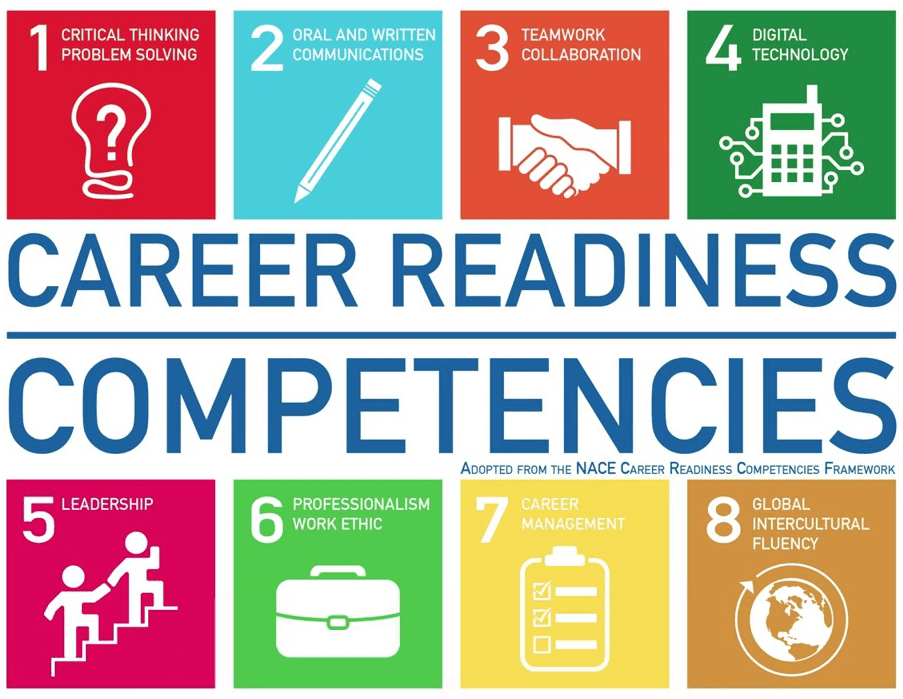
According to the National Association of Colleges and Employers (NACE) in partnership with University of North Carolina’s Career Services Center, there are 8 key competencies that every job seeker should possess as they are seeking employment:
✓Critical Thinking / Problem Solving and Creativity ☻ Exercises sound reasoning to analyze issues, make decisions and overcome problems ☻ Able to obtain, interpret, and use knowledge, facts, and data in this process ☻ Demonstrates originality and inventiveness
✓ Oral and Written Communications ☻ Articulates thoughts and ideas clearly and effectively in written and oral forms to persons inside and outside of the organization ☻ Possesses public speaking skills ☻ Able to express ideas to others ☻ Writes/edits effectively and clearly (e.g. memos, letters, and complex technical reports)
✓ Teamwork/Collaboration ☻ Builds collaborative relationships with colleagues and customers representing diverse cultures, races,ages, genders, religions, lifestyles, and viewpoints ☻ Able to work within a team structure ☻ Can negotiate and manage conflict
✓ Digital Technology/Technical Application ☻ Leverages existing digital technologies ethically and efficiently to solve problems, complete tasks, and accomplish goals ☻ Demonstrates effective adaptability to new and emerging technologies
✓ Leadership ☻ Leverages the strengths of others to achieve common goals ☻ Uses interpersonal skills to coach and develop others ☻ Able to assess and manage his/her emotions and those of others ☻ Use empathetic skills to guide and motivate ☻ Organizes, prioritizes, and delegates work
✓ Professionalism and Work Ethic ☻ Demonstrates personal accountability and effective work habits (e.g. punctuality, working productively with others,and time workload management, and understand the impact of non-verbal communication on professional work image.) ☻ Demonstrates integrity and ethical behavior, acts responsibly with the interests of the larger community in mind ☻ Able to learn from his/her mistakes
✓ Career Management ☻ Articulates personal skills, strengths, knowledge, and experiences relevant to the position desired and career goals ☻ Identifies areas necessary for professional growth ☻ Able to navigate and explore job options, understands ☻ Takes the steps necessary to pursue opportunities ☻ Understands how to self-advocate for opportunities in the workplace
✓ Global Perspective/Intercultural Fluency ☻ Values, respects, and learns from diverse cultures, races, ages, genders, sexual orientations, and religions ☻ Demonstrates openness, inclusiveness, sensitivity and the ability to interact respectfully with all people and understand individuals’ differences









 Careers with Michelle