New Year’s Resolution for Job Seekers

Image via Ashley Brooke Photography

Job searching in the middle of a pandemic has been the most challenging for job seekers. Job seekers have been blindly applying for 10 months or more and building their network. Some have been plugging away and applying to jobs since March and have had little success with interviews and no offers with no feedback. And some have been forced (by the pandemic) into starting their own businesses/side hustles to pay off student loans, rent, debt, etc.

Whatever the case may be, job searching has always been challenging. However, the best way for it to be a success is to remain positive, and to not give up. Giving up is not an option. Show employers that you are willing, wanting and able to work!

Here are some New Year’s resolutions to help jump start your motivation and pave way to a successful job search.


  1. Connections can help a great deal. Spend more time talking to people than submitting your application to posted job ads.
    • The quickest way to get back into the job market will be your network and your referrals. Who knows that a 30 minute coffee chat could turn into an opportunity of a lifetime.
    • You would be surprised that you will have connections in your circle who know about the existing job vacancies that aren’t posted on job boards. In other words, the hidden job market.
    • When reaching out to your connections, you may want to follow the email template below:
      • “Hi [Connection’s Name],

        I hope this email finds you well. How was your holiday season and New Year’s? It is shocking how 2020 flew by.

        I wanted to reach out because things have changed at [Current Company] and am specifically looking to transition to [Job Title] at [Industry/Sector/Company] where I can utilize my [Insert Relevant Skills] to be able to do [Insert Desired Activities].

        I wanted to reach out to see if you know of anyone who could connect me to such an opportunity. I understand that this is a big ask and your time is valuable. If it is too much right now, don’t feel any pressure as I totally understand.

        Either way, I hope you are staying healthy and safe. I look forward to catching up with you soon!

        Best Regards,
        [Your Name]”
  2. Update your resume.
    • Your resume should always be different and tailored based on the job description. Study the job description carefully and proofread your resume before uploading it on the job board because you want to get past the Applicant Tracking System.
      • Education: Don’t just focus on the schools and institutions that you have attended. Include organizations that you were involved with as well! If you had a GPA that is higher than a 3.0, showcase it and be proud of that achievement!
      • Work Experience: I mention this all the time but make sure your duties are not only duties, however make it into an accomplishment by incorporating quantifiable metrics using numbers and percentages. Also, tailor it towards the field that you are interested in.
      • Leadership Experience: This is important whether you are looking for a job or internship. If you were active in many organizations and clubs, list it and highlight that leadership because that is always going to be a plus.
      • Skills and Projects: Again, just like your work experience, tailor your relevant skills towards the field of interest. If you have worked on special projects that were tailored towards the specific field of interest, include that as well.
    • Have your peer, mentor, career coach or a professional critique your resume.
  3. Hone your interview skills.
    • Have a friend or family member interview you and provide feedback.
    • Participate in mock interviews. Especially during this pandemic, many virtual platforms are partnering with big companies (such as Moody’s, Google, McKinsey & Company, Credit Suisse) to connect with nonprofit organizations and social ventures to give back and provide these free services to job seekers.
  4. Sharpen your skills.
    • If there is a specific field you are looking to go into or a job that you want to apply for, study the job description closely and discover if your educations and skills are going to be a good match.
    • If you do not have the skills that the employers are looking for, you should look into taking online classes that will help you move forward in your intended field.
  5. Map out what you are looking for.
    • Don’t just randomly apply for jobs because you need a job. Seek purpose in the kind of job you want. Make sure your job search has a path. What is it that you really want in your job? Do you want to work entirely remote? Do you want to work on-site? Do you want to work flexible or set hours?
    • Follow the SMART goal outline via FlexJobs.
      • (S)pecific: What industry or sector do you want to work in? Do you want to stay local, or are you willing to move? How much do you need to earn?
      • (M)easurable: To meet your goal, how many resumes will you send out per week? How many networking events will you attend each month?
      • (A)ttainable: Do you understand the difference between your dreams and your goals? Keep in mind that some things are beyond your sphere of influence. You cannot control how many interviews or offers you get, but you can set a goal for the number of business connections you’ll make each month.
      • (R)ealistic: What can you achieve in this moment? If you have little experience, it’s unlikely you can move directly into a C-level job. Be honest with yourself about what you can achieve right now, but also plan for bigger and better goals in the future.
      • (T)imely: When is your deadline? This aspect of goal setting is often overlooked, but deadlines—even arbitrary ones—are important motivators. Since you can’t control when you’ll get hired, you may find that a resolution such as “I will find a job within the next six months” is less effective than “I will apply to at least five vacancies this week.”
  6. Target specific companies that you are interested in working for.
    • Make a list of your top target companies
    • Research, research, research them!!! Anything you can find such as articles, interviews with executives, surveys, podcasts, etc.
    • LinkedIn is a valuable platform for you to use in landing your dream job at your target company. From there, you may want to locate contacts who can refer you into your target role such as a hiring manager, team lead, recruiter or a friend who was hired there.
    • Reach out and cold email them.

NACE’s Career Readiness Tips: How To Prepare Yourself To Be More Career Ready

Today’s post will consist of very useful career readiness resources and tips from the National Association of Colleges and Employers because as I was reading their resource materials, I can similarly relate to the advice I have given job seekers.

Image via Center For Career and Experiential Education

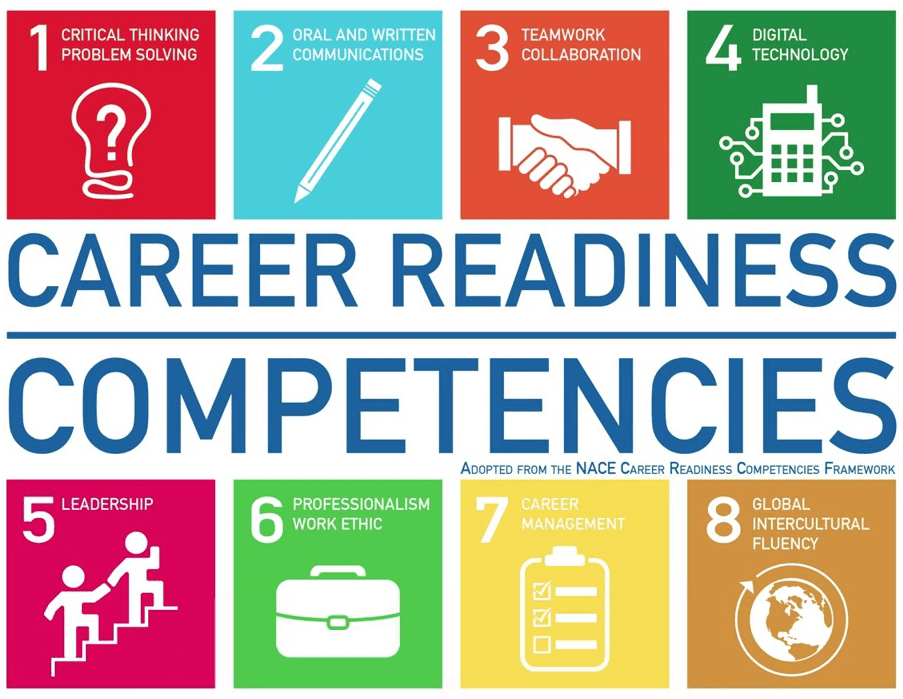
According to the National Association of Colleges and Employers (NACE) in partnership with University of North Carolina’s Career Services Center, there are 8 key competencies that every job seeker should possess as they are seeking employment:

Critical Thinking / Problem Solving and Creativity
☻ Exercises sound reasoning to analyze issues, make decisions and overcome problems
☻ Able to obtain, interpret, and use knowledge, facts, and data in this process
☻ Demonstrates originality and inventiveness

Oral and Written Communications
☻ Articulates thoughts and ideas clearly and effectively in written and oral forms to persons inside and outside of the organization
☻ Possesses public speaking skills
☻ Able to express ideas to others
☻ Writes/edits effectively and clearly (e.g. memos, letters, and complex technical reports)

Teamwork/Collaboration
☻ Builds collaborative relationships with colleagues and customers representing diverse cultures, races,ages, genders, religions, lifestyles, and viewpoints
☻ Able to work within a team structure
☻ Can negotiate and manage conflict

Digital Technology/Technical Application
☻ Leverages existing digital technologies ethically and efficiently to solve problems, complete tasks, and accomplish goals
☻ Demonstrates effective adaptability to new and emerging technologies

Leadership
☻ Leverages the strengths of others to achieve common goals
☻ Uses interpersonal skills to coach and develop others
☻ Able to assess and manage his/her emotions and those of others
☻ Use empathetic skills to guide and motivate
☻ Organizes, prioritizes, and delegates work

Professionalism and Work Ethic
☻ Demonstrates personal accountability and effective work habits (e.g. punctuality, working productively with others,and time workload management, and understand the impact of non-verbal communication on professional work image.)
☻ Demonstrates integrity and ethical behavior, acts responsibly with the interests of the larger community in mind
☻ Able to learn from his/her mistakes

Career Management
☻ Articulates personal skills, strengths, knowledge, and experiences relevant to the position desired and career goals
☻ Identifies areas necessary for professional growth
☻ Able to navigate and explore job options, understands
☻ Takes the steps necessary to pursue opportunities
☻ Understands how to self-advocate for opportunities in the workplace

Global Perspective/Intercultural Fluency
☻ Values, respects, and learns from diverse cultures, races, ages, genders, sexual orientations, and religions
☻ Demonstrates openness, inclusiveness, sensitivity and the ability to interact respectfully with all people and understand individuals’ differences

How The COVID-19 Pandemic Will Affect Millennial and Generation Z Job Seekers And What They Should Do

Image via Dribbble

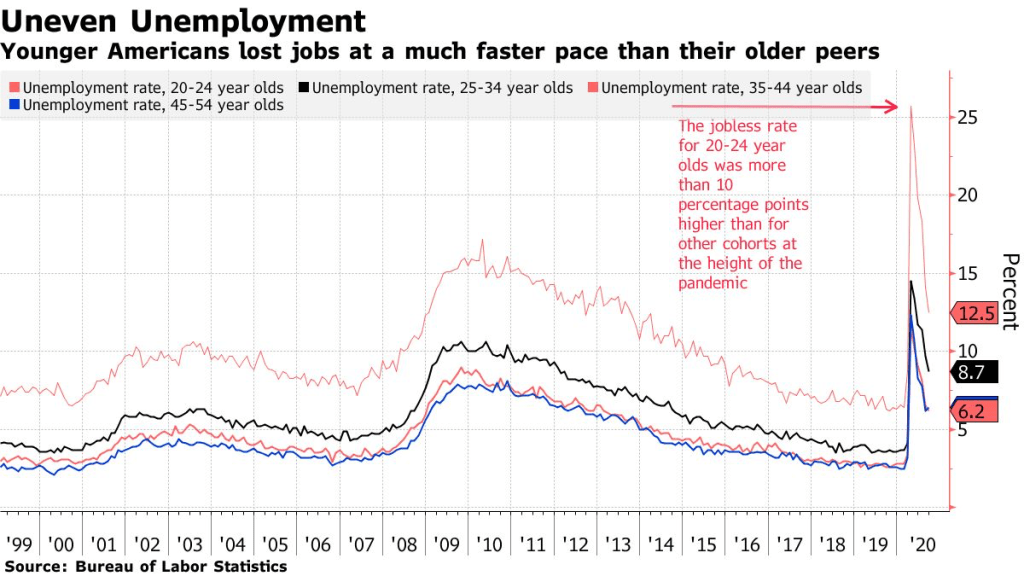
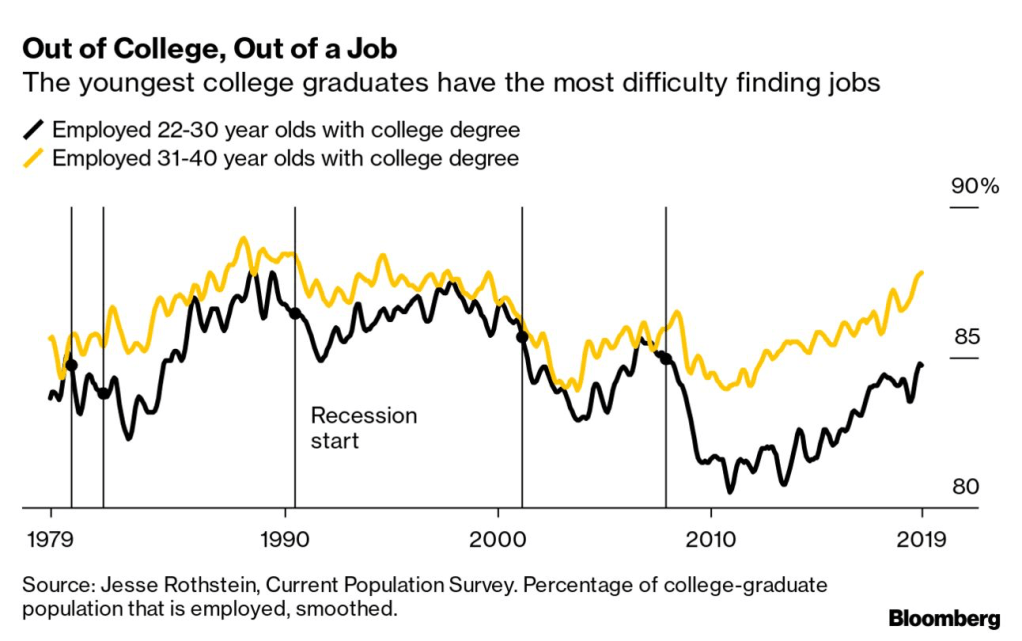
Research has shown that the Millennial and Generation Z’s who have just graduated at the end of 2019, during 2020, or in the next coming years, will be facing high unemployment rates which can affect the U.S. economy in the long-run.

Image via Bloomberg

According to Bloomberg, economists say the longer that young people are forced to delay their careers, the worse their prospects will be in the future to hold a job, accumulate wealth, or even get married or start a family.

Long periods of unemployment, or working part-time gigs or temporarily in jobs outside their desired fields, can jeopardize young professionals’ future salary increases and opportunities for them to build key relationships.

For college students and recent graduates, choosing a major based on availability of jobs is a recipe for an unsatisfying life. Instead, search for something you truly enjoy, something you find exciting, and the job will come, in due time.

Image via Shutterstock

Some of you are thinking that graduating in this global health and economic crisis may have delayed your career growth, however it is definitely not a career death sentence. Take as much time as you need to chase your dreams! Everyone you know may be interested in finance, STEM, healthcare, etc. but follow your own roadmap because these paths are certainly not for everybody. It may take you a month, 6 months or 1 year after graduation to find a job amid the pandemic. Many companies have resumed their hiring and have pivoted new ways in doing so. In addition, a lot of companies are hiring workers to work from home as well, which can be a new way of reducing unemployment.


Advice and Tips For Recent Graduates

  • You should definitely continue to explore your interests, values and motivators if you did not spend as much time in the exploration process before your graduation. Through networking and pivoting, chances are you may find roles that weren’t even on your radar and; potential opportunities — that are even better than the ones that you have initially considered.
  • You want to actively connect on LinkedIn with everyone from your college community — students, classmates, recent graduates, professors, mentors, connections from your school internships, career advisors, and career centers! The best chance of success is typically from a referral.
    • Take full advantage of your college career center. Even though you have graduated, you are still part of their alumni network!
    • Take full advantage of employment centers/workforce providers that are located in your area!
      • The services that your college career center and workforce providers (non-profit based) offer are completely FREE in terms of resume critique, mock interviews, career advisement, mentorship, networking help, job placement assistance and referrals, and many more.
  • You want to actively connect on LinkedIn with your outside connections — former colleagues, friends, family members, neighbors! Set up virtual appointments on Zoom, Cisco Webex, Google Meet, Slack, and virtual happy hour, etc. You want to inform everyone that you are currently job searching and let them know what kinds of jobs you are looking for. They may know of someone who is hiring for what you are looking for and they may end up passing along a lead.
  • Do something different and take free courses that will get you out of your comfort zone. Whatever it is that you are doing, traveling, eating, cooking, working with animals/pets, people, your true passion unfolds.
    • If you can’t discover anything you like, you should consider volunteering although nobody likes to work for zero profit. At a time like this, putting your gifts, talents and skills to help a nonprofit organization really helps many folks figure out what their purposes are.
      • This will lead folks to reflect on their passions and realizing how this experience ignites them, as this is a way of connecting them to their future career paths. Not many think of this, however volunteer experience actually offers you the opportunity to lead, grow and evolve as an individual — whether it is impacting the lives of young people, helping the less fortunate or patients/elderly, will allow you to continue to pave your way forward.
      • Also, volunteer work opens many doors for you! There are individuals that I know who have volunteered throughout their whole life, which has led them into their current leadership roles.
  • Keep in mind that there are many companies that have IT, finance, project management, HR, marketing, public relations, etc. Just because the sector/industry for that position isn’t what you are ideally looking for, this is a good time to still apply to that potential employer. The point is to not overlook them!

We all know that 2020 is undoubtedly a financial and emotional struggle for many college graduates. Many students are struggling to find employment and has also lost their jobs due to the pandemic. This has increased financial stress for students who are paying bills; financially helping their parents/family; paying for their tuition (which resulted in 68% returning to their home, 22% staying off campus, 7% staying on campus, 3% went elsewhere), etc.

According to Student Loan Hero:

However, do not be afraid to ask for help. If you feel that you are struggling with food and housing insecurity, paying for online classes, paying your rent, there are many resources to help you. You may want to look into Supplemental Nutrition Assistance Program (SNAP), Unemployment Insurance and Emergency Financial Aid.


Additional Resources for NYC and U.S. Residents

  • If you live in the NYC area, there are free meals where meals can be picked up at all Meal Hubs 9:00am to 12:00pm, Monday through Friday. Meal Hubs will operate for children, families and adults.
  • If you live in the NYC area and you, or a friend or family member has a small business that has been impacted by COVID-19, they may want to seek assistance and guidance from NYC Small Business Services. You may apply for emergency loans, like the Paycheck Protection Program as well as requesting financing assistance.

The Pros and Cons of Permanently Working Remotely For Corporate/Tech Industries

Image via RescueTime

In this rapidly changing job market today, it seems that salaries are gravitating downwards due to the flexibility of allowing employees to work from home in the corporate world and tech industry. And with COVID-19 layoffs, this global pandemic has put downward pressure on pay.

Employees from software giants such as Microsoft, Facebook, Google and Twitter — were given the option to work freely from home forever, even when their offices open back up.

With this new Work From Home/Remote standard, employers have the freedom to hire from any geographic location that they desire to. This will heavily affect areas with high costs of living because they will not account for higher salaries. Basically, compensation will change drastically depending on where you live in the country as they will do regionally-based salaries. We can see that this is already impacting the tech industry, which will generate an approach to more supply because it opens up the competition significantly. In the long run, this method of compensation will drive down employee salaries. This will also result in mass migration because people will no longer be tied down to living where they work. If you think about it, working remotely versus going into an office will not only impact the salary, but also promotions and growth.

For example, companies in the Silicon Valley are lowering the salaries of employees based on where they relocate.

“Even a move within the state of California will result in lower pay: workers who decamp for San Diego or Los Angeles will take an 8% pay cut”, Bloomberg reports.

Business Insider

Many tech firms are cutting labor costs for employees who move to less expensive areas. This isn’t fair for other employees who get paid less for carrying the same job title and performing the same amount of work. This is where the cost of living brings out the factors for these companies. The factors of the economic principles of supply and demand come into play.


Pro #1. The employers that are incentivizing this “WFH permanently” option, are widening their talent pool within their area – which can be great for folks who are highly talented. So therefore, the ability for an employer to hire at a lower cost due to the larger talent pool might compress the wage for that particular position, but if it allows the candidate to apply and potentially earn that position at a salary that is higher than what’s available in their current geographic labor market, then their respective salary has increased. Let’s not forget that WFH is not a mandatory thing for everyone. This is optional as there is still people who still prefers to go to back to their workplace and cubicles.

Pro #2. WFH offers more flexibility. WFH if you want, come in if you want. As long as you get the work done, your company will benefit from happier employees, wider talent net, smaller buildings and so on. For some folks, they may have a dedicated office space in their home or studio where it makes them feel much more productive as it has given them greater freedom to have a healthier lifestyle with less stress, and to be able to take care of their children.

Pro #3. WFH also improves ecology and prevents the contamination of the spread that’s still going around. Yes, it is nice to have an opportunity to work from home as this reduces carbon footprint! This reduces time in the traffic as there will be less cars on the road, and you won’t have to feel dreadful about waking up early. Not having to commute or paying for a $20 lunch meal daily, saves you a lot. Working from home is a great idea for both employees and employers who can save on their biggest expense, which is real estate and payroll.

Pro #4. This is a big step to reduce unemployment. Think about certain populations who have been out of the workforce for so long. For example, there are individuals who have disabilities or chronic health issues that limit their work options. And individuals who had to take care of their children because they do not have anyone else to look after them. But they are ready to enter the working world again and are still in search of employment. If they have the skills to do so, all they need is to set up their dedicated work space and equipment at home. With an unemployment rate of 8.4%, there are far more potential workers who are available to bring their valuable assets to the right employer.

However, it is not possible to fully live without the face-to-face interactions. As the world and labor trends continue to change and adapt, this brings us to the cons.


Con #1. If employers are extending offers to anyone in the country versus the local area, the demand for talent may decrease. This is a huge disadvantage for job seekers that lack digital skills. Fewer and fewer opportunities are available to those lacking a baseline of technology access as well. Studies also show that for many employers, working from home from time to time will likely continue as the new normal once the pandemic subsides.

Con #2. This is something that nobody has ever thought about, but employers would need to consider the time zone difference if conference calls/team meetings/client calls are needed. This can result in burnouts since there is no micromanagement. So the key variable here is engagement, where employees should feel supported and valued even behind the screen. Leaders would need to be willing to invest in software and hardware to make it work and build realistic protocols and accountability measures to ensure the work is being done. And this would require change in the design of workflow, teams and functions, as well as clear communication of expectations.

Con #3. In the long run, this can negatively affect some of the younger generations who are beginning their careers as some are visual learners. If they do not get to interact with their team or colleagues, this can limit their development since they won’t have the opportunities to learn from others on a daily basis. We need the face-to-face interactions to stimulate our communication with both internal teams and with our clients.

Con #4. Many employees (support staff, office admin staff, security staff, transport staff, etc.) who can’t work from home will lose their employment. This goes for jobs in the hardest hit sectors (hospitality/retail) — they are becoming obsolete, such as administrative assistants, receptionists, sales associates, etc. And, what will happen to the office space once that is all gone?

Con #5. Concerns have also been raised about work/life balance — where working from home only works if your environment is adapted. In other words, not all folks live in a place that is suitable for working from home. For instance, not everyone will have access to good WiFi, office supplies, ink, technology, etc. How many companies are willing to cover for that? And if they do cover that, how are they going to pay for all of their employees? Stipends?

Con #6. Mental health. An employee’s health matters too to ensuring a productive workforce! If employees do not make time for their wellness, they will be forced to make time for their illness. It’s true. This is a hot topic that has been discussed since the beginning of the lock down because many employees prefer office interactions and collaborations. We are humans. We develop the positive energy from being around people and the relationships/interactions are definitely not the same when working from home. In many cases, in-person discussions make a bigger difference and building solid relationships is more effective when done face-to-face.

Con #7. As you draw the big picture in your head about living situations when permanently working from home, some individuals will have the idea of selling their current property just to move back to be with their families because they will save more costs on rent, utilities, electricity, gas, etc. It is a nice recourse that many of these employers are offering, however things may/will always change. What if the employer reverts their decision and decides to make their employees come in to the office permanently? Or for a specific project/collaboration? This could be a logistical disorder for some individuals who are affected by their living situations. Not many folks are willing to pay an arm and a leg to live in areas that they cannot afford.


All in all, existing gaps between the haves and have not’s may be further heightened and it’s not hard to imagine folks being passed up for positions just because they simply don’t have the infrastructure to work from home and prefer working in the office instead. This pandemic is going to have far reaching impacts to many of our cities. But also, in a positive way in that here is an opportunity to close the wage gap between have and have not’s.

What To Do If You Are Unsure About Your Career Path

Image via MedCerts

Many students often had this question pondering in their minds about what they should do in their life after graduating from college. Some may have studied or majored in a field that didn’t match their interests or passion, and ended up pivoting their career paths – simply because the jobs or internships that they have worked at, are depressing and unsuitable for them.

On the other hand, older individuals who have been in the same role or sector/industry for many years often want to switch careers due to the following reasons:

  • Lack of professional advancement or career dissatisfaction
    • Job Burnout/Stress
    • Job isn’t suitable for you: Being bored or depressed because of the work you do
    • Loss of interest in that specific field/sector/industry
      • Re-entering the path of self discovery
    • You want to earn more income
    • You want better benefits, perks and rewards
    • Your life has changed because you have to take care of family or an illness so workplace flexibility is a must
    • The job outlook has worsened for your career field

During this uncertain time of the pandemic, it is difficult to imagine what the future of work will look like since anything can change over the course of the next few months. However, it is still crucial to establish personal and professional goals that pave the way to success.

So the big question is, “Where do I begin?” “How do I figure out what I want to do with my life?” As you are discovering what you want to do in life, the way to do it is by shifting your mindset from looking for a job, to achieving a purpose. Remember that sometimes not getting what you want is a wonderful stroke of luck. This is a reminder that what we want isn’t always what will be the best in the long run. You could say you have the passion to become a Mental Health Counselor because you have that kind of personality – compassion, empathy, therapeutic and you just love to talk to people. But you strongly dislike completing the caseloads and paperwork at the end of the session because administrative details aren’t really your forte.

With that being said, a good tip to consider for undergraduates or graduates who are still in school – you want to go behind the scenes in the professional world. In other words, you want to explore different career paths to see what really is your cup of tea. This will then establish your vision and clarity. Know where you want your dreams to take you.

Figure out your call to action. Prioritize what deserves your time, energy and happiness. Face the things that you have always desired to do and achieve. You want to map out a career plan/road map for yourself. What you want to do should align with your core values and strengths. Know and validate your strengths. Think about the jobs that you have worked for and think about what you do in your personal life and during your free time. List the things that you truly enjoy doing; things that bring a smile to your face and boosts your energy. Then list the things that you do not enjoy doing. Also, brainstorm and write down where you see yourself about 5-10 years from now.

You may also want to discover more things along the way. Discover what you don’t like by exploring, traveling, tasting, feeling, experiencing the things that you don’t like. Go out there and be fearless. Do the things that you’re afraid of because who knows, it may turn out to be your hobby/passion.

Another way in evaluating your core values, strengths, weaknesses, interests and skills are to take personality tests or career assessments to see where you want to be. There are numerous free career aptitude assessments that you may want to check out. Career Explorer also offers a free assessment to help you discover your career matches.

Once you have your road map in place, invest your time to hone those skills. Don’t compare yourself to your friends or connections who have landed a full-time role in Microsoft, Google, Facebook with good pay, perks and benefits. They are not you, and you are not them. Instead, you want to learn from them — and what I mean is learn from like-minded individuals — those who already have their life figured out and take advice from those who have what you want. In other words, surround yourself with individuals who are already at the level you want to be or those who possess similar goals who inspire you, motivate and encourage you to achieve your goals. Who you spend time with the most is who you will become. It’s important that you surround yourself with positive individuals — be it your friends, family members or colleagues.
Surround yourself with friends, family members and colleagues who serve as your life mentors; they believe in you even if you don’t believe in yourself. Surround yourself with leaders who will set you up for success by helping you learn, grow and taking your life to a new level!
LinkedIn is also a huge asset during your job search process. Reach out to your contacts on LinkedIn and set the tone. See below for an example.

Hello (Your Connection’s Name),

I hope this message finds you well. My name is (Your Name) and I decided to reach out to you since your background really stood out to me. I am interested in seeking for your advice regarding career transitions in (Role OR Sector/Industry) as this really piqued my attention.

If you have some time to chat, I’d love to hear more about your career trajectory and current role.

I know your time is valuable, and this is a big ask coming from a stranger. If it is too much right now, I totally understand. Either way, I hope you’re staying safe and healthy.

Rushing yourself to create success will cost you more in the long run. Speed costs accuracy. You don’t want to do that. What you should do, is lay the foundations carefully step by step. Do these things accurately and slowly, and you will get to where you want to be in life. It is never too late to rewrite your future, reignite your dreams and reinvent yourself. Keep learning and growing because your greatest achievements haven’t been accomplished yet. You matter and your value doesn’t go unnoticed. Wishing you the best of luck in your future endeavors, future leaders and topdogs! Onward and upward!


“Your work is going to fill a large part of your life, and the only way to be truly satisfied is to do what you believe is great work. And the only way to do great work is to love what you do. If you haven’t found it yet, keep looking. Don’t settle. As with all matters of the heart, you’ll know when you find it. And, like any great relationship, it just gets better and better as the years roll on. So keep looking until you find it. Don’t settle.”

Steve Jobs (CEO of Apple Computer and of Pixar Animation Studios) via Stanford University Commencement on June 12, 2005

How to Find a Job or Career If You Are Not a People Person

There are individuals who are very sociable, super energetic and outgoing – the extroverts. They share their endless ideas aloud and want to be noticed by others. And there are the introverts, those individuals who don’t really like to talk or socialize with others. They prefer to be alone and do their individual things. They are more silent and reserved. They think out loud with their minds rather than they do with their voice.

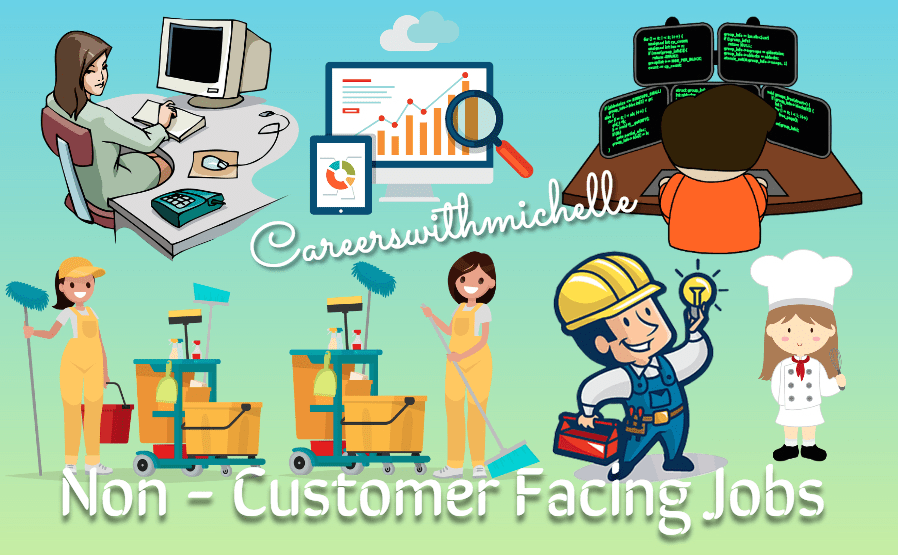
I do have a few clients who were seeking job placement assistance from me and I oftentimes receive this message, “I’m looking for a job that’s not customer service related or engaging with people.”

Well, that is definitely okay, because not everyone is built to thrive as a people person. However, it could be a challenge for them during their job search since they will most likely not want to network with professionals – and we all know that this is the quickest way to landing a job.

Especially since the global health and economic crisis that’s still going on currently, you can look into Work-From-Home jobs that do not require you to be client facing.

In addition, I have compiled a list of jobs and careers that do not require folks to be client facing. (Please note that all salary and educational percentages are obtained from Career One Stop and Bureau of Labor Statistics)

Data Entry Clerks – Basically, this is a very simple and straightforward kind of job. Although it’s not client facing, data entry clerks need to possess basic digital literacy skills – which requires their knowledge in spreadsheets, proficiency in typing, organization/administrative skills and word processing.
This role consists of compiling data, information or other documentation to report to their colleagues and of course ensure accuracy by checking/verifying the data for any errors. The median annual salary varies however, it typically is around $38,000-$39,000 in the NY Metropolitan Area. Over 50% of the workers in this field have a HS diploma (which is a requirement) or with some kind of college degree.
Click here to see how to build a resume focused on data entry clerk roles!

Actuary – This career requires not only a Bachelor’s degree, but they also need to pass a series of 2-3 exams in the U.S. to become a Certified Actuarial Analyst. That is their passport to landing a financial services career. The median annual salary in the NY Metropolitan Area is $130,100. Actuaries are keen in business (economics, finance, accounting), they are mathematicians (well grounded in algebra, calculus, statistics, probability) and possess strong computer skills since they need to be familiar with statistical analysis programs and many programming languages, as well as manipulating data. Now that you have an idea of their skills and competencies, actuaries combine mathematical reasoning and financial principles to help analyze financial costs of risk for their clients and businesses, and discover solutions to reduce that risk.
Click here to see a guide for those looking to pursue a career in the actuarial field!
Click here to see how to build a resume focused on actuarial science for students!
Click here to see how to build an Analyst Actuarial focused resume!

Software Developer/Engineer – They manage the systems software and applications by analyzing, developing, designing, creating and implementing software solutions. The thing about this career is that even though they build these programs for people, they do not need to talk to people while they are performing their duties. What they are engaging with is technology – the network systems, devices and programming. Typically, software developers need a Bachelor’s degree from Computer Science, Software/Computer Engineering or a related field. The median annual salary is typically around $117,680 in the NY Metropolitan Area.
Click here to see how to build a software developer/engineer focused resume!

Computer Programmer – Rather than engaging with people daily, a computer programmer will be engaging with coding languages instead. They are responsible for developing and writing computer programs/applications and assisting software developers to recoup specific data, documents and information as well designing software solutions. Computer programmers are familiar with coding, mathematics and engineering. They will need at least a Bachelor’s degree from Computer Science, Software/Computer Engineering or a related field. The median annual salary is typically around $92,100 in the NY Metropolitan Area.
Click here to see how to build an entry-level computer programmer focused resume!
Click here to see how to build an experienced computer programmer focused resume!

Janitor/Custodian/Cleaner – Obviously, this job does not require any kind of formal education and definitely not client facing needed since they are solely focused on making everything spotless, dust free and keeping everything in good condition. There are apprenticeships and certifications that they can take to pick up their skills, so that way they can prove to employers that they are competent and are able to do the job. This job is mainly based on experience and their ability to do the job, since it is labor intensive. Janitors, custodians and cleaners usually need to be able to stand for long hours since they clean everything – buildings, sweeping/mopping floors, windows, walls, doors, mowing grass, cleaning restrooms, removing snow, removing debris, etc. Depending on the employer, some might actually need to have a driver’s license since they might need to drive vehicles to other worksites. In addition, in many cases, they will need to know how to repair things, by putting on their maintenance hats. Over 60% of janitors/custodians/cleaners have a high school diploma or less. About 25% have a college degree, and those are probably students who need a job to pay off their student loans/tuition or to pay rent. The median annual salary is $34,030 in the NY Metropolitan area.
Click here to see how to build an entry-level janitorial focused resume!
Click here to see how to build a custodian focused resume!

Technical Writer – Instead of having to communicate with people, all technical writers need to do is to pivot their communication through written expression. They write about technical products. They create step-by-step guides, journal articles, instruction manuals and other electronic matters to make people’s lives easier. Almost 50% of folks in this field typically hold a Bachelor’s degree in Journalism, Corporate Communications or a relevant field specifically related to scientific writing, engineering, business, computer science, medicine. Over 30% of folks in this field hold a Master’s degree/Doctoral or other related professional degree. However, you can’t get away with just a degree. Experience is more relevant. To write about these inanimate objects, technical writers need to possess technical knowledge of how electronic equipment works, be good researchers and organized as they will need to stay up to date with new technologies and consistently compile technical information and other documentation. The median annual salary is $80,710 in the NY Metropolitan Area.
Click here to see how to build a technical writer focused resume!

Interpreter – This is for those who are bilingual, trilingual and even multilingual! If you love communicating in different languages, if you love translating and if you are sensitive to cultural differences, this could be the career for you. Interpreters are responsible for translating oral or written material from one language to another. On average, over 30% of workers in this field possess a Bachelor’s degree in Foreign Language. Interpreters and translators are very keen on the subject of the structure and subject matter of foreign language. Strong written, verbal and listening abilities are a must to do well in this role. They are also usually very knowledgeable on all aspects of the English language as it is very crucial in analyzing the rules of the framework/anatomy, grammar and pronunciation of each language. The median annual salary is $75,180 in the NY Metropolitan Area.
Click here to see how to build an interpreter focused resume!

Image Reviewer – The good thing about this job is it can be remote and done on a freelance basis! If you love photography, editing and touching up photos and approving images according to the company’s guidelines, this could serve as a good gig for you! According to Real Ways to Earn Money Online, image reviewers are responsible for evaluating the images for overall quality, technical execution, commercial suitability and adherence to the company’s acceptance standards. A popular company to work for in this role would be Shutterstock. In order to qualify, typically 2 or more years of photography experience is highly recommended. Photography careers are very dynamic, but to be very specific, if you have experience as a stock agency contributor, photo editor, portrait photographer, photojournalist/news photographer, freelance photographer or a photo researcher, you should go for it. The median annual salary is $54,845 in the U.S.
Click here to see how to build a photographer focused resume!

Film and Video Editors – If you have a creative mind for storytelling, altering motion pictures as well as synchronizing soundtracks with them, this is how they do it! Over 50% of those in this field hold a Bachelor’s degree in Film Studies. Film and video editors are very well versed with media production, electronic/broadcasting equipment and English language (to edit video & audio recordings). The median annual salary is $75,380 in the NY Metropolitan area.
Click here to see one way on how to build a video editor focused resume!
Click here to see another way on how to build a video editor focused resume!

Electricians – Instead of working with customers, electricians work with their hands. Electricians work on many electrical repair projects such as, installing street traffic lights, intercom systems repairing electrical wiring systems and control systems. They have to be knowledgeable in troubleshooting and figuring out what is causing the system/programs to not work – which says a lot about their judgment and critical thinking/decision making skills since they have to come up with quick ways to deliver a solution. Folks in this field are usually keen on tools that are associated with construction repair and mechanics – they must be familiar with the machines and tools that they are using to repair (whether it is a highway, road, street lights, etc.). Strong mathematical ability is a highly preferred skillset although not needed. A solid grasp of sums and geometry are helpful for calculating the areas/lengths for securing circuit breakers and wire installations. Algebra is also a big help for computing electrical loads and currents. About 70% of electricians hold a high school diploma/equivalent, or some kind of college degree (Associate’s & Bachelor’s). The median annual salary is $76,610 in the NY Metropolitan area.
Click here to see one way on how to build an “eye-grabbing” electrician focused resume!
Click here to see another way on how to build an electrician focused resume!

Head Chefs – If you are one of those who enjoy cooking and coming up with new recipes to showcase your creative cooking ideas, this may be the right fit for you. Plus, who doesn’t love food? Head chefs prepare ingredients and cook all kinds of meals and desserts. However, they do more than just those. They are responsible for monitoring other staff members to ensure that they are on the right track to provide customer satisfaction, and to swiftly handle any food-related issues. The median annual salary is $58,190 in the NY Metropolitan area. Over 30% of those in this field have a high school diploma or equivalent. No college degree is needed for this, however there are many vocational training schools below offered by Career One Stop that prepare others for this: