CareersWithMichelle consists of workforce related topics such as Q&A's, Career Development Resources, Job Search Tips/Strategies and Labor Market Information
The U.S. economy has lost at least 15% of jobs or more in every sector/industry. While many jobs are slowly picking back up, no industry has fully recovered yet. Most white-collar jobs (jobs that are professional, performed in an office or administrative setting) have transitioned to working from home, however blue-collar jobs (jobs that require manual labor; skilled or unskilled) have remained to be essential, so therefore they need to be on site. You can read more about the difference of white-collar jobs vs. blue-collar jobs here.
According to the Bureau of Labor Statistics, below shows the percentage of jobs in each industry that were cut and the percentage of job cuts that recovered as of November 2020.
Industry
% of jobs in the industry that were cut
% of job cuts that has recovered
Accommodation
43.62
20.46
Administrative and Waste Services
17.49
41.01
Air Transportation
15.28
-36.88
Amusement, Gambling & Recreation
58.06
51.05
Arts, Entertainment & Recreation
53.77
40.13
Clothing & Accessories Stores
61.83
59.24
Dentist Offices
56.2
93.24
Department Stores
24.82
93.31
Film & Sound Recording Industries
51.7
18.61
Financial Activities
3.15
41.94
Food & Drinking Places
49.39
61.85
Furniture & Home Furnishing Stores
46.12
73.65
Government
4.26
2.79
Healthcare
9.56
57.68
Hospitals
2.31
-3.62
Leisure & Hospitality
49.32
53.84
Manufacturing
10.61
52.53
Museums & Historical Sites
28.48
7.21
Professional & Technical Services
5.78
42.85
Retail Trade
15.21
79.74
Scenic & Sightseeing Transportation
65.94
38.02
Social Assistance
16.29
45.81
Source: Bureau of Labor Statistics, November 2020
With more job cuts and layoffs, there will be less job postings and this will impact the way that employers reassess and reevaluate their plans as they move forward. With the new wave of Coronavirus hitting this winter, many sectors and industries will be facing job deficits due to low demand.
There are some folks who have received one or multiple offers and voluntarily changed jobs during the lock down, while there are other folks who are very skilled and has talent, as well remaining diligent throughout their job search — can’t even get a slice of that opportunity; particularly those who are recent graduates, those with disabilities, illnesses, ageism or other personal reasons like taking care of children or a family member. It has become extremely difficult for folks who have extensive experience and are heads of households who need living wages. So, the longer that they remain unemployed, the harder they will be seen as employable, due to the harsh reality that they are letting those skills atrophy.
Because of the job deficits that these companies are facing, some promote internally or bring on a new external hire due to the fears of budgets up in the air. There are also a handful that are simply willing to hire entry-level workers at low wages to hedge their stakes against a declining economy.
Aside from employee layoffs, there are also many individuals leaving their jobs due to big cuts in their hours — affecting their pay. They want to find a job that is equal or slightly close to what they were making before the pandemic, however it is not easy. This leaves the labor market with more job seekers than job openings. In order for one to keep their unemployment insurance, they have to constantly apply to many jobs per week — which makes it very strenuous for individuals needing a job to finding one quickly or even at all.
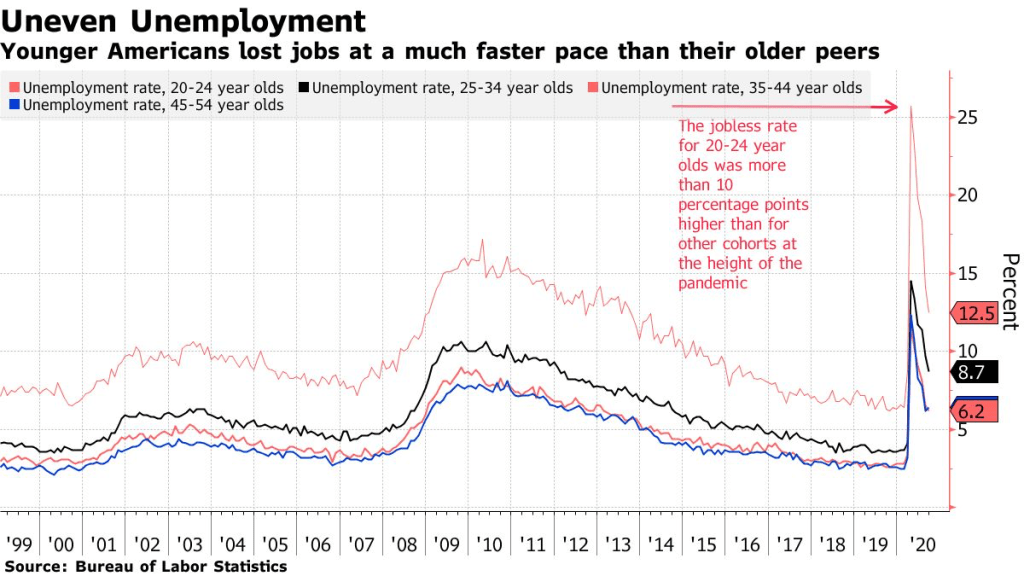
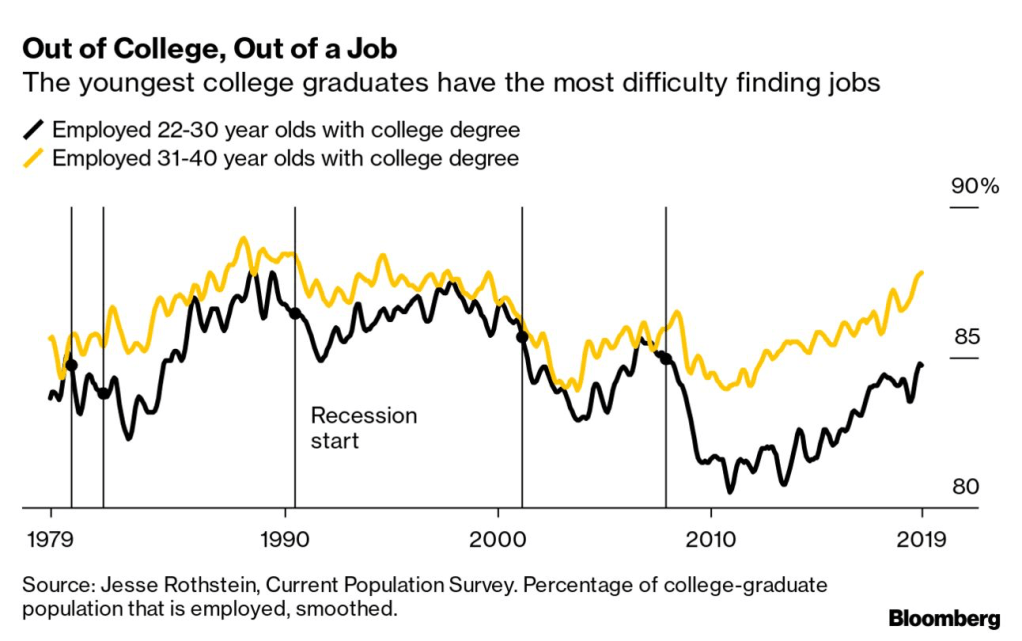
Research has shown that the Millennial and Generation Z’s who have just graduated at the end of 2019, during 2020, or in the next coming years, will be facing high unemployment rates which can affect the U.S. economy in the long-run.
For college students and recent graduates, choosing a major based on availability of jobs is a recipe for an unsatisfying life. Instead, search for something you truly enjoy, something you find exciting, and the job will come, in due time.
Image via Shutterstock
Some of you are thinking that graduating in this global health and economic crisis may have delayed your career growth, however it is definitely not a career death sentence. Take as much time as you need to chase your dreams! Everyone you know may be interested in finance, STEM, healthcare, etc. but follow your own roadmap because these paths are certainly not for everybody. It may take you a month, 6 months or 1 year after graduation to find a job amid the pandemic. Many companies have resumed their hiring and have pivoted new ways in doing so. In addition, a lot of companies are hiring workers to work from home as well, which can be a new way of reducing unemployment.
Advice and Tips For Recent Graduates
You should definitely continue to explore your interests, values and motivators if you did not spend as much time in the exploration process before your graduation. Through networking and pivoting, chances are you may find roles that weren’t even on your radar and; potential opportunities — that are even better than the ones that you have initially considered.
You want to actively connect on LinkedIn with everyone from your college community — students, classmates, recent graduates, professors, mentors, connections from your school internships, career advisors, and career centers! The best chance of success is typically from a referral.
Take full advantage of your college career center. Even though you have graduated, you are still part of their alumni network!
The services that your college career center and workforce providers (non-profit based) offer are completely FREE in terms of resume critique, mock interviews, career advisement, mentorship, networking help, job placement assistance and referrals, and many more.
You want to actively connect on LinkedIn with your outside connections — former colleagues, friends, family members, neighbors! Set up virtual appointments on Zoom, Cisco Webex, Google Meet, Slack, and virtual happy hour, etc. You want to inform everyone that you are currently job searching and let them know what kinds of jobs you are looking for. They may know of someone who is hiring for what you are looking for and they may end up passing along a lead.
Do something different and take free courses that will get you out of your comfort zone. Whatever it is that you are doing, traveling, eating, cooking, working with animals/pets, people, your true passion unfolds.
If you can’t discover anything you like, you should consider volunteering although nobody likes to work for zero profit. At a time like this, putting your gifts, talents and skills to help a nonprofit organization really helps many folks figure out what their purposes are.
This will lead folks to reflect on their passions and realizing how this experience ignites them, as this is a way of connecting them to their future career paths. Not many think of this, however volunteer experience actually offers you the opportunity to lead, grow and evolve as an individual — whether it is impacting the lives of young people, helping the less fortunate or patients/elderly, will allow you to continue to pave your way forward.
Also, volunteer work opens many doors for you! There are individuals that I know who have volunteered throughout their whole life, which has led them into their current leadership roles.
Keep in mind that there are many companies that have IT, finance, project management, HR, marketing, public relations, etc. Just because the sector/industry for that position isn’t what you are ideally looking for, this is a good time to still apply to that potential employer. The point is to not overlook them!
We all know that 2020 is undoubtedly a financial and emotional struggle for many college graduates. Many students are struggling to find employment and has also lost their jobs due to the pandemic. This has increased financial stress for students who are paying bills; financially helping their parents/family; paying for their tuition (which resulted in 68% returning to their home, 22% staying off campus, 7% staying on campus, 3% went elsewhere), etc.
If you live in the NYC area, there are free meals where meals can be picked up at all Meal Hubs 9:00am to 12:00pm, Monday through Friday. Meal Hubs will operate for children, families and adults.
If you live in the NYC area and you, or a friend or family member has a small business that has been impacted by COVID-19, they may want to seek assistance and guidance from NYC Small Business Services. You may apply for emergency loans, like the Paycheck Protection Program as well as requesting financing assistance.
For small business owners who are located anywhere in the U.S., the U.S. Small Business Administration can assist and guide them on Coronavirus Relief Options as they offer 4 funding options:
In this rapidly changing job market today, it seems that salaries are gravitating downwards due to the flexibility of allowing employees to work from home in the corporate world and tech industry. And with COVID-19 layoffs, this global pandemic has put downward pressure on pay.
Employees from software giants such as Microsoft, Facebook, Google and Twitter — were given the option to work freely from home forever, even when their offices open back up.
With this new Work From Home/Remote standard, employers have the freedom to hire from any geographic location that they desire to. This will heavily affect areas with high costs of living because they will not account for higher salaries. Basically, compensation will change drastically depending on where you live in the country as they will do regionally-based salaries. We can see that this is already impacting the tech industry, which will generate an approach to more supply because it opens up the competition significantly. In the long run, this method of compensation will drive down employee salaries. This will also result in mass migration because people will no longer be tied down to living where they work. If you think about it, working remotely versus going into an office will not only impact the salary, but also promotions and growth.
“Even a move within the state of California will result in lower pay: workers who decamp for San Diego or Los Angeles will take an 8% pay cut”, Bloomberg reports.
Many tech firms are cutting labor costs for employees who move to less expensive areas. This isn’t fair for other employees who get paid less for carrying the same job title and performing the same amount of work. This is where the cost of living brings out the factors for these companies. The factors of the economic principles of supply and demand come into play.
Pro #1. The employers that are incentivizing this “WFH permanently” option, are widening their talent pool within their area – which can be great for folks who are highly talented. So therefore, the ability for an employer to hire at a lower cost due to the larger talent pool might compress the wage for that particular position, but if it allows the candidate to apply and potentially earn that position at a salary that is higher than what’s available in their current geographic labor market, then their respective salary has increased. Let’s not forget that WFH is not a mandatory thing for everyone. This is optional as there is still people who still prefers to go to back to their workplace and cubicles.
Pro #2. WFH offers more flexibility. WFH if you want, come in if you want. As long as you get the work done, your company will benefit from happier employees, wider talent net, smaller buildings and so on. For some folks, they may have a dedicated office space in their home or studio where it makes them feel much more productive as it has given them greater freedom to have a healthier lifestyle with less stress, and to be able to take care of their children.
Pro #3. WFH also improves ecology and prevents the contamination of the spread that’s still going around. Yes, it is nice to have an opportunity to work from home as this reduces carbon footprint! This reduces time in the traffic as there will be less cars on the road, and you won’t have to feel dreadful about waking up early. Not having to commute or paying for a $20 lunch meal daily, saves you a lot. Working from home is a great idea for both employees and employers who can save on their biggest expense, which is real estate and payroll.
Pro #4. This is a big step to reduce unemployment. Think about certain populations who have been out of the workforce for so long. For example, there are individuals who have disabilities or chronic health issues that limit their work options. And individuals who had to take care of their children because they do not have anyone else to look after them. But they are ready to enter the working world again and are still in search of employment. If they have the skills to do so, all they need is to set up their dedicated work space and equipment at home. With an unemployment rate of 8.4%, there are far more potential workers who are available to bring their valuable assets to the right employer.
However, it is not possible to fully live without the face-to-face interactions. As the world and labor trends continue to change and adapt, this brings us to the cons.
Con #1. If employers are extending offers to anyone in the country versus the local area, the demand for talent may decrease. This is a huge disadvantage for job seekers that lack digital skills. Fewer and fewer opportunities are available to those lacking a baseline of technology access as well. Studies also show that for many employers, working from home from time to time will likely continue as the new normal once the pandemic subsides.
Con #2. This is something that nobody has ever thought about, but employers would need to consider the time zone difference if conference calls/team meetings/client calls are needed. This can result in burnouts since there is no micromanagement. So the key variable here is engagement, where employees should feel supported and valued even behind the screen. Leaders would need to be willing to invest in software and hardware to make it work and build realistic protocols and accountability measures to ensure the work is being done. And this would require change in the design of workflow, teams and functions, as well as clear communication of expectations.
Con #3. In the long run, this can negatively affect some of the younger generations who are beginning their careers as some are visual learners. If they do not get to interact with their team or colleagues, this can limit their development since they won’t have the opportunities to learn from others on a daily basis. We need the face-to-face interactions to stimulate our communication with both internal teams and with our clients.
Con #4. Many employees (support staff, office admin staff, security staff, transport staff, etc.) who can’t work from home will lose their employment. This goes for jobs in the hardest hit sectors (hospitality/retail) — they are becoming obsolete, such as administrative assistants, receptionists, sales associates, etc. And, what will happen to the office space once that is all gone?
Con #5. Concerns have also been raised about work/life balance — where working from home only works if your environment is adapted. In other words, not all folks live in a place that is suitable for working from home. For instance, not everyone will have access to good WiFi, office supplies, ink, technology, etc. How many companies are willing to cover for that? And if they do cover that, how are they going to pay for all of their employees? Stipends?
Con #6. Mental health. An employee’s health matters too to ensuring a productive workforce! If employees do not make time for their wellness, they will be forced to make time for their illness. It’s true. This is a hot topic that has been discussed since the beginning of the lock down because many employees prefer office interactions and collaborations. We are humans. We develop the positive energy from being around people and the relationships/interactions are definitely not the same when working from home. In many cases, in-person discussions make a bigger difference and building solid relationships is more effective when done face-to-face.
Con #7. As you draw the big picture in your head about living situations when permanently working from home, some individuals will have the idea of selling their current property just to move back to be with their families because they will save more costs on rent, utilities, electricity, gas, etc. It is a nice recourse that many of these employers are offering, however things may/will always change. What if the employer reverts their decision and decides to make their employees come in to the office permanently? Or for a specific project/collaboration? This could be a logistical disorder for some individuals who are affected by their living situations. Not many folks are willing to pay an arm and a leg to live in areas that they cannot afford.
All in all, existing gaps between the haves and have not’s may be further heightened and it’s not hard to imagine folks being passed up for positions just because they simply don’t have the infrastructure to work from home and prefer working in the office instead. This pandemic is going to have far reaching impacts to many of our cities. But also, in a positive way in that here is an opportunity to close the wage gap between have and have not’s.
For many decades, retail cashiers and sales associates served as a common entry point into the labor market for generations of workers. However, these positions are becoming obsolete due to automated self-checkouts and no requirement of any kind of human interaction. Beginning of the 20th century, the big transformation of technology has caused more than half of the jobs to go automated — causing the labor market to become extremely competitive for candidates, as employers expect a considerable level of technical skills for entry-level to mid-level positions.
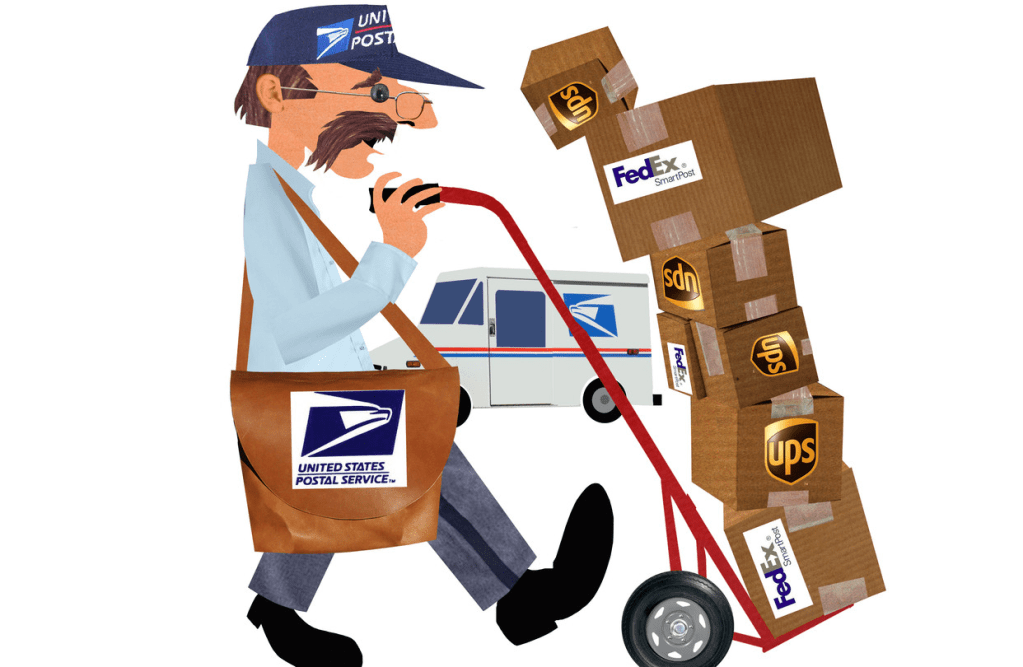
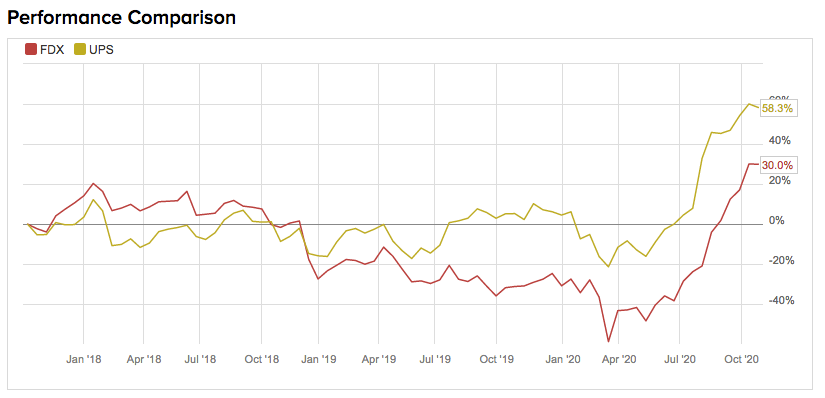
With COVID-19 impacting store closures and bankruptcies in the fashion retail industry, there has been an uptick in the number of online orders and an increase in the U.S. eCommerce spending. This creates an unprecedented demand in hiring for more delivery workers and package handlers at UPS and FedEx in order to speed up the delivery process on millions of orders to consumers — making their services more crucial than it ever was before. COVID will set a new precedent in eCommerce penetration.
UPS is one of the many employers that has been hiring for thousands of workers since the start of the pandemic. They are still currently in good shape as all businesses and consumers drove eCommerce and shipping to a new level. UPS is currently hiring for 100,000 seasonal workers to handle and deliver to meet a surging volume of packages for the upcoming holiday season, with Black Friday, Cyber Monday and Christmas approaching. This includes “extra drivers, driver helpers and package handlers”, according to Business Insider.
UPS isn’t the only courier industry hiring for holiday workers. FedEx is as well. They are looking to fill many critical openings that fall under these categories: Package Recovery Agent, Package Handler, Maintenance Tech, Operations Manager, CIL Material Handler, Customs Trade Agent, Forklift Operator, Warehouse Worker and Retail Positions.
If you are still looking for a job and have a driver’s license in your area, you may want to consider applying. Due to the growth of eCommerce and a decline in retail, there is an increased need for workers in the courier and delivery services industry especially during this peak holiday shipping season. UPS, FedEx, and USPS will see package volume soar by up to 70% over last year.
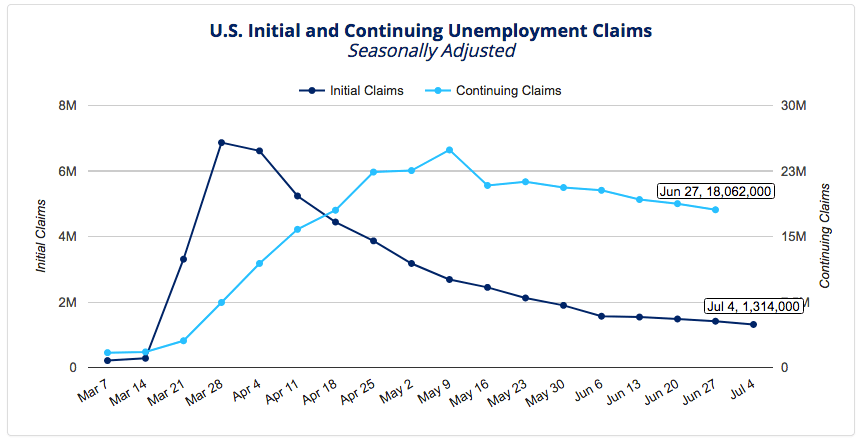
According to the U.S. Initial and Continuing Unemployment Claims line chart (Chart 1) below from NYC Comptroller Scott M. Stringer, it shows that the unemployment claim numbers have not been below 1 million since the start of the pandemic. That is an indicator of how painful that this economic downturn has been. And once it gets closer to dropping below 1 million, we will be closer to adding more jobs than shedding jobs. So we are still in a place that is not good. The longer this drags on, the slower it would take for us to come back and for the economy to come back.
The same thing goes for continuing claims. The chart depicts that these claims have been pretty flat since mid-May. There was a positive jobs report in June nationally, but this is probably going to tick up again as we are seeing with Texas, California, Arizona, Florida starting to boom with Coronavirus recently. As more and more vulnerable individuals become infected, we’ll see their economies re-closing and this will mean that we will see numbers creep back up again (slowly or rapidly).
According to the data from the New York State Department of Labor, initial/new claims are 1.3 million between June 27th to July 4th, 2020 with 14 consecutive weeks of 1 million new claims. For point of comparison on active/continuing claims, there was a total of 18 million as of June 27th, 2020 compared to 1.7 million from June 29th, 2019. That is ten times as many unemployment insurance benefits claims. At this rate, it was really important that the federal government passed that law to extend the duration of unemployment so that it would buy us more time for us to put together the strategy, systems, approaches, treatments to be able to deal with the pandemic so that the economy could come back a little more easily. But as we are all aware, this isn’t exactly happening yet.
So to summarize this all together, there was a total of 47.3 million applications between March 7th to June 25th, 2020 and a total of 30.5 million claims between March 7th to June 6th. There is a difference between those two things. There are many applications and claims that have not been reviewed or approved yet, due to the influx.
As a point of comparison, the Great Recession – dating back to 2008 – 2009, the total unemployment claims over the span of 18 months was 37 million claims. However, in our case right now in 2020, we have achieved that in the span of 2.5 months, which is a living nightmare.
Scott M. Stringer’s Chart 2 above depicts the Regular Unemployment Insurance (UI) vs. Pandemic Unemployment Assistance (PUA). If you look at the last bar on June 20th, almost half of the continuing claims fall in the PUA category. The PUA is a special, new category of eligibility for unemployment that Congress and the federal government passed so that freelancers, self-employed and gig workers could claim unemployment insurance – which has never happened before. This is the first time in history to create this – which is a vital thing to point out about this downturn from previous ones.
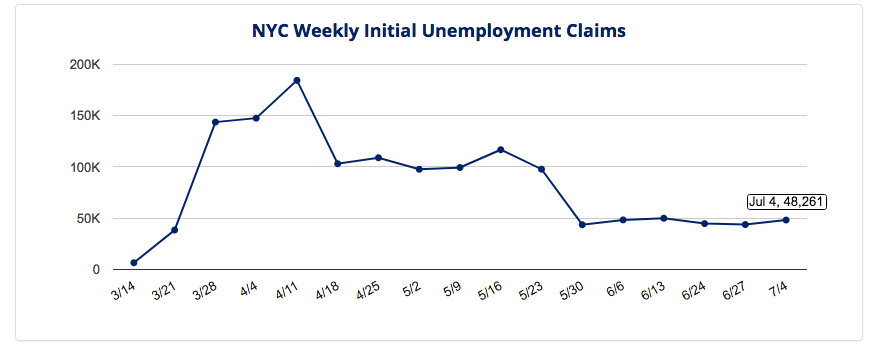
Scott M. Stringer’s Chart 3 above depicts New York City unemployment claims. We have currently – 48,261 initial/first time unemployment claims as of July 4th, 2020. Please note that this is not continuing claims. You can still see that the trend is still flat; it’s not trending down. It is still the number that we had in the end of March – but slightly higher.
If New York City’s economy might have to re-close and if it needs to go back on PAUSE, we might see that number go back up again if it’s a new category of workers who haven’t filed for a claim before. But, as we all know, if one has reached their maximum, permitted amount of weeks of unemployment, you cannot reapply until you get to the next 12 month cycle.
For national rates, the unemployment rate was 14.7% on April 2020 – which is the official unemployment rate, excluding discouraged workers. By June 2020, the unemployment rate was 11.1% – which most of those were rehired temporary layoff workers. We are unsure as to if furloughed workers fall into this category. It really depends on each employer and if they are using a formal and official word to describe what they are doing with their employees, OR in most cases, if they’re calling them furloughed when it turns out to actually be a temporary layoff.
As mentioned above, questions that arise are those who were furloughed, do they count as employed or unemployed? I believe that being furloughed counts as being employed. However, you can collect unemployment if you are furloughed but I am not sure if you are counted as part of the unemployment rate. If their employer indicates that their job will be available when they return to them, they would be employed. However, those furloughs tend to be less common than what’s called a temporary layoff and they may have a high prospect of returning back to work.
The Great Recession peak was 10-11%. So the longer that the current national rate (14.7%) is above the Great Recession peak, which is what it seems like in this case, will take us longer to recover.
According to the U.S. Bureau Labor of Statistics, 3.9 million individuals were employed in NYC as of February 2020. By May 2020, 2.9 million individuals were employed – which shows that that there was a 25% loss in jobs. On the other hand, 138,000 individuals in NYC were unemployed on February 2020. By May 2020, 662,000 individuals were unemployed.
What’s interesting about this, is that the current official unemployment rate in New York City is the greatest among Asian workers – which is 25%, followed by Black workers – which is 24%, then Hispanic/Latino workers – which is 23%, while White workers fall into 11%. This is an indicator of the disparate and inequitable economy that we live in and have been living in for decades.
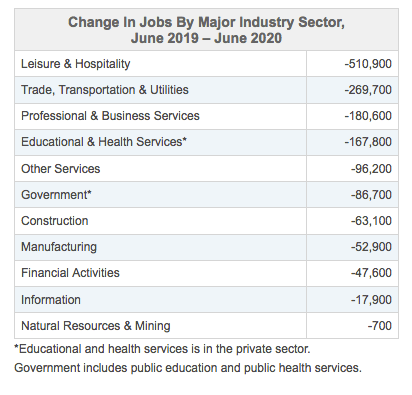
The U.S. Bureau of Labor Statistics released an insightful report on the Current Employment Statistics Highlights on changes in jobs, job losses and job gains in both private and public sectors from dating from January 2010 through June 2020.






 Careers with Michelle