
Things That You Should Never Leave Out On Your Resume

Image via inChemistry
You may want to refer to the source as well, where they discuss the top 10 early career resume mistakes.

These are common things I want to briefly highlight some resume advice for folks who typically miss out on the important details.


✎ Add a section called SKILLS. Many job seekers forget to do that. This section is just as important as your work experience and education. Here, you would put the names of the software and apps SPECIFICALLY that you use well and that you’re proficient with.

✬ E.g. Microsoft Office is too general as many only just list that. Expand on it – do you use MS Publisher, MS Access, MS One Note, One Drive, Teams, and SharePoint as well? These are also part of the MS Office Suite, and some are critical business tools as well.  So, list out the all the tools used by name. 

What about social media tools? Skype or Skype for Business, YouTube, LinkedIn, Twitter?  The list goes on, but you should list the ones you use. If you have a LinkedIn profile, add it to your resume – if not, be sure to create one and start to network there if you’re looking for jobs. This is a good thing to show employers as they can see beyond your resume. According to Zety, “a recent study says that up to 40% of employers may not consider interviewing you at all if they can’t find your LinkedIn profile.”

Please also keep in mind that hiring managers also look at “crossover skills”… that is what OTHER skills do you bring as shown on your resume? — Does your resume show a history of consistently sticking to your goals? Do you stay on jobs for short-term or long-term? You want to be mindful of that because if you are selected to the interview — During the interview, did you come across as teachable and focused on success, or “just need a job” attitude? If you don’t know what crossover skills you should include, you may want to refer to 8 Crossover Skills You’ll Need Whether You Go To College Or Not.


EDUCATION – Just list your most recent education. If you have attended a college/university, please do not forget to include what your major is. This is especially helpful for employers to know when you are applying for a job in a specific field.

Note: High school graduates, College students and recent graduates often include their GPA in their resume. However, if you are worried about a low GPA, simply leave it off your resume. You can still include your school, graduation date, and any awards received.

If you are still attending high school, or you are currently an undergraduate in college, or if a high school diploma is your highest degree, you can include your high school information. To save space and time, there is no need to include your high school if you have completed higher education. It is only relevant if you have graduated from high school and are not planning to attend college or a university.

However, once you complete any other form of education including a training program from a trade school, you should eliminate this HS information from your resume. Your resume should constantly be up to date.


WORK EXPERIENCE – I cannot stress this enough, however job candidates often miss out on the details of “numbers that define” how they did their job. Always use numbers to show how you helped your employer, as that is what many employers want to see.

Remember, list accomplishments/achievements, and not just your duties. Don’t forget to include numbers as well!

“Greet customers” tells me what you do… but not how well you do it; “Managed 50-60 face-to-face customer inquiries daily” tells me both;
“Restocking shelves” tells me what you do… but not how well you do it; “Supported store revenue goals by overseeing 17 aisle inventory consisting of 300 items per shelf” tells me both.
♛ How many team members did you collaborate with? What tasks or goals did you meet together?
♛ Were you involved in monthly, quarterly, or annual cycle count of the inventory at either store?

Don’t forget – employers are looking for candidates who bring the “tools” for success.
❅ E.g. What tools did you use for custodial duties?


✎ For a general resume, what is listed above would be ideal… I want to underscore that. That said, however, with a little more effort on specifics, you’ll be able to transform it into a “powerful personal branding tool”. Your resume is your marketing tool of selling yourself to the employer.

✎ You can also visit O*NET OnLine, where you can point your cursor to Occupation Quick Search and search up “Customer Service Representative” and there, you will find many performance objectives that match up things you also did. Use those to create additional bullets that demonstrate your acquired skills and experience.

How To Combat Impostor Syndrome

Image via UnderPinned

“I just got this job by luck, I feel like I do not belong here.”

“I feel like everyone in my team is smarter than I am.”

“I feel like I’m unable to comprehend anything. I am going to fail.”

Many suffer from impostor syndrome at some point in their lifetime related to the work that they do. Those who are constantly in doubt about their potential, work and success.

Impostor syndrome is very common for individuals who feel like they are never good enough no matter how much they have accomplished, how smart others say they are and how successful they may seem to be. It is never enough for them because they find it hard to accept praise and constantly fear failure. It usually affects their confidence and career growth in the long-term.


❀ Instead of striving for perfection, know that it is OKAY to be imperfect. Accentuate on the value that you bring and be realistic on the goals that you are setting for yourself.

❀ This is easier said than done, but push yourself to work harder to the point where you don’t feel like an imposter. You have to do all the stuff that makes you feel like an imposter in order to not feel like an imposter. Don’t wait until you develop your confidence, because by then it would be too late. Put yourself out there now. Courage comes from taking risks.

❀ If you make mistakes, don’t beat yourself up to it. Take the time to learn from it, and how you can overcome this differently and do so with care – by taking responsibility for your failures. Analyze those mistakes honestly and objectively. Ask yourself the 5 W’s and H on what you did wrong. Map out a plan and practice the skills that will prevent you from repeating the same mistakes.
Failure is only the opportunity to begin again more intelligently.” – Henry Ford

❀ Stop comparing yourself to others. Everyone has their own stories, own strengths and weaknesses.

❀ Aspire to learn from your team members to know more about your role. It is okay to ask for help when you don’t understand. Learn to appreciate constructive criticism because when you don’t ask for help, you are actually putting your team behind. When you ask a question, it will bring more ideas to the table and oftentimes – inquiring leads to better solutions.

“Chances are, acting on what you’ve learned will require the discipline and motivation to change your habits, or to change the way that your team works. Doing so will help you to avoid self-sabotage in the future, and will allow you to reap the rewards and benefits of implementing better work practices.” – according to MindTools

❀ Own your success. You did not get the job by luck. You got the job because the hiring manager saw potential in you. Believe in yourself that you are capable of doing the job. This also means, be more open to saying “YES” to opportunities that come your way. Of course, those who have had impostor syndrome for a very long time, can find it hard to accept new challenges, because they feel that they are not capable or worthy of taking on that challenge. But be mindful that saying ‘yes’ can open many doors for you. Don’t let impostor syndrome shy you away from these growing opportunities.
If someone offers you an amazing opportunity and you are not sure you can do it, say yes. Then learn how to do it later.” – Richard Branson

❀ Let go of that pressure on yourself, let go of your perfectionism and break the ropes on all of that negative talk! Impostor syndrome is often like a devil that manifests as an evil spirit inside one’s mind because all the negative thoughts that are controlling you, can heavily impact your stress and anxiety levels. Be more selfish for your own good and treat yourself with more respect and positivity. Your body is like a temple.

❀ Embrace your feelings, stay kind to yourself and bring positivity to the spotlight! Take it one step at a time and don’t let self-doubt consume you. Let us be guided by facts, not fear.

How To Reduce Your Chances of Being Laid Off

Some have inquired about how they can avoid or protect themselves from being laid off in the future, or seeking a career that would be recession-proof. This can be a scary thing especially for folks who are employed with a company that offers no stability, no perks and no advancement opportunities.. and even companies who are at risk of laying off their employees right now due to the global recession. During a time of uncertainty, this is very tough because nobody is immune to this.

Image via GeeksforGeeks
Check out their article. They have excellent tips on how to manage layoffs as well!

In this case, half of the world is unemployed due to unwanted situations of COVID-19: temporary furloughs which in many cases, leads to permanent furloughs and massive layoffs over the span of 2-3 months since the pandemic.

So, for those of you who are currently employed, take a moment to appreciate the job/career that you have. Appreciate your contributions. Appreciate your colleagues. Be thankful for what you have and what you receive. Many of us do not take the time to think about this, however the job that you are currently employed at, gives back to you in many ways. Of course, income is one of them. But think about the things you are receiving at the moment: paid time off, health insurance, blended benefits, experiential rewards. The list goes on.. There is always something to be thankful for.

Sometimes, layoffs are hard to avoid (due to organizational restructuring, business downsizing, a pandemic, etc), however the list of advice below are ways you can prevent or protect yourself to lower the odds.

  • You should hone or learn a new, unique skill that will set you apart from others in the applicant pool. Put a plan in place to gain those new skills. List the skills that you want to learn.
  • Make an effort to educate yourself on all aspects of your employer. During these strenuous economic times, it is likely possible that you may be asked to take on additional tasks of other employees – which can be something that you may be under qualified / overqualified for, let alone something that you do not feel comfortable in taking on.
    • Show that positive demeanor, no matter how hard it can get – because in the long run, this behavior will yield good results. Employers will most likely remember those who assisted them through these arduous times.
    • When you are knowledgeable of all aspects of your employer, this shows that you are more exposed to different projects and learning about what other teams are doing. If you make the effort to engage in team meetings, inquiring to collaborate and assist colleagues with project deadlines that they are struggling to meet, this will convince the employer that you are a valuable asset to them – leading them to reconsider their decision in letting you go. You already have built a strong bond with the employer and they will have a difficult time in letting you go.
      • Do not slack off just because you have received a positive performance review or an appraisal from your boss/supervisor.
      • Take an extra mile and do more than just the responsibilities that are being assigned to you. Deliver great results. Understand the contribution that you make. This is key to becoming a superstar in your workplace. Employers want irreplaceable employees.
      • Put your skills into use and take ownership. Acknowledge how you are viewed and reevaluate what your reputation is. Instead of focusing on day-to-day and short-term goals of the job, start thinking of long-term goals and how you can demonstrate your leadership to your employer.
        • How can I improve the financial health of the business?
        • How can I build a lasting legacy?
        • How can I increase more traffic?
        • What new strategies or tools can I implement to market my employer?
        • Any new products or services I can add to the employer’s existing offerings?
        • Are there ways I can increase productivity?
        • What are some of the best practices to increase market share online?
  • If you are a job seeker who is seeking employment during this suffering economy, make sure that you are researching on the fastest growing companies. If you are located in the New York City area, you may find this helpful: 100 Fastest Growing Companies in New York City in 2020. Don’t let the unemployment numbers fool you, as the labor market is more competitive now than it ever was before due to the high number of job seekers and less job openings.
  • Stay in touch with your network on LinkedIn and reconnect with your existing connections – such as your former bosses/supervisors/colleagues, employment advisors! Do so in a meaningful way where they can speak favorably and highly of you. With this, you will have more people to speak with, as well as keeping you in the loop of any potential opportunities that can reduce your chances of being laid off.
  • If the employer you are working for is at risk of laying off their workers or filing a bankruptcy chapter, you might want to put yourself in your boss’s shoes. Seek ways and methods to help your employer reduce costs, increase revenues, etc.

Tips for Marketing Your Webinars and Virtual Workshops on Social Media

Everything has shifted virtually, with everyone being stuck at home and glued onto their phones – applying to jobs, working from home, attending virtual interviews and acquiring new digital skillsets by taking online classes.

At times like this, we should never stop educating and sharing information with our communities especially when we are in the midst of a pandemic with very limited resources.

The following suggestions are for the workshop facilitators.


Before you write, consider the following:

♕ What is the goal of my webinar/workshop?
♕ Who is my audience? (ex: small businesses, startup businesses, job seekers, students)
♕ Do I know my call to action?
♕ Do I know what I should include in my program flyer?


First, you want to have an attention grabbing and presentable flyer:

  • Keep your language simple and error free. Avoid confusing sentences and words that do not fit the context of your workshop.
    • Be realistic and make sure your flyer has a friendly and relaxed tone that feels welcoming and speaks to the audience.
  • Keep it brief.
    • Include a brief description on what your webinar/workshop will be about. No more than 2 sentences. You want to save the details for the webinar. That is the point of a webinar.
  • Use realistic photos (preferably those that you took and it should relate to the flyer)
    • Keep them minimal. Less is more.
  • Include a clear call to action or a link for the audience to learn more.
  • Make sure the flyer is catchy and exciting.
    • Be creative! Add visual interest by using colors and patterns. I’ve noticed that posts with images often receive higher engagement.
  • Make sure your co-branding is accurate, in terms of the logos and positioning.
  • Double check to ensure that nothing is left out. And of course, don’t forget to spell-check!
    • This can turn your audience away if they notice spelling errors on the flyer.

Second, how do you increase attention and engagement with your flyer through social media?

  • Make sure your tone sounds like a human, and not like a robot. Keep it brief and simple. No one wants to read a long and boring flyer.
    • It should reflect your tone and style. Keep it consistent with the language and imagery.
    • Include real-life images that is necessary and applicable to your content.
  • Consider your goal.
    • Be transparent about how you want to facilitate the webinar/workshop.
  • Co-brand correctly! This is so important.
    • Include necessary and accurate hashtags on your posts.

Example Template for Marketing Your Online Event

I will focus on job seekers as my audience, since the webinars that I have been facilitating are catered to job seekers.

Pre-Event: We are pleased to announce a new virtual series of our Career Development webinars, which will focus on job searching strategies during today’s tough job market. Join us for a free virtual workshop focused on Chronological vs. Functional Resumes on [insert day, date and time / ex: Wednesday, May 13, 2020 at 2PM] to learn about the advantages and disadvantages of using both formats. Please register here. [Include RSVP or webinar link here]

A pro tip would be to hyperlink “register here”.

➜ You may want to consider marketing your event on these social media channels:
LinkedIn, Twitter, Facebook, Eventbrite, Instagram, your organization’s newsletter/website/blog

➜ Include hashtags to increase visibility and engagement:
#careers, #jobseekers, #jobsearch, #careerdevelopment, #jobs, #professional, #business, #professionaldevelopment, #resumes

After the event, it is necessary to share photos on your organization’s newsletter, LinkedIn and other social media platforms that you have taken just like you would at every professional event that you attend.

Except the only difference is that these events are fully virtual now. Instead, you can screenshot your audience on Zoom, Cisco Webex or Google Meet. If you want to take a photo, make sure you switch to the gallery view (in Zoom’s case) so you can capture everyone. If the host’s screen is being shared, please be mindful that you do not screenshot their PowerPoint presentation due to strict policies/confidentiality that is enforced by each employer.

In other cases, if the webinar was held via GoToWebinar, there is no access to the audience’s face nor the speaker/panelist since it is a listen-only mode. Then you would not need to take a screenshot. However, there is another solution. You may want to share about your experience and highlight a few insights/key takeaways that was helpful and enriching to your audience on your LinkedIn post!


See below for some free online resources/tools to aid you in getting started with your content creation.

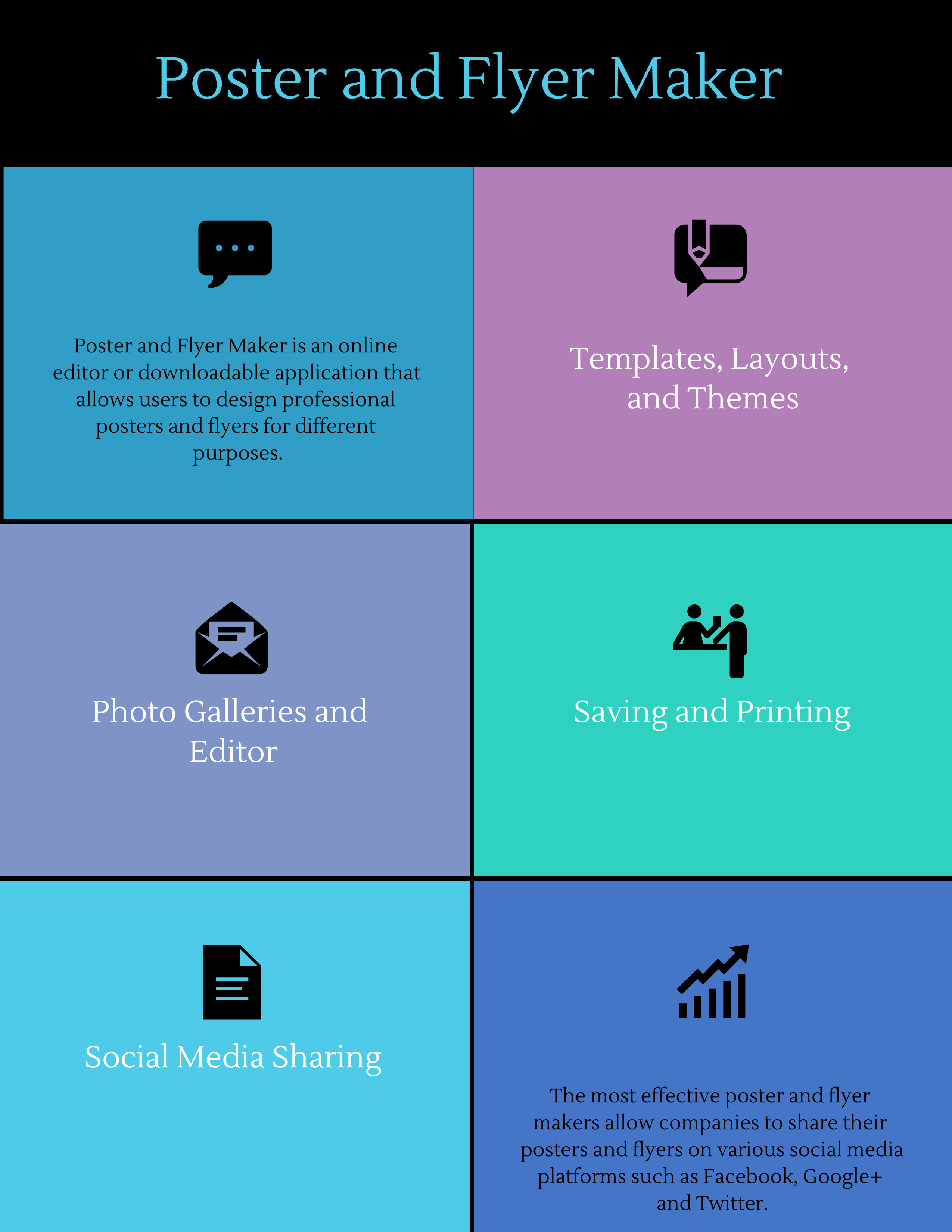
Before checking out my suggestions below, I recommend reading this great article to see which platform best caters towards your needs: Top 9 Free Poster and Flyer Maker Software

https://www.predictiveanalyticstoday.com/wp-content/uploads/2019/07/What-are-Poster-and-Flyer-Maker-Software.png
Image via Predictive Analytics Today

Canva
Flyer Templates
Instagram Templates
Facebook Templates
Twitter Templates

Adobe Spark

PosterMyWall

Crello

How To Get Past The Applicant Tracking System (ATS)

Image via TalSuite

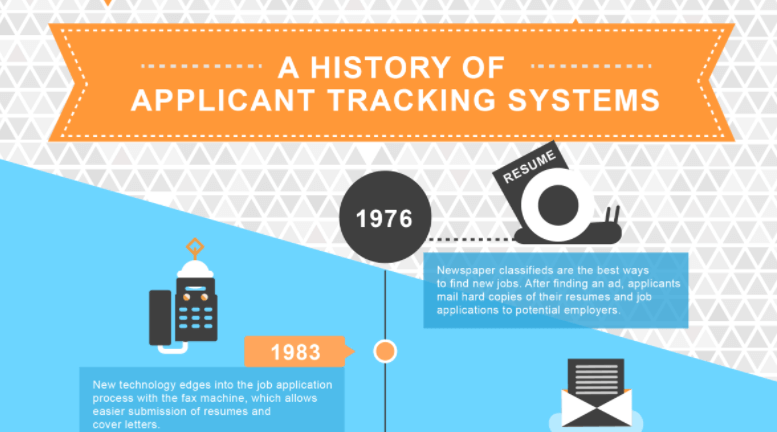
I am sure many of you are aware of what an Applicant Tracking System (ATS) is, since all job applications are required to be submitted online. Back then, job seekers had it way easier. They just had to rely on the newspaper and telephone, and they will be asked by the employer to come in for an interview. However, they have since, revolutionized the hiring process and the labor market in a blink of an eye.

Image via Jobscan
To find out more about how Applicant Tracking Systems have evolved, their article gives useful facts on their infographic.

An ATS is basically a robot that is programmed to pre-screen the applicant’s resume before the hiring team gets a chance to lay their eyes on them. Obviously, it is not as intelligent as humans are, since it is pre-programmed to do what it has to do.

The ATS is programmed to scan for specific keywords that the employer has entered into the system. Some resumes will only be selected to move on to the next step, based on the keywords that the employer has configured. Many employers use the ATS as a way to screen out candidates by asking knockout questions. This is a way to determine which candidates are able/willing or unable/unwilling to perform a job function. For instance, if an ATS is programmed to eliminate resumes that do not hold a Bachelor’s Degree, then those with an Associate’s Degree will definitely not be considered. Here are more examples of the types of knockout questions to look out for when applying on an online portal/job board.

The ATS has simplified the hiring process for employers, since 75% of recruiters and talent managers use some form of recruiting or applicant tracking software; according to Capterra.

On the other hand, causing it to be opposite for job seekers – the ATS makes their job search process more challenging and stressful as they have to pay close attention to every little detail. According to Mashable, nearly 80% described their job search as time-consuming and stressful, and many reported that they would be deterred from completing an application if they encountered tech hurdles (60%), couldn’t upload their resume (55%), couldn’t follow up on the application’s status (44%) or couldn’t complete the application on a mobile device (20%).

The nitty-gritty of getting past the ATS is to analyze and study the job description and keywords carefully as you tailor your resume to what they are looking for. Many job applicants tend to just submit their resume without tweaking their resume to the positions that they are applying for. Always make sure your resume matches the job description and that it has the exact keywords listed.

Note: The ATS is unable to distinguish the difference between the terms CPA and Certified Public Accountant, it is always more safe to list the whole word out instead of abbreviating or shortening it.

Note: Make sure your resume font and format is simple, organized and consistent. If a resume looks too fancy and abstract with colors, images, symbols and other unnecessary stuff, the ATS may count it as unqualified and will move on to the next resume. According to Forbes, studies have shown that up to 75% of qualified applicants are rejected by ATS programs because they can’t be read. You don’t want to be one of the 75%.


DO’s

  • Keep your font simple. Use Times New Roman, Calibri, Arial or any font that looks “appropriate” and “legible”. Make sure the size font is between 10-12. No bigger, no smaller.
  • Use simple bullet points like the one I am using at the moment or even a dash (-) works as well. Just make sure it isn’t a special kind of symbol because that can program the ATS to view your resume as “unqualified” and you don’t want to jeopardize a qualified resume just because of an unrecognizable symbol.
  • Consistent formatting. This is important to ensure that your resume will pass an ATS, so that it would not confuse the system.
    • Margin Size: 1 inch
    • Left Alignment is the way to go because that is the standard way of reading. Don’t center it or align it to the right. Definitely, do not include text boxes. I’ve seen some job seekers do that. This will just confuse the ATS. If we all read from left to right, that is how the ATS will be programmed to read it as well.
    • Length: Keep it minimum at 1 page and maximum at 2 pages. Remember, make sure it has the included keywords and is visually appealing to the employer! You are not writing a Curriculum Vitae. Unless you are applying for a profession that you have had years of experience in and highlighting publications that are linked to the work you do, (i.e., college professor), there is no need to go past 2 pages with irrelevant experience. Know how to distinguish the difference between a resume and a curriculum vitae.
    • Font: As mentioned in the first bullet point.
  • Your resume should aim towards the specific position. Like I have mentioned earlier, read and study the job descriptions. Always always always, keep a look out for specific keywords whether it is in the required qualifications or preferred qualifications that involves your education, competencies/skill sets, licenses, trainings and experience.
  • Do your research on the employer! Make sure you are always tweaking your resume based on their mission, goals and culture.
    • How can you be of value to them? How does your experience, education, skill sets match the employer’s needs of the role?
  • Make sure your section headers are simple: “Objective”/”Professional Summary”, “Skills”, “Certifications/Licenses”, “Work History”/”Experience”, “Education”

DON’Ts

  • Unless you are a graphic designer, avoid including images, graphics, tables/charts, special fonts or unrecognizable symbols. The ATS is programmed to read simple and straightforward things.
  • As mentioned in the DO’s section, section headers are preferred to be simple rather than overdone. An ATS will not understand “Where I Attended School”. So leave it as “Education”.
  • Do not misuse keywords. Use them where you see fit.
  • So many job seekers that I have assisted often put on the bottom of their resume, “References Available Upon Request”. This consumes space and employers obviously know that if needed, they will contact you for it.
  • Select the right file type for your resume. To play it safe, upload your resume as a .doc, .docx or .pdf file. These are the most common and preferred formats. It just looks more appealing to employers as well.
    • Please avoid using specialty formats such as .dot, .dotx, .rtf, .txt, .htm, .docm, .dotm, .xml, .mht because not only are employers unable to access the file, but many ATS can’t read them.
  • Categorize your section headers carefully.
    • If the employer is seeking specific skills (pro tip: when they list the requirements/qualifications, pay attention to those on the top as those are what they looking for in a candidate the most) and you have that, you may want to shift your skills section to the top while leaving your experience and education to the bottom.
    • If the employer is seeking 5+ years in talent management and you’ve been a talent lead or in the HR team for over a decade, you may want to put your experience first and highlight those relevant skills as you go along.
  • Never list your job duties using other terms other than action verbs!
  • When listing out your experience, make sure you do not include the word “I”. It should always be in third person as if you are the narrator of your resume.

Still need more career and resume advice on how to tackle the ATS and ensure that you land your dream job/career? Check out TopResume’s useful article and their informative infographic about ATS.

Alignment of Core Values and Recommendations on Improving Behavioral Expectations Internally

Image via Nvolvegroup

What are the ideal core values that employers are looking for in candidates? Each employer has different behavioral expectations, however this has to align with what the candidate is looking for as well.

For instance, let’s look at the retail sector. For example, CVS Health vs. Nordstrom.

CVS Health is more than just retail, as it is truly focused on healthcare. CVS Health’s 5 core values are Innovation, Collaboration, Caring, Integrity, Accountability.

You want to work for a company that has and shares the same values that you have – so you want to research and make sure that company’s values match your values and style. Basically, you need to do your homework by thinking deeper on what that means. CVS Health can acquire and adopt new practices if you are looking for innovation.

Nordstrom is highly focused on their core values as well – Customer Obsessed, Owners At Heart, Curious and Ever Changing, Here To Win. If you are applying for a job, they usually list their core values on the bottom of the description.

CUSTOMER OBSESSED
We strive to know our customers better than anyone else. We listen, anticipate, build trust and move with speed to deliver on their needs.

OWNERS AT HEART
We treat every interaction as an opportunity to make an impact and deliver excellence.

CURIOUS AND EVER CHANGING
We approach problems with curiosity and create solutions. We unlock potential to be bold, think big and inspire innovation.

HERE TO WIN
We’re committed to delivering results, both today and tomorrow. We win as a team by supporting and challenging one another to be better every day.

Nordstrom Careers

Now, when you are applying for a job – you do not just want to solely focus on submitting 50 resumes via Monster.com or Indeed.com without knowing the purpose of the company! This is one of the biggest mistakes a job applicant can make. If you think that relying on online applications with just your resume and cover letter is enough to land you an interview in 2020, you need to try harder. With the highest unemployment rate in history, there are more available job seekers than job openings. You are competing with many hungry job seekers. And talent acquisition is not going back to the way it was, pre-covid.

Keep in mind that when applying, most applications require you to complete a Virtual Job Tryout (It is typically valid for 3 months if you score well. If you don’t score well, you can reapply 6 months after your application date) – It feels like an assessment, but what it’s really like is that it’s a way to find out what it would feel for you to work there and see what you’ll most likely do and what you’ll least likely do.

For example, CVS Health implements Virtual Job Tryouts to deliver better quality candidates and fill roles quicker.

“What work style is most like you?” It’s just mostly looking for you to answer consistently and honestly. Don’t lie, keep your professional hat on so that the results can determine what you are able to do in your job. For example, you want to put yourself in the customer’s shoes and think of what it would be if you were a family member shopping at your local retail store.

Once you have applied, please don’t forget to go on LinkedIn – begin to reach out and start building relationships with your potential hiring manager or colleagues in the recruitment/HR team. Let them know that you understand their needs, mission and goals and find ways to emphasize your value in relation to them.

The retail sector among many others, are one of the hardest hit right now – with some temporary or permanent closures of hundreds to thousands of stores, production coming to a halt, getting ready for a second or third stage of layoffs; in which all of these factors are causing bankruptcies, putting businesses in massive debts – resulting in thousands and millions unemployed as businesses are no longer in service.

However, research shows that the healthcare sector is high in demand and the demand will continue to surge in the next 5+ years. Healthcare is so crucial to the economy and the New York job market growth as well as many states.

Luckily, if you have worked in retail for many years – you are still in luck! CVS Health is still actively hiring. Sometimes when applying online, hiring managers receive a lot of applications and it will take them a long time to filter through the applicants’ applications. So a pro tip is when you are going to the store to do some shopping, you want to also let the manager know – by introducing yourself, give your elevator speech about how you have applied for a role with them. Keep in mind that you are sort of interviewing with that person already. You want to show them your first impression.


On the other hand, let’s look at Spectrum (Charter Communications). Spectrum offers four primary value propositions: accessibility, convenience, performance, and brand/status. Let’s say you are looking to apply for a Customer Service role there. Here are some tips, coming from Spectrum’s recruiter.

  • If you have 20+ years in customer service, customer account management, resolving customer concerns – you’ll do well on the interview.
  • But, there is a computerized assessment you would have to first pass to get the interview.  The test is designed to answer the question, “has this applicant the aptitude and / or experience to work in a call center?”
  • If you’ve worked in a call center (like 311, Geico, Telemarketing, Survey Center), for certain you’ll pass the assessment based on your experience alone – however if you’ve never worked in a call center but have the aptitude for it, you’ll still pass the assessment. If that really isn’t your thing, for sure you wouldn’t pass the assessment – then, the system will notify you your application will not be moved forward.
  • If all of those factors work for you, then, you should give it a try. Click here to apply.

But before you apply, I want you to make sure that the employers that you apply for, has core values that aligns with your values. You want to ask yourself, “What values do I look for in my future workplace?”

This is important to so many job seekers that I have assisted. Many candidates look for employers that not only care about their employees especially during this challenging time, however the employers must have missions and values that align with the candidate’s personal values as well. There are so many well rounded candidates out there that are looking to work on products that matter, especially when they are deciding where they want to head towards in their career path.


Transparency of core values are important, but not all employers express it in their job descriptions. Below are some of the company values that HR professionals and recruiters from different states/countries and sectors/industries, provided 1-2 of their multiple perspectives – in which they are looking to improving their behavioral expectations for their employees and organization in the long-term:

  • Me: “Stay committed to eliminating barriers that restrict the employment opportunities available to the disabled and minorities, by making sure that all individuals are supported and feel included regardless of age, race, gender, religion etc. – which ultimately leads to a bigger step in being a better employer.”
  • Manager from the Recruiting Operations team at a technology-based consulting company: “Improving behavioral expectations could revolve around a rewards based system for positive customer praise. This could be a public practice where an employee is acknowledged company wide for going above and beyond for customer, receiving the deserved approval. This illustrates the importance of the company’s values with recognized appreciation. For the specific role of Program Manager, a financial reward could be given acknowledging the positive impact their behaviors have had on the customer. This would promote the continued effort of the behavior producing favored results for all parties.”
  • Be transparent in compensation to gain employee trust.
    • Recruiter at an automotive insurance agency: “My recommendation is to really stay true to our min, mid, max points of roles and to share with the candidates a narrowed range that their compensation will increase before they interview. This gives them a chance to decide if the position aligns with what they are hoping to get out of it and also it doesn’t take away from their moment of celebration if they are shocked at the amount they are offered. I think the fear from our company is that we don’t want to create an environment of people pursuing roles solely for the pay and we want people to pursue their talents and interests. I happen to agree with this, but I think it’s also realistic to believe that we’re all here in someway for a paycheck and a candidate is agreeing, before seeing a salary range, to give 40+ hours a week to this team and their promise to ‘work with purpose and energy’ (our value) but we need to offer them the same respect of giving some indication of what we feel that is worth as far as a salary goes.”
  • Human Resources Recruiter/Employment Specialist at a College: “We currently have a bonus program in which employees who interact positively with our clients are eligible for a significant bonus. However, not all positions interact with clients, so a number of employees are automatically ineligible.  Instead, it may be beneficial to have some kind of reward or recognition program for colleagues who have a positive impact on their coworkers and/or who show respect to everyone that they interact with. This would reinforce the importance of those interpersonal skills. 
    To improve sustainability we could have a program where individuals who come up with a sustainability program or initiative to receive a portion of the money that was saved due to the implementation of their suggestion or some kind of recognition. We often talk about the importance of sustainability but demonstrating some real-life situations may help employees understand why it is important and increase their usage of the various strategies as well as our employee’s commitment to finding new ways for environmental and financial sustainability.”
  • Talent Acquisition Specialist at a management consulting firm: “To improve and sustain each employees behaviour with a clear focus on the three school pillars, an ongoing mentoring program among staff and faculty could be taking place so  each employee can learn from others on different behavioural situations that they’ve experienced in the past. Another one could be to extend a situational assessment test during the recruitment process of new staff or faculty  members. Therefore the test could more precisely and effectively identify staff behaviours when exposed in different situations.”
  • Talent Acquisition Service Manager in a globally operating technology company: “Area of improvement is to have a culture meeting that would allow employees from different areas of the organization experience more these values and shared with others outside of their own organization and that would help embed more these values within the employees so it becomes part of their DNA of service and mentality. Have these values as a permanent part of the employee’s performance metrics of each objective. Communication tends to focus on a specific strategy and can feel disassociated from the values which can tend to cause confusion if these are not constantly articulated by Leadership.”
  • Talent Acquisition Specialist at a mobile telecommunications operator company: “Firstly, many employees do not see a link between the values and their role, so a good way of communicating these values would be to include them in the individual employee’s Job Description. Each task Listed can have a box next to it which identifies the value (if applicable).
    Secondly, Employee Value Proposition campaigns should not be run once and forgotten, they need to happen annually to remind employees.”
  • Director of Talent Management at a software startup company: “Our company is still in its early stages and our core values were recently introduced. One way in which we could improve behavioral expectations is by incorporating our core values and expectations into our recruiting process. Our values should be represented within our job postings, discussed during the screen process and be a part of our actual interview questions so that we can establish how a person will fit into our culture. This would also ensure that employees know what’s expected of them on their first day. Another way we can incorporate these expectations is through our performance management processes including 30-60-90 day plans for new hires, performance reviews, performance plans, manager/employee 1:1s and promotions. The first step would be to include the expectations in our goal setting, 1:1 and performance reviews. Goal setting is a great way to tie individual goals to our values. The 1:1s are really a follow up on those goals as well as reinforcing the manager’s commitment and responsibility to the employee’s success. Finally, the performance reviews are a review of the goal attainment and a culmination of the continuous feedback via the 1:1s.”
  • Benefits Manager at a book publishing company: “More transparency at my company is overdue. This is a hugely missed opportunity for the incumbent talent to really feel valued and supported; and that their longevity and careers are equally important. We often find that people who sit in privilege or have been given the privileged of exposure to those making decisions are the ones who repeatedly get recognized or are invited to sit on different committees impacting change.  Something that is currently in the works is rebuilding the structural foundation of mapping out career opportunities and planning.  I think when we become more transparent than more employees will be able to assess what they are trying to aspire to attain and then curate a path to reach their goals. In addition we have to invest in the tools to take on more accountability of performance reviews and put more weight on their value – it’s unfair for an employee to put the time and effort into answering the questions if they are going to go unnoticed.”
  • Human Resources Manager at a real estate – bustling urban playhouse: “I think the organization does a good job with communicating the behavioral expectations. We have a monthly micro-bonus incentive in place that monetarily rewards employees who are mentioned by name in a 5-star online review. My suggestion would be to continue to reward and praise these behaviors, so our employees stay motivated and feel fulfilled. Another suggestion would be to be clearer in communicating our pay scales with regards to long-term growth in positions; this would help employees understand the timeline in which they are encouraged to achieve certain goals/metrics in order to advance within the organization.”
  • HR Professional in the Cannabis Industry: “My recommendations for improving compliance and consumer education are to introduce regular training outside of the new hire period and to make products available at a steeper discount for Retail Associates to try.
    Regular training outside of the new hire period would include an overview of state regulation and refreshers on existing products, their effects, and their recommended use. It would also occur as new products are released for sale. This training would occur in the form of a short seminar, which would include written materials, a presentation by a product expert, and a question and answer session.
    Most of our Retail Associates are product users and have requested to purchase discounted product to test it and report back on its effects. Our regulations stipulate that we cannot give product away for free for this purpose, but discounting is permissible.
    Customers continually ask employees how a product has worked for them, and empowering employees with both the high-level training as well as the hands-on experience will improve the customer education experience.”
  • Lead HR Consultant at a small HR consulting firm: “I felt as though these expected behaviors could have been better communicated throughout the entire recruitment process, starting at the job posting phase. In addition to better communicating our expected behaviors through the recruitment process, a more rigorous performance management system involving bi-monthly ‘check-ins’ would be beneficial. Typically, any given mandate does not last more than 90 days, so having more frequent touch points would be helpful in ensuring the quality of our final product is where we would like it to be.”
  • HR Specialist at a 5 star hotel: “Leading by example – management should clearly stick to the desired behaviors and especially stick to the “top 12″ ones. They should know them by heart so that they can cite the according behavior or standard in case of negligence demonstrated by an employee. This will make it easier for managers to be heard and have their criticism accepted, because they base their recommendation on organization wide common knowledge.  Incorporate the desired behaviors in all kinds of trainings: classroom trainings, mentorings and coachings as well as cross departmental trainings. Use a blend of theoretical reminders as well as practical exercises where the values are connected to resulting behaviors.”
  • Talent Acquisition Partner at a beauty and cosmetic company: “The first recommendation I have for my company when it comes to improving behavioral expectations is tied to the Covid-19 Pandemic: I think it’s important to harp on the fact that just because you’re working from home doesn’t mean you need to work 12 hours a day. Though we will go back to the office at some point, WFH is going to be huge going forward. We care a lot about employee mental and overall health, and I fear we aren’t communicating enough that people need to take breaks throughout the day and stop working at a certain point. We say that behaviorally we want people to not overwork, but we need to communicate that more (over slack, emails, announcements, etc.).
    The second recommendation I have is to be clearer about Career Paths. Our Director of HR was just brought on about 4 months ago and I was only brought on 1 month ago, so this is something we know is really important for us to get done. Part of what I’m implementing is when a new opportunity opens up at the company, the Hiring Manager needs to provide me with a 3-5 year career path for this person. Once I have that, I can communicate it with potential candidates. That said, for anyone in the organization that communication isn’t there, and we really need to reinforce this fact that we want people to stay and grow with us.”
  • Director of HR: “One of two recommendations I would give to the company is around the issue of avenues of communication. We have a strong desire for people to speak and be heard but we primarily rely on the singular form of communication in person or through email. Although this is great I believe more communication avenues would bring about a greater sense of people’s value within the company. Some online company forums and anonymous drop boxes for suggestions and complaints would encourage people’s honesty and make people feel like the company desires to hear from them. 
    The second recommendation an administrative one. On some occasions, we have neglected to reward people for the actions because we simply didn’t have proper administration set in place. This leaves people feeling like they have been neglected within the company. There should be a better format for administering rewards to employees. All those who have achieved something deserving of recognition should be placed within a program that reminds management until they physically check it off as complete.  That way no one will feel neglected by the company but would always receive recognition for a job well done.”
  • Founder and Director of legal services: “At my company, we have 3 pillars that serve as our company values. First, we use technology and operational excellent to deliver a delightful customer experience. Second, we embrace and relish change, growth, and celebrate failures as opportunities to grow. Three, we share goals, support each other across organizational boundaries and we win and lose together. In order to fully embrace our three pillars, employees need to be open minded, accept radical change often and look at mistakes or failures as opportunities instead of as a shameful occurrence. For all of this to happen, communication and transparency are key. In order to improve expectations and measure performance, the use of periodic check ins, and conversations about performance are very important. In addition, I believe strongly in 360 degree feedback, although it requires a mature team, and a commitment to personal and professional development. My organization does not engage in 360s now, however, I think it would be a huge improvement if we did.”
  • Practice Lead on Compensation and Benefits at a multinational corporation that provides next-generation digital services and consulting: “I work for one of the leading service based organization where it is more valued and believe in company cultural Values in the form of “C-LIFE”. Each letter of the word representing a value and it stands for the following: C – Customer delight, L – Leadership by example, I – Integrity and Transparency, F – Fairness to all transactions and E – focus on Excellency. 
    > Compensation plays a critical role in attracting and retaining the right talent to meet organizational goals and also it is important to think about the employee as they are one of the important key stakeholders of the company who has major role to play and align to meet the organization goals Hence it is recommended to demonstrate individual with transparency and fairness in all the transaction with an effective compensation strategy and communication.
    > An effective compensation strategy and communication. should connect the individual performance and organizational outcomes. In order for a total rewards system to function efficiently and effectively, we need to ensure through effective communication on the process / Policy / Training on the company value system.”
  • Recruiting Manager at a College admissions service company: “My recommendations are focused on how we communicate the above behavior expectations/core values. I would first recommenced that we glorify the teacher as well as the student when highlighting student success stories because right now we make a big deal about the student who got into the Ivy league school or had the most score improvement but not the teacher that helped get them there. Additionally, I would recommend highlighting a student who succeeded under extraordinary circumstances (someone in a low income area, etc) event if that success looks a bit more average. We have a tendency to focus on the students who got into Ivy League schools but I think that our average student’s idea of success is simply getting into college or getting a merit based scholarship. We make an effort to help undeserved communities but we never highlight those student’s successes and I think that is more reflective of the average student than the highest achieving student who came to us with a 1400 already and we got them to a 1500 after their wealthy parents purchased the most expensive private tutoring packages.”
  • Talent Management Specialist of Organizational Development at a multinational corporation that provides next-generation digital services and consulting: “Behaviour expectations from employees are largely communicated through managers. Two improvements that can be done – (1) Introduce success stories of folks who have emulated these values and been successful in the organization – this can be communicated to the larger organization for others to learn (2) Introduce a positive reinforcement in terms of an additional incentive for achieving certain specific outcomes that drive those values.”
  • Human Resources Manager at a Staffing Agency that provides nurses for facilities and homes: “One recommendation for improving behavioral goals is by offering a monetary reward when a scheduler finds a replacement for nurses that call out.  Some schedulers just leave a position open due to someone calling out.  Others go the extra mile and call another nurse that can cover the shift.  If a scheduler goes the extra mile, we could give them an extra $50 because they are showing a commitment to the organization. 
    The second recommendation would be to have a quarterly bonus for the percentage of open cases they fill.  As with any job you can work fast or drag your feet.  If a scheduler stays busy they should be able to cover all our open cases.  By choosing to be prudent with their time they are making a decision that aligns with our core beliefs which is to help as many people as possible.”
  • Employee Experience & Organizational Development Specialist at a nursing home facility: “A recommendation that I would put forth as to how we could improve behavioral expectations is to create consistency throughout the organization. It appears that certain teams make up their own rule and expectations, which causes a bit of turmoil when other departments observe these actions/behaviors and try to do the same but can’t ‘get away with it’ because their leader adheres to the company’s standards.  I think this comes down to not all leaders feeling comfortable with having difficult conversations and holding their employees accountable. 
    I believe another area of opportunity is how we communicate these expectations.  We are a large organization – 1200 employees across three different campuses.  We have many front line workers who do not have computer access so simply sending out an email is not good enough.  In theory, leaders should be conveying information with their direct teams but I am doubtful that is actually happening.  I would suggest creating a standard of behavior and having a core team meet with every single team directly and sharing the same consistent message.  From there, I think leaders should be held accountable themselves to ensure this behavior standard is always being met.”
  • Area Manager in the Logistics Department at an e-commerce company: “What could be done better is the transparency to all members of management when seeking diversity within the management staff.  Internally they do make a focus on diversity and inclusion with multiple diversity groups within the organization, in which members of management have open round tables of discussions and panels to illuminate their experiences, as well give insight for entry-level associates feedback on how to help achieve their goals as well.  When hiring externally the recruiter and upper level management have clear data and make a conscious effort to have the population of the management team mirror the population of the employees as a whole.  Where there is a disconnect on the transparency is between the department managers when they are trying to identify all-star associates that they want to train and develop into assistants or entry level management.  If all members of management are aware of the current management profile and the goals of diversity and inclusion, they can evaluate the decisions of who they could possible identify as those future leaders.  This will also in turn help morale of the associates because they will not just see those leaders hired in externally that they can relate to, but know that with hard work they can advance and achieve it as well themselves.
    The other opportunity I see is the practice of hiring entry-level associates.  I do not have the access in data of cost/benefit analysis which I am sure has been performed for the practice of working with a sourcing agency when it comes to hiring in contrast to the internal recruitment department which handles management and higher technical positions within the company.  The sourcing agency I am sure yields a higher quantity of individuals especially to meet production demands at various peak seasons of the year, but due to attrition, cos to hire/train new associates, their productivity, capacity to advance into leadership roles, and whether or not these individuals are in as much alignment with the company values if it would be more efficient or not to invest more time and money into screening to yield better qualified associates that align with company values.  If we are then increasing the quality of the entry level associates that we bring in, then in turn if we as managers are doing our job of proving the coaching and training needed to develop those associates to set them up for success, we wouldn’t have to hire externally as much when it came to managerial roles.”
  • HR Associate for a Meat Manufacturing Company: “I think that we have pretty basic values, but we don’t do a very good job a explaining how and why they are so important to our employees. One way we could improve on this is to start an initiative where we post the values around the office and manufacturing facility with their definitions and ways that employees  help contribute to the values. Another way that we can improve behavioral expectations is to create a recognition program. We can create value cards where people can recognize something a coworker did that exemplified a company value. Drawing attention to good behavior will lead to more good behavior in line with company values.”

Stephanie Cheng: In The Shoes of A Successful Nonprofit Leader

Stephanie Cheng knew from a young age, that she would never become a doctor. She was not a fan of getting her blood drawn and was never comfortable walking through the halls of a hospital. However, she loves helping people and was sucked into the world of nonprofit work after watching an episode of Oprah in Africa, in addition to her exposure of the immense poverty on TV.

Stephanie is no stranger to the nonprofit world. In high school, she was heavily focused on community service and social justice. Stephanie was the President of KEY Club where she received a Bronze Community Service Award from the former U.S. President, George W. Bush for her successful volunteer work, coupled with her outstanding leadership role in the community.

During her undergraduate years at Stony Brook University, Stephanie majored in Business Management, with the thought that she would end up working in the world of finance or become an entrepreneur – but things didn’t work out that way. However, she graduated Magna Cum Laude with a Bachelors of Science in Business Management – where she was very much involved with Marketing for a while.

She definitely did put her degree to good use. She is a Partnerships Specialist for the U.S. Census Bureau under the U.S. Department of Commerce, where she specializes in connecting businesses, nonprofits, local city and state governments to many resources such as promoting social corporate responsibility as well as establishing partnership agreements.

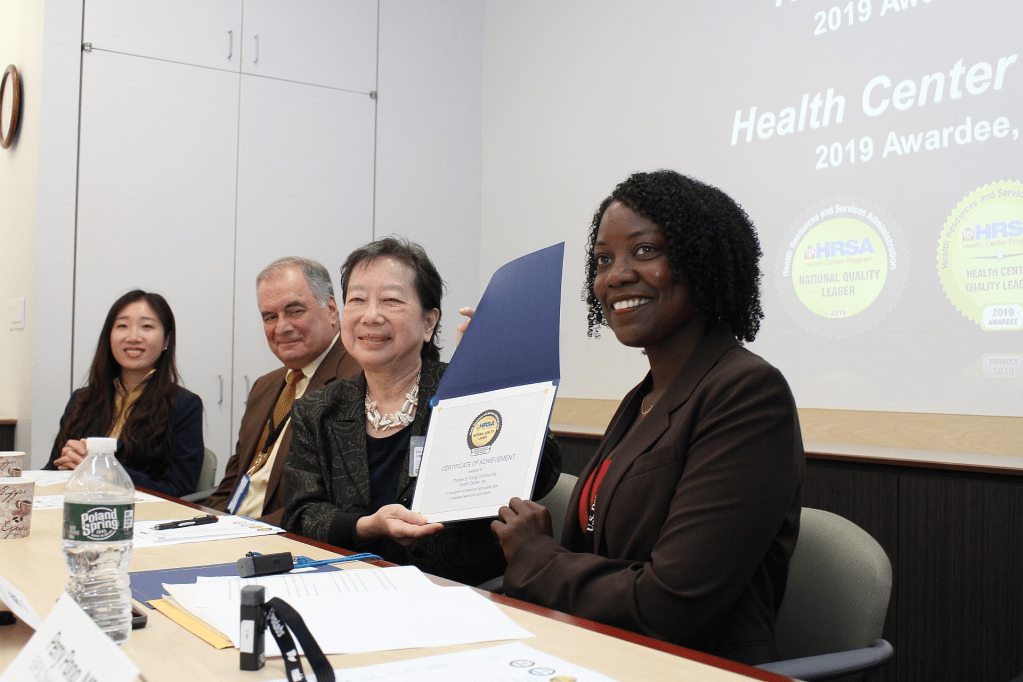
Left – Stephanie Cheng (Board Member of Charles B. Wang Community Health Center) / At a Press Conference

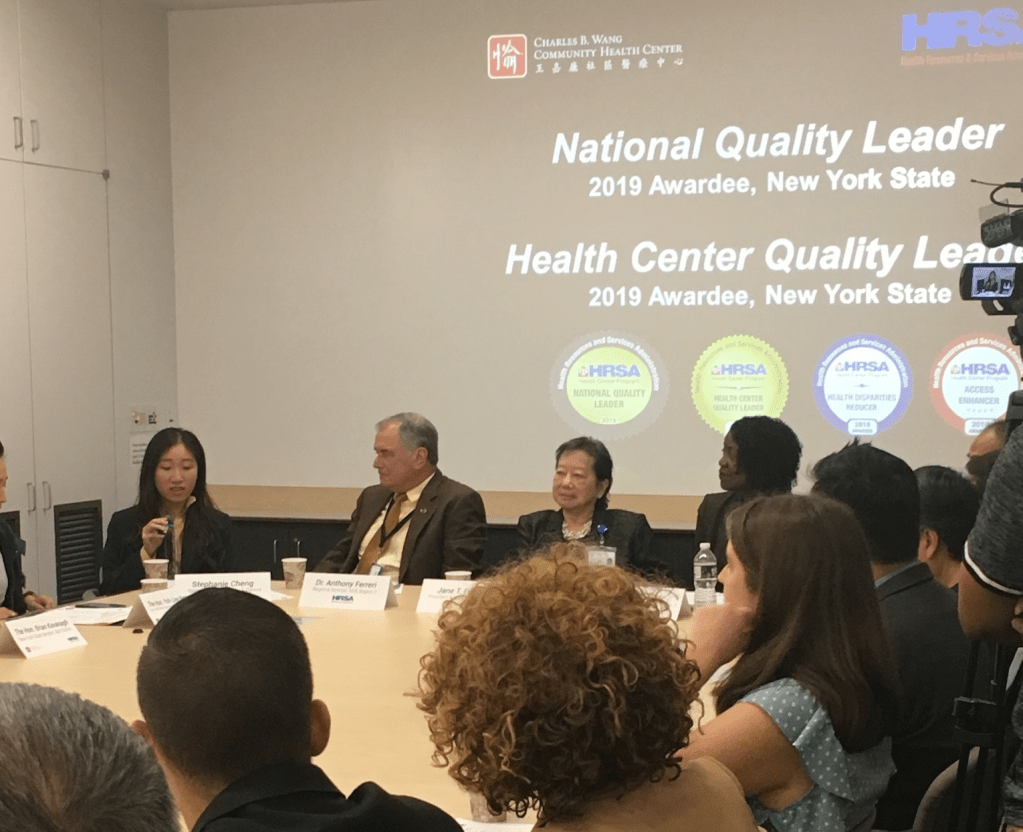
Currently, Stephanie sits on the Board of Directors – of the Charles B. Wang Community Health Center for almost 6 years, which provides free and affordable healthcare for the underserved community. In her role as a Board Member, some of her many tasks include approving the annual budget, establishing policies and making business decisions to ensure the delivery of a positive impact in the community.

Stephanie Cheng speaking at Press Conference

Recently, she was appointed to a national expert advisory board for the National Association of Community Health Centers and the Association of Asian Pacific Community Health Organizations (AAPCHO) under a grant from the Robert Wood Johnson Foundation.

Stephanie Cheng speaking at City Hall In Your Borough
To the left of Stephanie – Peter Koo (NYC Council Member of District 20)
To the right of Stephanie – NYC Mayor Bill de Blasio

If you are interested in learning about joining nonprofit work, joining a nonprofit board, Pro Bono Consulting or volunteering, feel free reach out and connect with Stephanie on LinkedIn!

In her free time, she enjoys traveling and has been to over 42 countries. In addition, she enjoys building websites and she dabbles in acting.


• You currently have been serving as a Board Member at Charles B. Wang Community Health Center since 2014. How has this professionally shaped your career and leadership?

Being a board member of a federally qualified health center gave me a high level overview of the strategic direction of the organization, but also being a patient allows me to see first hand the great work that our doctors and healthcare practitioners are doing.

Collaborating with people from different backgrounds gives me a sense of responsibility and drive. You are always representing the health center. 


• What sparked your interest in connecting businesses, nonprofits, local city and state governments to establish partnership agreements?

I think I was always concerned with how I can maximize impact. Growing up in NYC, I wanted to make a change after seeing people who are homeless or students going hungry at school while trying to learn. I remember when we were recruiting, I signed up a number of people who were homeless. I love working and meeting people so I can’t think of a better way to extend my reach other than giving people an opportunity to work. I think we all want to make some type of impact at work or in our personal lives.


• How has your role as a Partnerships Specialist at U.S. Census Bureau helped the NYC community and Manhattan region in the past year?

We’re building NYC for the next 10 years. The Census determines how billions and billions of dollars are distributed across the country. This is money for the street lights in front of your favorite restaurant, public schools, universal pre-k, school lunch programs, and even how much funding hospitals get. Being a native New Yorker, I’m proud to help my community and make sure that everyone is counted.


• I am aware that during your free time, you enjoy building websites and incorporate some coding. That is an amazing skill set to have on the side! What is your purpose of this and what do you hope to achieve out of doing this?

I have a travel blog, www.backpacktraveling.com and I have a new website up, www.zombiconvalley.com for a book I’m writing called Zombicon Valley – when zombies take over Silicon Valley. I just submitted a screenplay for this to a screenwriting contest. 

I created these websites using HTML/CSS and some Javascript that I copied from GitHub ’cause I rather do things myself especially when I could host it for free using Netlify. The cost for a website is $10 a year for the domain name and I get to learn a new skill, which seems like a good deal to me.


• You participated in a Hall Council at Stony Brook University. Could you tell me more about how this led you to your passion today? How did this help you thrive in your career?

I became a Resident Assistant because I needed a place to live. I literally camped out on my friend’s dorm in a sleeping bag for a semester because the dorms were full and I didn’t apply in time. 

When you’re an RA, you get free housing at the university. And there were a number of notable people that were RAs including Hillary Clinton and celebrities like Adam Sandler, so I thought that could only be a plus on my resume.

As an RA, I worked with a diverse group of students in helping them navigate their school year. There were many issues that came up including the occasional roommate problem, but also issues surrounding mental health. I was a confidante, mentor and friend to people who might/did not have any friends. 

This role taught me another layer of empathy. I remembered having to write up a student because there was a strong smell from his dorm. He was a hoarder and had collected so much garbage and plastic bags that you could not see his floor. We dealt with all types of people and I saw that most of us are going through something.


• You have a very diverse work background. You were very focused on Public Relations and Marketing. How did you make your transition into the non-profit and public sector? Is there anything unique about getting into this sector?

I thought I would go into finance but when I studied abroad in Beijing at Tsinghua University, my plan went out the window. During my winter break, I was in the Gobi Desert where I met a fellow New Yorker who gave me an internship working for a greentech conference for a month. Then, he introduced me to a music producer where I basically hung out with Jimmy Page from Led Zeppelin because they were working on a nonprofit project. When I got back to NY, I thought to myself “Do I really want to work in the corporate world or do I want to make a difference?”

I don’t know if there is anything unique about getting into the nonprofit sector but being kind and having empathy would be at the top. You never know who would get you your next job, so you want to talk to as many people as you can.


• How would you recommend someone who is interested in the same career pursue a similar path?  

Anyone can go into the nonprofit or government sector. It’s probably easier to get into than in the corporate world, however the salary would not be comparable. So make sure you take care of yourself first. I was lucky that I didn’t have any student debt when I graduated. That allow me to pursue anything I want, ’cause I didn’t owe anyone anything.


• What would you have told your younger self that would have added more value into your career today?

Fail fast, learn fast. Watch everything at 1.75 times speed. Speak less, listen more.

What To Do If Your Internship or Job Offer Was Rescinded Due to the Recession: VOLUNTEER

COVID-19 has done collateral damage to our economy and markets, with the labor market being one of the many that has been heavily impacted. This leaves our job seekers feeling stranded and hopeless. If you are seeking an internship or if you are having a tough time throughout your job search because your offer has been rescinded due to the hiring freeze, I understand how strenuous this can be. However, volunteering would be your best bet at the moment to building your career. Yes, no one likes unpaid work however, being involved with your community can actually help you not only build your experience and skill sets, but it will also help build potential connections that could open doors for your future career.

Many students or recent graduates who have received an internship/job offer right before the global health crisis hit OR those who have even lost their jobs that they love and have been working with their employer for over a decade, is HARD. You are not alone. There are over 30 million others in the U.S. who are in the same boat as you. It is extremely detrimental and discouraging for those who have been out of the workforce for so long, and those who have social anxiety and depression because this can cause low self esteem issues during their job search.

Job searching is not easy because it is still a full-time job for the unemployed. Oftentimes, thoughts like these can cloud the mind – “I’m afraid of rejection”, “Most of these jobs don’t sit well with me”, “I don’t know where/how to begin”, “No one will hire me, I’m worthless”, “I don’t have the skills that they are looking for”, “I have employment gaps”. Do not become your own opponent. Do not let those negative thoughts consume you. It is okay to start from square one. It is okay if you feel like you are behind all of your friends who are working in big corporations. You are not behind. This is not a race because everyone’s careers have different outsets and paths. And of course, employment gaps are definitely understandable during this time, IT IS NOT YOUR FAULT that this recession occurred.

So, with all of the free time that you have at the moment – why not consider volunteering? If you are looking for something productive to do, this is it. This is how you can keep yourself sane during unprecedented times like this, let alone your unemployment period.

Like I have mentioned earlier, volunteer work actually helps you gain access to a bigger network – which will open doors to your next job/career that may be waiting for you. For example, if you are an aspiring journalist – you may want to pitch yourself to an organization or business within the industry to write articles or press releases for free. Volunteering makes it easier for you during your future job search since every new connection you make at the organization can become one of your potential references.

Volunteering also helps you acquire skill sets, such as soft skills that will be transferable within the labor market. These soft skills include paying close attention to detail, excellent communication skills, good listening skills, time management, etc.

All in all, volunteering is not just a gap filler for your resume or LinkedIn – however it is a good way for employers to see in general. It is still “work” after all. Volunteers hold the soft skills that employers look for in an ideal candidate. It tells the employer that this candidate is someone who takes initiative and is driven by the work/passion that they deliver to the communities.

When we all think of volunteering, the purpose of doing so is for a good cause, right? Many job seekers tell me that they are embarrassed to include it in their resumes or LinkedIn profiles. There should be no reason to feel that way. It is something you should be proud of when highlighting your volunteer experience on your resume. Think of it as an accomplishment and showcase your leadership – that you have proven to take ownership by helping vulnerable communities and those in need, because chances are that you will outshine the other candidates; in addition to getting noticed by potential employers and recruiters.

While this economic recession and global health crisis will continue to impact our economies and markets, it is important that we collectively remain hopeful and build our self-confidence as we travel through this period of uncertainty together.

Workforce Confidence Levels Drop in the U.S.

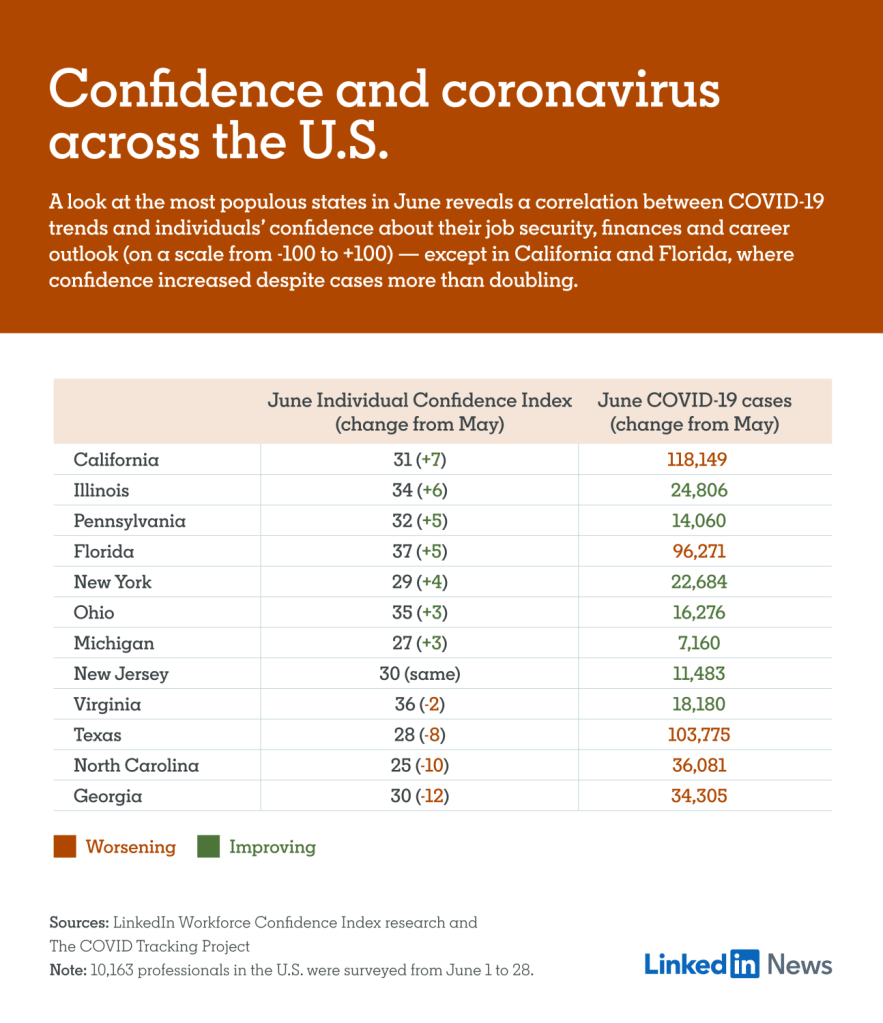
Workforce confidence levels have been improving in many states by the end of June compared to the beginning of March; and to name a few: Ohio, New York, Illinois and Pennsylvania. Many small and medium sized businesses are slowly getting back up and bustling. For the most part, these states have been reopening cautiously.

However, due to the rapid reopening of some states such as Texas, California and Florida – their employment recovery has been shifting backwards recently. Their workforce confidence levels have dropped significantly due to the sudden spikes of COVID-19 cases in June.

Below, you will find a more specific chart illustrated by George Anders from his LinkedIn article to show the confidence levels across the U.S. that are heavily affected by this pandemic.

Table of 12 large states, showing their June COVID-19 cases as well as the workplace confidence levels of residents in those states

Image via George Anders’ article

Once the workforce confidence level has been exhausted, this can trigger setbacks in causing rollbacks of the reopening plans – delaying the economy and businesses as well as weakening our consumer spending.

While there are still huge spikes in confirmed cases, the unemployment rate in many states are still continuing to rise slowly if not rapidly.

Many Americans are still unemployed, however more are slowly becoming employed again as the unemployment rate has decreased from 14.7% on April 2020 to 11.1% on June 2020. Due to economic reasons, over 9 million are employed as part-time workers or working with significantly reduced hours.

According to the U.S. Private Sector Job Quality Index (JQI), over 37 million jobs in the U.S. are more susceptible to layoffs in the short-term. These jobs are the hardest hit by this economic and health crisis, which include the following that are in the service sector: those in retail, hospitality, food service, real estate, education, etc. It is stated that “most of these were front-line, customer-facing jobs that offer both low hourly wages and a limited number of hours of work per week.

These low-wage workers are hit in multiple fronts since many of them do not have health insurance from their employers, many of them are underrepresented and underpaid, some of them are in debt, and some do not have enough money in their savings to secure their living expenses. In addition, some of them are ineligible to claim unemployment insurance because there are also those who work off the books and do not pay taxes.

It is also becoming more transparent that many who were supposedly temporary layoffs, are becoming permanent layoffs. This means that there will be a longer extension period of unemployment benefits and we will soon – see a significant increase in new filing claims, surpassing 30 million unemployed Americans as of the week ending July 4th.

With the expansion of unemployment benefits, in addition to the new federal funding of the $600 Pandemic Unemployment Assistance during this recession – many find that it creates a disincentive for the unemployed to return to work, since it is argued that these individuals earn more from unemployment benefits than they did from employment.

However, these unemployment benefits are actually a good thing since it helps keep the economy running. With the coverage and payouts, this will permit individuals to continue paying their rent, groceries, utilities, Internet, other insurance and consuming goods while the economy is still playing its role. While some states are shifting back to their normality, not all of them are confident enough to financially support their citizens, residents as well as businesses. After all, the federal government has the power to generate resources and twist things around to inhibit this exacerbation.

While the $600 Pandemic Emergency Unemployment Compensation is running out and is set to expire on July 26, 2020, all 49 states except for South Dakota are offering an extra 20 weeks of regular extended unemployment insurance benefits until December 31, 2020. In addition, our second stimulus bill which was approved by the House of Representatives – offers an extension of $600 Pandemic Unemployment Benefits until 2021, however it has not been passed by the Senate yet.

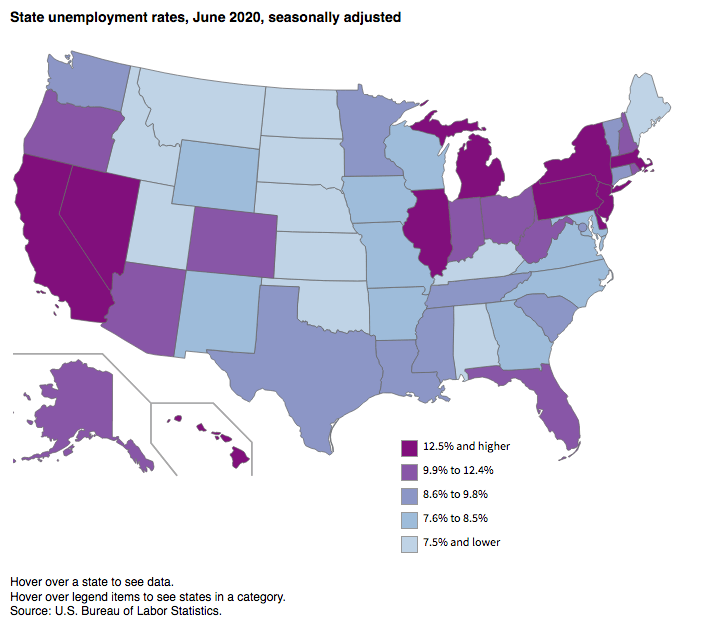
Chart via U.S. Bureau of Labor Statistics (To see the number values for each state, refer to the source.)

Based on the chart above, this depicts where the 50 states are currently standing as of June 2020 over a 12-month period since June 2019. It is affirmed that “Massachusetts had the highest unemployment rate in June, 17.4 percent, followed by New Jersey, 16.6 percent, and New York, 15.7 percent.

Due to the prolonged joblessness, it is necessary that these unemployment benefits continue even if the economy picks up. Right now, supporting those low wage workers who are now jobless, will be obligatory in ensuring a resilient economy once there is a solution to this public health crisis.

Once everything normalizes, this will be the approach to economic recovery as we will continue to see that there are more available job seekers than job openings.

2020 Resume/Career Advice For Beginners

Image via Vecteezy

While there are certain sectors or industries on the rise, job searching can be tough during this current economic uncertainty. With over 30 million Americans unemployed, many may not have the experience or knowledge base for the role that they are applying for because 1) the job that they were temporarily/permanently laid off or furloughed are currently unavailable since there are no openings due to COVID-19; OR 2) the available jobs available in the labor market is not what they are ideally searching for.

This has been extremely overwhelming for the whole nation and this especially makes it harder for individuals who have to keep a roof over their families’ heads, have babies/children to feed, pay rent and bills, etc.

The key component that is really important right now, is your RESUME. As we all know, it is mid-July now… we are all home since mid-March, which has been 4 months. There are ways that job seekers can change their adaptations of their resumes from what used to be on their resumes. Back then, we generally like to include as many details as possible and what we are proficient in to tailor it according to the job description.

Ideally during then, you want your resume to look presentable to the employer. However, the main issue has always been that job seekers struggle very hard on translating or interpreting that information to their interviews. Now, with COVID-19 and people being home, what job seekers need to do is to draw themselves between two things. Either you are a good public speaker and you should just have general stuff listed on your resume so that you can save it all for the interview to showcase your excellent communication skills; or if you are more shy/introverted, you might have all detailed information on your resume but you will need to practice more on improving your communication effectively during your interview.

Many individuals oftentimes get so nervous about changing their resumes. It shouldn’t be hard when they have it on their flash drives or saved onto their desktops. Many of them right now just do not want to go back to square one again and I totally feel for them. And that can pose issues for those who may have criminal justice record, failing a drug test and anyone who refuses to start from scratch all over again.

On the other hand, those who are still working in their part-time jobs or have reduced hours, are the ones who are still hungry and are currently looking for work. They’re hungry by saying – “Now is not only about experience and not about your resume, because everyone not only in New York City but the U.S. is looking for a job right now. It’s you versus everyone.” Unless you have a good relationship with people and can build or have built some kind of connection with them through LinkedIn or by volunteering, it will be difficult.

So let’s say, what if you only have 1 month of experience at a retail store because it was a seasonal role? What if you do have experience but you couldn’t translate that into a resume? Especially with difficult times like these, you really want to hone in on your job description and you want to place emphasis on the skills that you know the employer wants – which is conveyed in the job description. For instance for a cashier role, if they are seeking someone who is great with the cashiering, customer service skills and using numbers to define how much revenue you increased for the company – you want to really emphasize those things on the resume but you have to tailor it each time because each job, each employer desires different things. And if it’s a customer service job, you will want to shift the customer service bullet up to the top and if it’s not, then you either take it off or shift it to the bottom. This is what would be recommended for someone who does not have a whole lot of experience, on how to at least get the resume to help them advance to the next step.

One of the most resourceful and quickest ways in landing your job/career if you have not built your network, is to seek a career coach to assist you with your resume since they are armed with many valuable resources. On top of that, they have connections with many employers from different industries and sectors – which they can help place you in a job that you are looking for. Many non-profit organizations that are workforce providers offer free services on career development such as resume/cover letter writing, honing your interview skills, career advice, work readiness training and even job placement assistance.

Career coaches are very helpful during this time since they have employer partners who reach out to them for recruitment assistance. They are the ones who are consistently up to date with the labor market trends and which industries/sectors are hiring and not hiring. Career coaches and job placement specialists have seen and judged resumes that they thought would not make it to a job, that actually made it. If they are referring the job seeker to an employer, a useful way with helping them tailor the resumes are by looking at the job description as mentioned earlier. If the job description doesn’t convey honestly what the employer wants, your career coach can help you find out what the employer wants. Career coaches will take their time to coach and counsel you to the best version of yourself and make sure that you know every single thing before you walk into the interview.

They will be there to teach you not to give up, to really hang in there for the long haul, keep applying, keep at it – although we know at this time it is terribly difficult.

Normally, job seekers are asked “What have you been doing ever since you’ve lost your job and how do you fill in that gap?” and now we want to replace it with “What have you been doing since COVID-19 has invaded our lives?”
If you are learning how to use Zoom, remote work or even taking courses to enhance your digital literacy skills, then that is a resume builder. If you are currently taking care of family, then you are a caretaker.

To wrap this up, this is about teaching yourself how to fail. This is about teaching yourself how to not be afraid, how to throw your chances out there and be hungry. If you’re not taught to fail and you’re just going to hold onto that one job, what if they never practiced their interview skills after working in that same job for 2 years?

Moral of the story is, don’t be afraid to throw your resume to every single job opportunity out there in every field because guess what? You may end up liking that job that you’d never imagine that you would be doing. In many cases, there is always room for advancement regardless of what your title is, what department you work for or which industry/sector you are coming from. Your learning experiences come through your resume, you’re receiving feedback during your interviews and if a job really wants you, then you will possess that confidence.

It has been such a fast and deep downturn and that’s what’s unprecedented – we can’t compare it to any other downturn because of that. The problem is that we don’t know what the next 6 to 24 months are going to look like but the job search/hunt process and every new growing opportunity out there is, has always been and will be limitless.